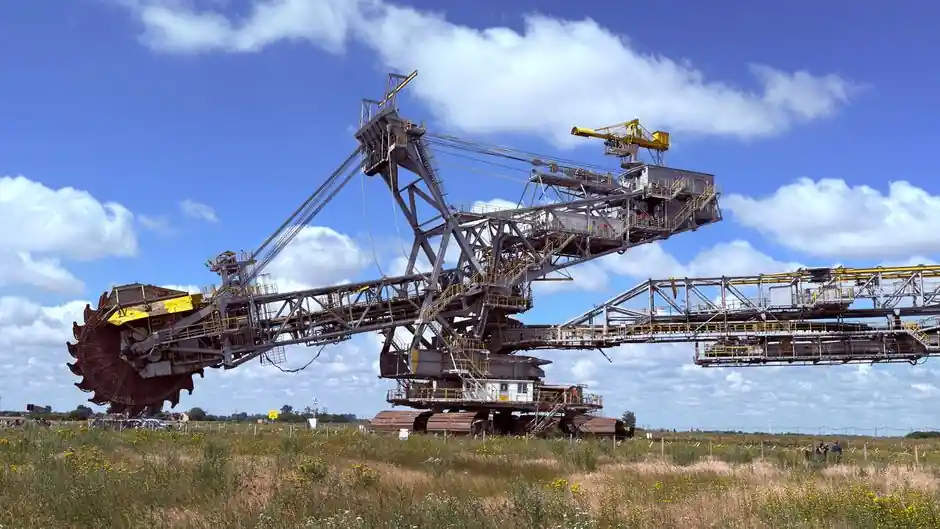
Wheeled excavators reach 22-37 km/h on paved surfaces, against 3-6 km/h for tracked units, with the gap translating into trailer-free roading for wheeled models and mandatory low-loader hauling for crawlers [S2][S3][S5].
Stability is the inverse trade: crawler tracks generate 4-6 PSI ground pressure on a wide footprint with a low center of gravity, while a wheeled machine sitting on rubber tires carries 30-50 PSI and depends on outriggers, dozer blades, or axle locks to match lifting performance [S2][S4]. For a process engineer specifying iron, the undercarriage decision is driven by surface, transport logistics, and lift envelope, not by raw engine power.
Travel Speed: Road Speed vs Crawl Speed, and the Trailer Question
Wheeled excavators can roading travel at up to 22 mph (35 km/h), with operator sources placing the upper end of the range near 37 km/h on flat paved surfaces [S3][S5]. Crawler units, by contrast, are mechanically limited to a self-propelled top speed of 4-6 mph (6-10 km/h) and are not legal, nor practical, for highway use; they require a low-boy trailer between jobsites [S3][S7]. A wheeled machine eliminates the haul truck, the loading dock, the pilot car, and the permit run, which is why utility contractors and municipal fleets standardize on tires for stop-and-go work [S2][S4].
Top-speed figures vary by source and machine class: Hengwang's spec table shows crawler 3-6 km/h and wheeled 25-40 km/h [S2], Cat Rentals reports wheeled up to 22 mph with tracks at 4-6 mph [S3], and Kellands lists the wheeled envelope as up to 37 km/h [S5]. The 35 km/h number in the Sany comparison reflects EU road-legal roading modes with lighting kits, mirrors, and fenders, configurations now offered as factory roading packages on Volvo, Cat, Develon, and Liebherr wheeled models [S4].
Stability: Footprint, PSI, and the Outrigger Compensator
A wheeled excavator sitting freely on rubber has measurably less inherent stability than a comparable crawler because steel tracks present a larger footprint and a lower center of gravity [S4]. Crawler ground pressure runs 4-6 PSI, against roughly 30-50 PSI for a wheeled unit on tires, which is the mechanical reason a tracked machine can sit on soft mud, sand, or a forest floor without sinking while a wheeled equivalent bogs down [S2]. Track length and width also act as a built-in counterweight, letting crawlers swing heavier loads and reach deeper dig depths than wheeled machines of the same operating weight class [S1][S3].
Wheeled OEMs close the gap with three stabilizers: a lockable oscillating axle, a rear dozer blade, and either two or four outriggers deployed before lifting [S2][S4]. Dual-tire (eight-tire) configurations widen the footprint further, improving flotation and lateral stability on uneven pavement; single-tire four-wheel setups keep the machine narrow for tight urban sites at the cost of some base stability [S4]. The trade is real but managed: with all stabilizers down, a wheeled excavator can lift close to its rated capacity, without them, the upper structure will rock and the load chart drops sharply.
Selection Matrix: Terrain, Transport, Lift, Surface Damage
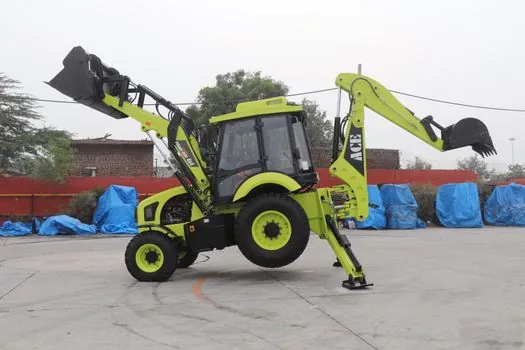
Choose a crawler when the ground is soft, muddy, steep, or unknown: low PSI and track grip let the machine work where a wheeled unit cannot stand. Choose a wheeled excavator when the work is on finished pavement, asphalt, or concrete, and the machine has to reposition between multiple sites in a single shift. The Hengwang comparison table codifies the split: mud, slopes, and soft soil map to tracks; asphalt, concrete, and flat hard ground map to tires [S2].
On the cost side, wheeled machines save on transport (no trailer, no permit, no pilot) and on undercarriage wear (rubber tires are cheaper to replace than a full track set) but lose on heavy-lift capacity and dig depth [S5][S6]. Crawlers cost more per mile to move and more per hour in undercarriage parts, but they stay productive on terrain that grounds a wheeled fleet, which is the dominant consideration for demolition, quarry, pipeline, and forestry work [S1][S3]. For a fuller look at how tires and tracks compare on adjacent iron, see the wheel dozer travel speed vs crawler dozer analysis and the cost-per-hour breakdown for 2026.
Use Cases Mapped to Machine Class
Urban utility work (gas, water, fiber, streetlight bases) is the wheeled excavator's home territory: roading at 35 km/h between manholes, four-wheel or crab steer around tight work zones, and rubber tires that do not scuff finished asphalt [S2][S4]. Municipal ditching, roadside grading, and small-scale demolition on paved lots also favor wheels because repositioning time, not cycle time, dominates the day [S5][S7].
Heavy earthmoving, foundation excavation on raw ground, slope work, quarry loading, and any site with rainfall or soft subgrade remain crawler territory, where 4-6 PSI ground pressure and the wider track footprint keep the machine working in conditions that immobilize a wheeled unit [S1][S2]. Forestry, land clearing, and pipeline spreads through unbroken ground are also crawler-first applications; the wheel loader size class reference provides context on how these machines sit within the broader wheeled-equipment hierarchy.
Limitations, Failure Modes, and Sourcing Notes
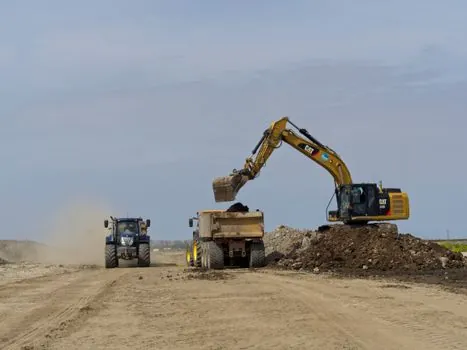
Wheeled excavators fail in three predictable ways: tire punctures on rocky sites (where tracks would have rolled through), tip events when operators dig at full reach without deploying outriggers, and roading-mode violations where machines are driven on tires across unfinished ground and sink up to the axles [S4][S6]. Crawlers fail differently: high hourly undercarriage wear, slow site-to-site moves that burn daylight, and pavement damage on finished surfaces that can trigger contractual penalties [S1][S5]. Sizing matters too: at the compact end, mini excavators are almost universally tracked because the weight savings of wheels do not offset the stability loss at small operating weights [S3].
Specifications referenced here draw on OEM-aligned comparison data from Cat Rentals, Sany, Hengwang, Kellands (Develon dealer), and Construction Equipment magazine's August 2026 wheeled-excavator buyer's guide, with corroborating figures from Yufan Machinery and a Cyclica 2026 used-equipment analysis [S1][S2][S3][S4][S5][S6][S7]. No single ISO or SAE standard governs wheeled-versus-crawler selection, so decisions rest on the comparison metrics above: top speed, ground pressure, terrain envelope, transport logistics, and surface-damage tolerance. For more on the excavator category as a whole and the broader equipment family it belongs to, the encyclopedia entries are worth a read.
Track these signals through 2026: OEM rollout of factory roading packages (lights, mirrors, fenders, license-plate brackets) on more wheeled models [S4]; expanding dual-tire and four-outrigger options on mid-size wheeled units to lift the stability floor; and continued undercarriage-cost pressure on crawler TCO as track steel and bushing wear remain the dominant scheduled-maintenance line item [S5][S6].
Spec-level background on the components involved: crawler crane.