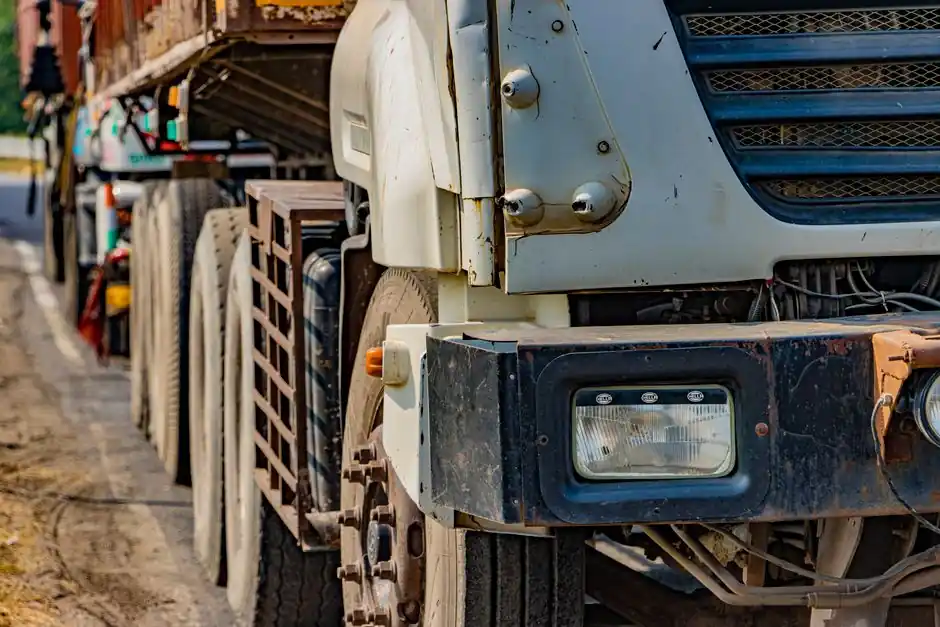
A truck-mounted crane needs a front stabilizer leg whenever the load moment vector falls forward of the front axle, or whenever the rated capacity at the required radius exceeds what the rear outriggers alone can react without lifting the nose of the carrier [S1][S4].
On loader cranes in the 8 to 16 tonne-metre class, front stabilizers are typically specified as standard equipment specifically because the working envelope sweeps over the driver's cab during folds and tip-overs, and the geometry of that over-cab arc is what makes a single rear outrigger pair insufficient [S1].
What the Front Stabilizer Actually Reacts
The front stabilizer does two distinct jobs and conflating them is the most common specification error. First, it resists the vertical compression force generated when the load is directly over the front outrigger, which on a loader crane can be a large fraction of the lifted weight because the stabilizer sits close to the load line [S3]. Second, when the load is positioned forward of the front axle, the stabilizer reacts a tension or uplift force, because the crane's tipping moment tries to lift the nose of the truck off the ground rather than push it down [S3].
For the 8 to 16 tonne-metre class covered by HMF, the published design intent is "extra stability in lifts going over the driver's cabin," which is the over-cab arc case described above, and that geometry produces both effects simultaneously depending on boom angle and load radius [S1].
Front vs Rear vs Both: A Decision Comparison
Choosing whether to deploy, specify, or retrofit a front stabilizer is a four-criteria decision. On a 4-criteria layout: (1) load arc over cab requires front stabilizer yes, rear alone no; (2) maximum lift at full reach with boom behind the truck rear only usually sufficient, front optional; (3) chassis lift-off risk under heavy load front mandatory to prevent carrier rotation; (4) working envelope flexibility over-cab work needed front yes, behind-cab only front no [S1][S2][S3].
OSHA data summarized in industry guidance puts 80% of crane tipping incidents down to human error, and more than 50% of those accidents trace to improper outrigger or stabilizer use, so the front-leg question is not a comfort accessory, it is part of the tipping-incident prevention envelope [S2].
How Outriggers and Stabilizers Diverge on Bigger Cranes

On light-duty knuckleboom and service-crane rigs the legs are usually called stabilizers, they do not lift the chassis off the ground, and a typical small rig carries 2 or 4 stabilizer legs holding the chassis down through tire deflection [S3]. On larger crane trucks the same hardware class is called outriggers, has a much larger cross-section, mounts to substantial outrigger beams, and the crane will actually raise the carrier off the wheels when fully extended [S3].
Larger outrigger-equipped cranes also feed the outrigger position into an LMI or RCI system in the cab, and the rated capacity is automatically reduced when the outrigger spread is less than full, or when fewer than the full set of outrigger positions is selected [S3]. This is the second reason a front leg matters: not just the structural reaction, but the rated-capacity calculation that the cab electronics run on every lift.
When the Front Leg Is Mandatory, and When It Is Not
A front stabilizer is required when any of the following applies: the load arc passes over the cab, the lift is at or near maximum rated capacity at a radius forward of the front axle, the chassis is a short-wheelbase carrier where the rear outrigger spread alone would allow carrier rotation, or the operator plans to fold and tip loads over the cab as a regular working mode [S1][S4].
A front stabilizer is not required when the crane works strictly behind the cab, when the load is light enough that the rear outrigger spread and tire load alone keep all four tires on the ground, and when the rated-capacity chart for the machine already shows the behind-cab envelope at 100% with rear stabilizers only [S3]. Service cranes on standard mechanics trucks that only lift engines and components behind the cab typically fall in this second group [S4].
Ground Conditions That Invalidate the Calculation
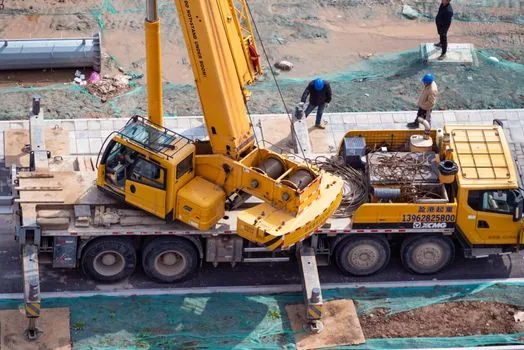
Even with a correct front stabilizer fit, the lift is only as good as the soil under the pad. Outriggers concentrate hundreds of thousands of pounds of force over a small patch of ground, and if that force exceeds the ground bearing pressure of the surface, the equipment sinks or topples regardless of how many stabilizer legs are deployed [S2].
Operators are advised to measure ground bearing pressure with a penetrometer on asphalt, concrete, gravel, or wet soil before any lift, and to lay outrigger pads larger than the outrigger feet, kept clean and level, with the foot centered on the pad [S2]. A waffle- or lattice-pattern wood crib under the pad increases the effective bearing area and gives the rig added flotation on soft ground [S4].
How This Connects to Other Equipment Decisions
The same stability logic that drives a front stabilizer on a truck crane also drives freestanding runway column decisions on overhead cranes, where the support count and spacing are set by the load arc rather than the static weight; the freestanding runway column case is the bridge-crane analogue of the front-leg question. On the carrier side, the trade-off between rubber-tired mobility and tracked stability echoes the same outrigger-count question for carrier-base lifts, and is laid out in wheeled versus crawler travel stability. [S3]
For fleet planners tracking specification drift, the practical signal to watch over the next buying cycle is whether more chassis OEMs are offering factory front stabilizer prep on 8 to 16 tonne-metre loader crane packages rather than treating the front leg as a dealer-installed accessory; that trend would compress retrofit lead times and shift the standard configuration closer to the HMF 8 to 16 tonne-metre default [S1]. Secondary signal: updates to LMI or RCI capacity-reduction logic that explicitly factor in front-leg deployed versus stowed states, since current guidance treats the front leg as a structural member rather than a capacity-input [S3].
For the relevant spec sheets and selection criteria, see truck mounted crane, truck mounted concrete pump, and dump truck.