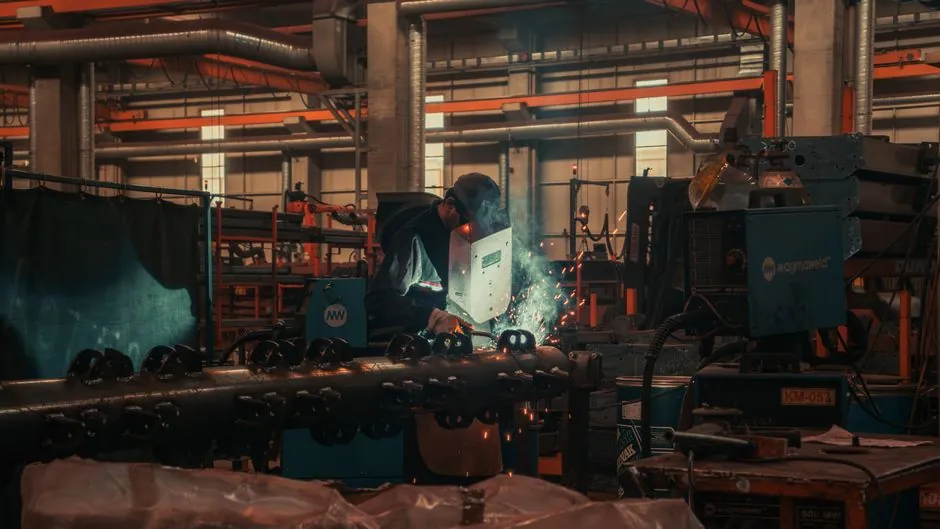
For cast iron repair and fabrication, DC stick (SMAW) with a nickel-based electrode is the working default: a DC arc is more stable, produces less spatter, and delivers about 10 percent more penetration at a given amperage than AC [S1][S3].
AC stick is not banned on cast iron, but it is conditional: it only works with electrodes rated for AC operation, and the result is rougher than DC [S5][S1]. The right call depends on the casting grade, joint geometry, preheat access, and the available machine, not on a one-line rule.
Why DC Stick Wins for Most Cast Iron Repairs
DC stick output holds a constant polarity, so the arc does not pass through zero 120 times per second the way a 60 Hz AC arc does, which is the main reason DC arc starting is easier and the puddle is calmer [S3][S4]. A smoother arc translates directly into lower spatter, fewer arc outages, and easier vertical-up and overhead work on cast iron pump housings, gearbox covers, and manifold sections [S1][S3].
DC reverse polarity (DCEP, electrode positive) gives about 10 percent more penetration at the same amperage than AC, which matters when the casting is thick or contaminated; DC straight polarity (DCEN, electrode negative) is preferred for thinner sections where burn-through is the bigger risk [S1]. For general-purpose cast iron repair with a 99 percent nickel rod (Lincoln Ferroweld, Hobart Ni-Rod 99, or equivalent), DC straight polarity is the standard recommendation in the field [S5].
When AC Stick Is Still the Right Tool on Cast Iron
AC stick belongs on cast iron in two narrow cases. First, when the casting is magnetized, the constantly reversing AC polarity helps cancel arc blow, while a DC output will deflect the arc off the joint [S1][S2][S3]. Second, when the only available power source is an older AC transformer (a Lincoln "crackerbox," for example), and the operator accepts the rougher bead in exchange for finishing the job [S5].
Even in those cases, the electrode must be rated for AC: most nickel and nickel-iron cast iron rods carry an AC/DC rating, but cheaper mild-steel 6010 and 6011 rods behave poorly on cast iron regardless of polarity, and 7018 typically requires DCEN to avoid porosity [S5]. A budget arc welder that only outputs AC can still produce an acceptable cosmetic repair on a non-critical, clean break, but it is not the right tool for a stressed gear tooth or a hydraulic block.
Electrode Choice Drives the Decision More Than Polarity
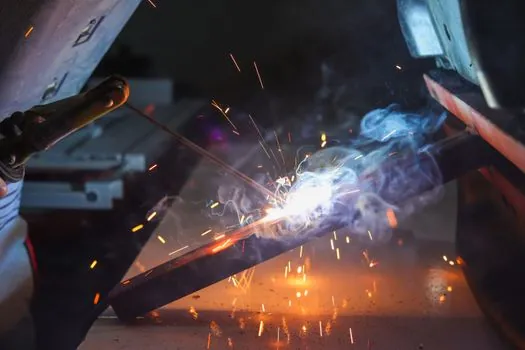
For cast iron, the rod chemistry matters more than AC versus DC. The 99 percent nickel rod (AWS ENi-CI) is the most forgiving: it welds dirty and oil-soaked cast iron with minimal preheat, deposits a soft machineable bead, and tolerates a fair amount of contamination [S5]. The 55 percent nickel-iron rod (AWS ENiFe-CI) is stronger and matches the thermal expansion of ductile iron better, but it is less tolerant of poor surface prep.
Steel rods (6010, 6011, 7018) are not designed for cast iron; they produce hard, brittle martensite at the fusion zone and almost always crack on cooling. If a steel rod is the only option, the casting must be fully preheated to 500 to 1200 degrees F, welded hot, and slow-cooled under insulation, which is closer to a foundry brazing procedure than a normal stick weld [S5].
Decision Matrix: Polarity, Rod, and Preheat for Cast Iron
Pick the cell that matches the casting, not the other way around. For a clean, lightly stressed break on a small casting with a DC machine available, the right call is DCEN with a 99 percent Ni rod, no preheat, short 1 inch beads, and peen each bead while hot to relieve stress. For a magnetized heavy casting with arc blow, AC with an AC-rated Ni-Fe rod, light preheat to about 400 degrees F, and longer beads. For a critical load-bearing component, the right call is oxy-fuel or furnace brazing with cast iron filler, not arc welding at all [S5].
Across the three options, DC stick with a nickel rod scores best on arc stability and bead cosmetics, AC stick scores best only on arc-blow resistance, and oxy-fuel fusion brazing scores best on parent-metal match and crack resistance but loses on portability and skill floor [S5][S1].
Failure Modes Specific to Cast Iron
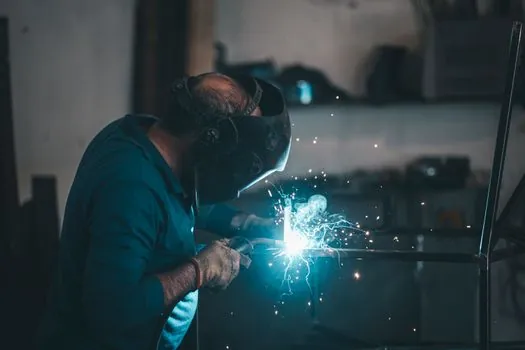
The failure modes to plan around are cracking, porosity, and hard zones. Cast iron has a high carbon content (typically 2 to 4 percent), and rapid cooling locks that carbon into brittle carbides or martensite, which cracks as the weld shrinks [S5]. Short beads, peening, and slow cooling under vermiculite or wood ash keep the heat input balanced. Porosity shows up when the rod is too hot or the casting is oily; a 99 percent Ni rod tolerates more contamination than an Ni-Fe rod.
Hard zones appear at the heat-affected zone when steel rods are used, and they cannot be drilled or tapped afterward. A machineable 99 percent Ni deposit avoids this on a repair that has to be re-machined, for example a bored engine block or a refaced manifold face [S5].
Practical Sourcing Notes for 2026 Buyers
Modern inverter arc welder packages that output DC stick, DC TIG, and AC TIG cover the full cast iron envelope with one machine, and a 200 A dual-voltage inverter is the typical shop floor spec for repair work. Pure AC transformer machines are still common in farm and field-repair fleets because they tolerate generator power and rough handling, and they remain a legitimate fallback when arc blow rules out DC. Always confirm the electrode carton lists AC and DCEN or DCEP compatibility before buying, since some import nickel rods are rated for DC only. [S5]
When comparing welder options, three data points make the cut: rated amperage at 30 percent duty cycle (200 A is the practical minimum for 1/8 inch nickel rods), open-circuit voltage (higher OCV helps strike on dirty cast iron), and weight (an AC transformer at 150 lb versus a 40 lb inverter changes the field-repair math). Trackable signals worth watching: AWS A5.15 electrode revisions and any new IEC 60974-1 amendments on welding cutting tool safety that affect shop retrofit decisions.
Related analysis: Wheeled vs Crawler Excavator: Travel Speed and Stability Compared.