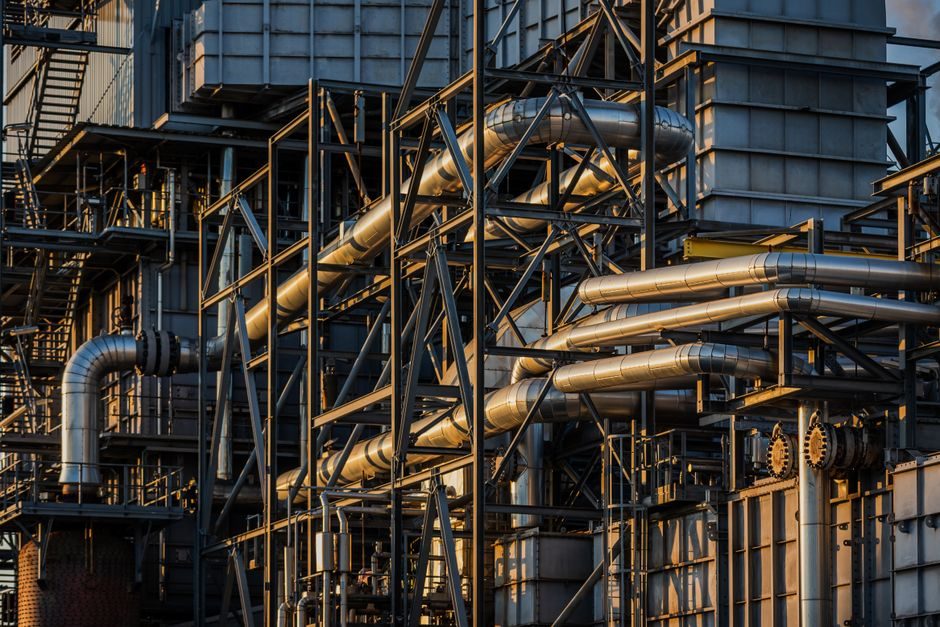
The throughput bottleneck of metal additive manufacturing in 2026 is no longer the laser or the powder bed — it is the queue of parts waiting to enter and leave the printer, with build cycles often running many times longer than every upstream and downstream handling step combined [S3].
That imbalance is reshaping how OEMs such as ABB, Grenzebach and Siemens position products and services around powder handling, inert gas management, part extraction, heat treatment, post-machining and factory-level digital orchestration [S1][S3][S5]. For a working definition of the processes inside that envelope, see the additive manufacturing material reference page.
Defining Upstream, Build and Downstream in a 2026 AM Cell
Upstream covers everything that arrives at the machine: powder or filament production, sieving, drying, alloy certification, powder reuse logic, build-plate preparation, inert-gas supply and chamber-purge verification. Downstream starts the moment the chamber opens: depowdering, support removal, stress-relief or hot-isostatic pressing, heat treatment, machining, surface finishing, dimensional inspection and final certification [S3].
Grenzebach's automation framing — long build times inside the printer, short processing times before and after it — matches what plant engineers have been measuring on L-PBF and DED cells: the printer is asset-rich and time-rich, while loading, sieving, blasting and HIP are asset-light and time-poor, so any unsynchronised handoff shows up as idle build capacity [S3]. The same logic is why Siemens' AM Network positions factory planning, not printer hardware, as the binding layer across the chain [S5].
Where the Throughput Loss Actually Sits
Grenzebach's published statement that the "challenge of additive manufacturing lies in the long production time of a part in the 3D printer, while upstream and downstream production steps have significantly shorter processing times" sets the engineering priority: the build step is the rate-limiter, so every other station has to be overprovisioned or buffered to prevent it from stalling [S3].
Three physical consequences follow. First, powder-feed skids for alloys such as 316L, Ti-6Al-4V (Grade 5) and AlSi10Mg are sized for multiple builds per shift, not for one. Second, depowdering and blasting cells are duplicated so that a slow heat-treatment furnace never blocks extraction. Third, post-machining is treated as a parallel station with its own queue, not as a downstream afterthought [S3].
Selection Criteria: What Buyers Should Lock First

Engineers specifying a 2026 AM cell should resolve four gates before choosing hardware brands. (1) Alloy family and powder spec — gas-atomised vs plasma-atomised, particle-size distribution, recyclability ceiling and required test coupons. (2) Build envelope and chamber atmosphere — argon vs nitrogen tolerance, oxygen-ppm target, build-plate preheat range. (3) Required post-build chain — stress relief only, HIP, machining, surface finish grade, NDT method. (4) Data and control interface — OPC UA exposure, SECS/GEM, ISA-95 batch model or a vendor-proprietary MES [S1][S3].
For a process-control view, the PLC reference page describes what an end-of-line cell controller typically has to orchestrate. ABB's own framing of additive manufacturing sits inside its medium-voltage laboratories group, which signals that electrical infrastructure, drives and chamber power quality are part of the integration scope, not an afterthought [S1].
Comparison: Polymer Bed Fusion vs Metal L-PBF vs DED on the Upstream–Downstream Axis
Three process families dominate industrial AM in 2026, and they stress the upstream/downstream chain very differently: [S1]
• Polymer PBF / SLS — upstream is filament or nylon-12 powder with simple drying; downstream is depowdering, bead-blasting and optional dyeing, with no heat treatment, so the chain is short and automation gains are mostly in unpacking and powder recovery [S3].
• Metal L-PBF (laser powder-bed fusion) — upstream is heavy: argon-purged build chambers, oxygen monitoring at the 100-ppm class, powder sieving, humidity-controlled storage, and traceability per powder lot. Downstream is the longest in the industry: stress relief, support removal, optional HIP at roughly 1000–1200 °C for Ti or Ni superalloys, machining of datum faces, and CT or coordinate-measuring-machine inspection [S1][S3].
• DED (directed energy deposition) — upstream is wire or coaxial powder feed with multi-axis robots; downstream often merges with subtractive machining on the same platform, so the upstream/downstream boundary is blurred and the automation problem becomes one of in-process sensing, not handoffs [S1].
The Siemens Additive Manufacturing Network pushes the same idea at software level: one planning layer across machines, materials and post-processing partners, so that build jobs are routed to whichever cell has the matching downstream chain free [S5].
Who This Map Is For — and Who It Is Not

This upstream/downstream split is genuinely useful for process engineers specifying serial-production AM cells for aerospace brackets, medical implants, hydraulic valve bodies or mould inserts — applications where one alloy, one downstream chain and one inspection regime are repeated hundreds of times per year [S1][S3][S5].
It is less useful for prototyping-only shops, designer studios or creative-industries users, who run many alloys, low volumes and ad hoc post-processing, and who value the "layered material" definition of 3D printing more than the production-line automation layer [S6]. Academic researchers sit between the two — MDPI's JMMP special issue on Design, Processes and Materials for Additive Manufacturing explicitly aims to bridge the research/production gap rather than to standardise the cell layout [S2].
Standards, Sourcing and Failure Modes to Plan Around
Three real-world risks recur across published AM case studies. First, powder reuse drift — repeated recycling shifts the particle-size distribution and oxygen content, and buyers should demand per-lot chemistry certificates and a documented reuse ceiling. Second, HIP bottleneck — a single shared HIP furnace can throttle an entire L-PBF factory, so downstream capacity planning belongs in the original cell spec, not as a retrofit. Third, post-machining distortion — residual stress from the build step moves parts by measurable amounts, and datum strategy must be designed together with the support-removal sequence, not after it [S3].
For buyers sourcing upstream feedstock against 2026 market bands, the nickel market spec map and cobalt industry spec map are directly relevant because Ni-base superalloys and Co-Cr alloys are two of the highest-value AM feedstocks. For a broader 2026 view of the full chain including hardware and end-use segments, the 3D printing upstream & downstream map covers the rest. A peer AM reference paper, "Additive Manufacturing: Current Status and Future Prospects", frames the same chain from an Australasian survey angle [S4].
2026 Signals Worth Tracking
Three verifiable signals to watch over the next reporting period. (1) Whether ABB extends its PEHLA Laboratories Ratingen additive-manufacturing scope beyond medium-voltage test work into full-cell electrical integration packages [S1]. (2) Whether Grenzebach discloses named reference cells where the upstream/downstream automation ratio is published, not just promised [S3]. (3) How the Siemens Additive Manufacturing Network evolves its partner onboarding — the 2019 announcement already positioned partner expansion as the network's growth lever, and 2026 reporting should show whether the partner count is still climbing [S5].