
A truck-mounted aerial work platform is installed in four controlled stages, mission-fit sizing, chassis and outrigger setup, control and interlock verification, and operator handover, before any boom extension is permitted on site [S1][S2].
OSHA 29 CFR 1910.67 governs vehicle-mounted elevating and rotating work platforms and references ANSI A92.2-1969 as the design baseline for aerial devices acquired on or after July 1, 1975, while 29 CFR 1926.453 covers construction-site operation of aerial lifts [S1][S4]. The same standard requires brakes set, outriggers positioned on pads or a solid surface, and wheel chocks installed before the unit is used [S1].
Stage 1: Mission-fit sizing before any truck is specified
An installation starts with the job, not the catalog: required platform positions, workers, tools, and material loads must be mapped against the working envelope of the exact model before a chassis is chosen [S2]. Working height alone does not prove side reach or obstacle clearance, so platform height, outreach, boom path, payload, and setup footprint have to be checked together [S2][S3].
Common platform heights for truck-mounted units range from roughly 6 m to over 40 m, with basket capacities typically between 200 kg and 600 kg, and a separate personnel-platform rating that is not interchangeable with a crane or material-hoist rating [S3]. Treating the basket as a crane is a documented mis-spec that breaks both load and stability cases [S2]. An aerial work truck selected only on maximum height will fail the first real site test, the obstacle clearance check. For adjacent selection logic on access platforms, see the aerial work platform reference page.
Stage 2: Chassis, outrigger, and ground setup
Wheel chocks shall be installed, the parking brake set, and outriggers positioned on pads or a solid surface before the boom leaves the stowed position; this is the verbatim OSHA 1910.67 requirement [S1]. Outrigger pads must distribute load to ground that can carry the reaction force generated at full platform reach, since the same truck on poor subgrade behaves as a different, less stable machine.
Stabilization goes beyond outrigger extension: slope, ground bearing capacity, traffic space, and overhead electrical exposure are all part of the same setup calculation [S2]. A common failure mode is accepting a job on the strength of road access alone, then discovering the boom envelope intersects a soft shoulder or a live conductor at full outreach [S2][S5]. Stop-work conditions for setup include unsafe ground, wind outside the manufacturer envelope, traffic exposure without positive control, or a load outside the approved envelope [S2].
Stage 3: Controls, interlocks, and electrical safety
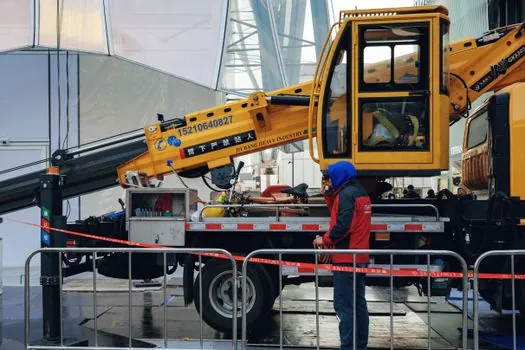
Vehicle-mounted booms carry two control stations as standard, an upper set in the work platform and a lower set at the base, and either set alone is not acceptable for installation acceptance [S6]. Emergency lowering, emergency stop, and the required interlocks for the selected configuration must be functionally tested before the unit is signed over to operations [S2][S4].
For work on or near energized lines, the lift must be specified as an insulated aerial device with a defined category, configuration, test status, and use limitation; a generic controls package or a hand-waved insulation claim is not evidence [S2]. The applicable electrical safety rule for clearance is OSHA 1910.333(c)(3), referenced from 1910.67(b)(4) for overhead-line operations [S1]. Ladder trucks carry a separate limit of 325 lb including the operator, no load line, and no lift attachment points, so any signage or material handling must respect that envelope [S5].
Stage 4: Inspection, documentation, and operator handover
Pre-operation inspection covers tires, hydraulic systems, guardrails, emergency stop, and fall-arrest anchor points; only trained and certified personnel are permitted to operate the unit [S3][S4]. The inspection record is a controlled document, not a clipboard courtesy: a failed or missing inspection returns the truck to the previous controlled step, it does not become an assumed pass [S2].
Acceptance evidence for the install is a defined package: task-position and hazard map, exact working-envelope and platform-load data for the model, chassis/outrigger/ground setup calculation, and functional, emergency-control, and inspection records [S2]. A field modification pattern applies here too, since OSHA 1910.67(b)(2) requires any field modification to be certified in writing by the manufacturer or a nationally recognized testing laboratory as conforming to ANSI A92.2-1969 and at least as safe as the original equipment [S1].
Failure modes and when to stop the install
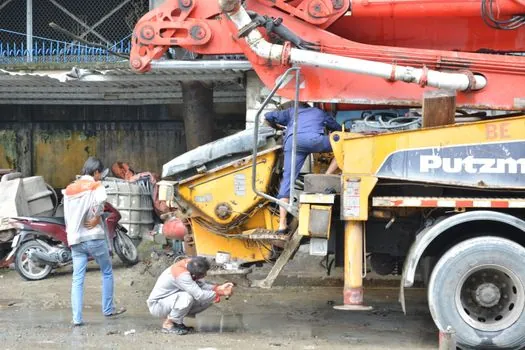
Three failure patterns repeat on truck-mounted aerial installations: choosing by maximum height, treating the platform as a crane, and assuming electrical insulation without configuration evidence [S2]. Each maps to a stop condition: envelope failure on the obstacle map, load exceedance on the platform rating, or unverified category on the boom.
Replace, do not repair, any control station that fails functional test, any outrigger pad showing deformation, or any fall-arrest anchor without a current inspection record; these are not field-fix items [S1][S4]. A truck that cannot produce its working-envelope sheet, platform-load sheet, and the last inspection record is not install-complete, regardless of how new it looks on the lot.
Sourcing, standards, and limits of this guide
Controlling references are OSHA 29 CFR 1910.67 and 1926.453, with ANSI A92.2-1969 (1969 designation, still cited by 1910.67) and the A92.3 / A92.5 / A92.6 family for related elevating work platforms [S1][S4]. University and municipal programs typically mirror the same package: 1910.66, 1910.67, 1910.68, 1926.20, 1926.21, 1926.451-453, and the A92 series [S4].
This article does not approve work near electricity, at height, or on a public road; qualified planning, trained operators, and the exact manufacturer instructions remain controlling [S2]. Next signals to watch: the operator training record currency, the dated ANSI A92.2 conformance reference on the data plate, and the most recent outrigger-pad and ground-bearing calculation on file for the chassis you intend to accept.
Spec-level background on the components involved: linear guide.