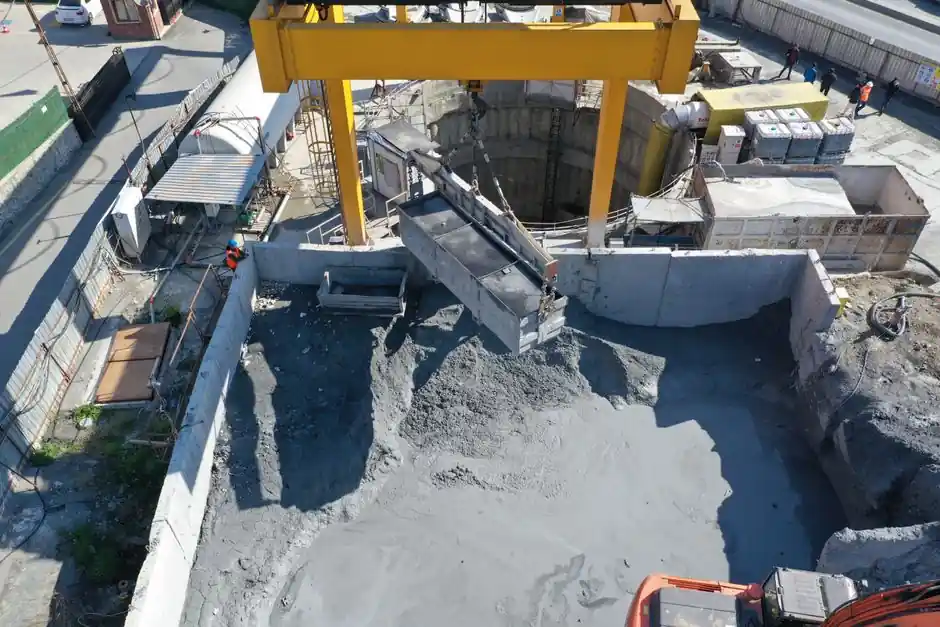
Shield machines are classified primarily by face-support principle, with three canonical families in current service: Earth Pressure Balance (EPB), Slurry Pressure Balance, and Hard Rock Tunnel Boring Machines (TBMs) [S1][S3].
Documented machine diameters span from 2.48 m dome-face mud pressure units up to a 16.1 m EPB machine launched in 2017 for the Tokyo Outer Ring Road, and total thrust force for active machines runs 10,000 to 50,000 kN depending on cutterhead size and ground resistance [S3][S4].
Face-Pressure Mechanism: EPB vs Slurry vs Open TBM
EPB shields stabilize the working face by filling the excavation chamber with conditioned excavated soil, then balancing the chamber pressure against ground and hydraulic head. Additives are injected at the cutter face and mixed by cutterhead rotation to control spoil fluidity and water-stopping quality [S1].
Slurry shields, by contrast, balance face pressure using a high-specific-gravity, high-viscosity bentonite slurry that forms a "mud permeable film" across the soil skeleton, a method that allows stable excavation in water-bearing cohesionless soils and under high hydrostatic head [S1].
Open hard-rock TBMs discharge spoil either by conveyor belt (rock) or screw conveyor (soft ground) and apply mountain-stop logic in weaker formations, with the spoil system selected by geology rather than by face pressure [S1].
Sub-Types by Cutterhead and Structural Layout
Within the EPB family, the documented variants include bubble-type earth pressure shields, accordion-fold (two-step extension) mud pressure shields, peripheral-beam machines, dome-face machines, and center-shaft machines; diameters in current production range from 2.48 m up to 10.80 m for the bubble EPB class [S1].
Within the slurry family, documented variants include circumferential-support machines (Kawasaki-developed 1975), intermediate-support machines, curve-excavating slurry shields, rock-ground slurry shields (10.20 m dome type), and long-distance mud-stone units; the largest confirmed build is the 14.14 m Tokyo Bay Aqua-Line machine [S1][S3].
Special-function shields extend the taxonomy further: SENS (Shield-ECL-NATM-System) units at 11 m class for Shinkansen/railway tunnels, MSD pipe-jointing machines, vertical-shaft shields, criss-cross successive (Horn) shields, T-BOSS branch-connection shields, and multi-cutter special-section shields (DOT, MF, H&V) for non-circular cross sections [S2].
Stratum-Based Selection Criteria
EPB shields are specified for soft soil, silty soil, and fine-sand layers, with typical urban-subway daily advance rates of 6 to 12 m and reported ground-settlement control below 3 mm when the conditioning system is correctly tuned [S5].
Slurry Pressure Balance shields are specified for water-rich sandy cobble and seabed soft strata, where cross-river and undersea tunnels run typical advance rates of 4 to 9 m per day [S5].
Hard Rock TBMs are specified for medium-hard to extra-hard intact rock, with daily advance rates of 10 to 20 m in mountain railway and hydropower-diversion service, the highest among the three canonical classes [S5].
Comparison Table: Canonical Shield Families
Selection of shield machine type is governed by four primary criteria: applicable stratum, face-pressure medium, typical advance rate, and representative use case. EPB uses conditioned spoil, suits soft soil/silt/fine sand at 6 to 12 m/day, and is dominant in urban subway. Slurry Pressure Balance uses bentonite slurry, suits water-rich sandy cobble and seabed strata at 4 to 9 m/day, and is standard for cross-river and undersea tunnels. Hard Rock TBM uses open or gripper-mode cutterhead with conveyor or screw discharge, suits medium-hard to extra-hard rock at 10 to 20 m/day, and is standard for mountain railway and hydropower tunnels [S1][S5].
For non-circular and special geometries, DOT, MF, H&V, and T-BOSS variants replace the standard circular family, while construction machinery and equipment fleets are typically augmented by shaft-sinking and pipe-jacking attachments from the same OEM [S2].
Historical Diameter Milestones and Reference Builds
Four reference builds anchor the current production envelope: 1957 roof shield at 11.6 m for the Marunouchi Subway Line, 1988 full-shield TBM at 8.78 m for the Channel Tunnel, the 14.14 m slurry machine (then world-largest) for the Trans-Tokyo Bay Expressway, and the 2017 EPB at 16.1 m for the Tokyo Outer Ring Road, a 16 km alignment with a 9 km Kawasaki portion [S3].
Special-shield SENS units in the 11 m class are documented for Shinkansen and railway tunnels, with method-switching capability between full Shield and SENS-NATM-ECL modes for cost-efficient boundary-ground excavation [S2].
Reliability, Wear, and Mismatch Risk
Equipment-stratum mismatch is documented as a primary failure driver: industry reporting attributes over 68% of shield machine operation failures to incorrect type-versus-stratum pairing, making upfront geological characterization non-optional [S5].
Cutter wear in hard rock is controlled by reducing cutterhead rotation speed by approximately 15% and applying high-strength alloy protection layers, with field data showing a cutter wear rate reduction exceeding 40% and meaningful downtime savings [S5].
Refurbishment and re-deployment is a documented cost lever: over 72% of shield machines are reported to be dismantled, maintained, and upgraded with new modules, then re-deployed across 2 to 4 subsequent tunnel projects, with total equipment input cost reductions exceeding 40% [S5].
Sourcing Standards and Maintenance Discipline
ITA 2026 industry consensus holds that standardized scheduled daily maintenance extends full service life by approximately 32% compared with unplanned fault-repair-only regimes, a benchmark that should be embedded into any construction machinery and equipment acquisition evaluation [S5].
For procurement and total-cost modeling, shield machine selection interacts with site crane strategy: see tower crane TCO math for the lifting and overhaul cost bands that frame a 5-year ownership plan, and crawler crane vs overhead bridge crane selection for site-cycle fit when shaft erection and segment handling share the same logistics footprint.
Trackable signals to monitor through 2026: cutter wear rate logs from hard-rock TBM sites, ITA 2026 service-life benchmark updates, and the next-generation EPB diameter announcements above 16.1 m for sub-sea or high-coverage motorway tunnels [S3][S5].
Spec-level background on the components involved: face shield.