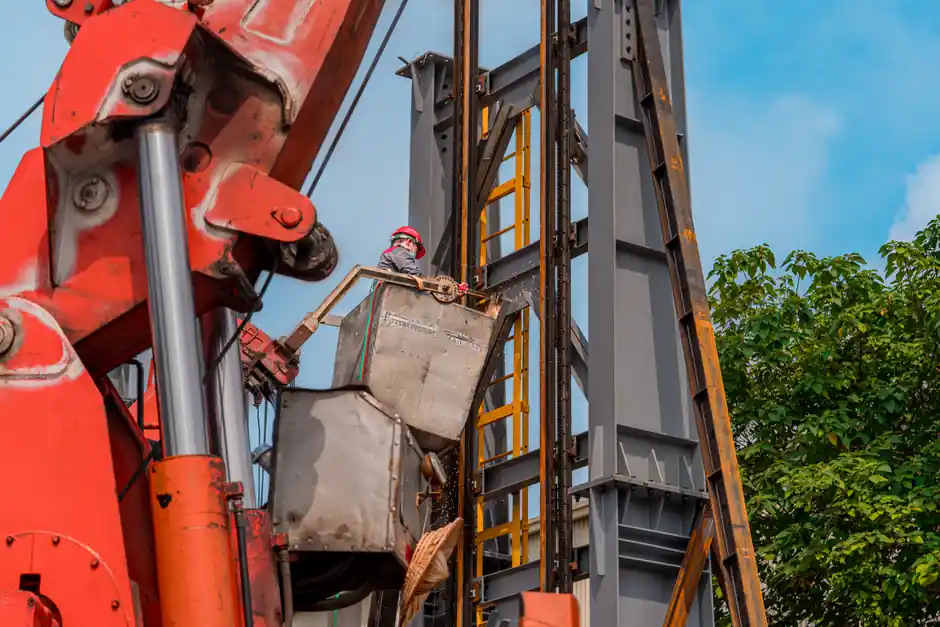
Diaphragm wall excavation divides into two main equipment families: trench cutters for hard ground and large depths, and diaphragm wall grabs for cyclic excavation in softer to moderately hard soils, with slurry support in both cases [S1].
On the grab side, the main types in service are hydraulic grabs (including the DHG class), cable grabs, Kelly grabs, and small mechanical/rope-suspended clamshell grabs, with panel widths generally 2.5–6.0 m and wall thicknesses 0.6–1.1 m [S2][S3].
Two-tool taxonomy: cutter vs. grab
For depths above roughly 50 m, or in rock and very stiff soils, the standard choice is a hydraulic trench cutter: Bauer reports record depths of more than 250 m with the BC cutter family, where cutting wheels loosen soil and a mud pump in the cutting frame lifts the slurry-soil mix to a desanding plant [S1].
Where ground conditions are softer or the project does not justify a cutter spread, the cyclic diaphragm wall grab method is used: the grab is inserted, the soil at the trench base is loosened, and the bucket is lifted clear before the next bite [S1]. Cutter spread dominates deep urban metro shafts; grab spread dominates typical building-basement and cut-off wall work at depths that keep crane and slurry-plant footprints manageable [S4].
Grab subtypes and operating envelope
Within the grab family, four sub-classes recur in contractor specifications: hydraulic grabs (including the Bauer DHG V, with trench lengths up to 3,800 mm and trench widths up to 1,500 mm), Kelly grabs, cable grabs, and small rope-suspended mechanical grabs (e.g. clamshell C800 with 270 cm bite, B250 with 250 cm bite) used for shallow or T-panel work [S1][S3][S6].
Selection follows ground stiffness, depth, panel geometry, and crane capacity: Kelly and hydraulic grabs handle the stiffer end of the grab range, cable grabs are typical on soft-ground cut-off walls and dam-seal work, and small mechanical grabs are used for the least stable, narrow, or shaped panels where a lighter tool and shorter bite reduce the risk of slurry-level loss and trench collapse [S3][S4][S6].
Hydraulic vs. mechanical vs. cable: comparison
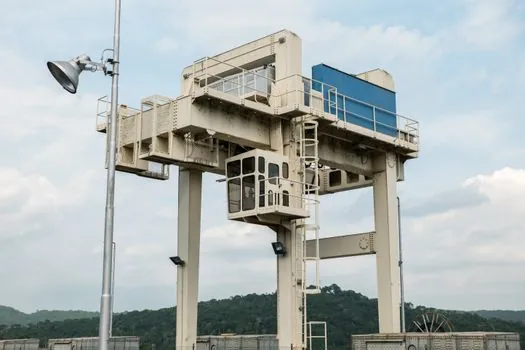
The market for these tools is commonly segmented into hydraulic diaphragm wall grabs and "normal" (mechanical/cable) diaphragm wall grabs, with hydraulic units priced higher but delivering higher cycle output and deeper reach [S5].
On four decision criteria, the comparison lines up as follows: (1) ground suitability, where hydraulic grabs cope with relatively hard ground, cable grabs with soft ground, and trench cutters with hard/rock; (2) cycle continuity, where cutters run continuous and grabs cycle; (3) depth capability, where grabs are typically specified to roughly 50–80 m and cutters push past 100 m, with records above 250 m; (4) bite/panel geometry, where grab bite length sets the bart layout and panel width (typical 2.5–6.0 m), and cutter passes produce a continuous rectangular slot [S1][S3][S4][S5].
Panel geometry, barts, and how grab size drives layout
A diaphragm wall is built as a sequence of primary and secondary panels jointed into a continuous wall, with each panel divided into "barts" whose maximum size equals the open length of the grab bucket [S3][S4].
For example, a 7 m panel is typically drilled as three barts: two end barts at the full grab opening (e.g. 270 cm for a C800, 250 cm for a B250) and a shorter central bart, a layout that keeps the trench stable and lets tremie concrete displace the bentonite slurry cleanly [S3]. Panel shapes extend beyond the rectangular default to T, L, U, and cross layouts where high bending moments, corner geometry, or wall intersections require it [S2][S3].
Slurry, verticality, and quality control around the grab
Every grab-bite cycle takes place inside a slurry-supported trench, with bentonite (or polymer) slurry balancing groundwater and soil pressure; the displaced slurry is routed through a desanding plant and returned to the circuit, which is why the desander sits inside the same worksite footprint as the crane and grab [S1][S4].
Slurry is monitored for density, viscosity, sand content, and pH throughout excavation, and the level is held above the groundwater head at all times because the upper trench section is the least stable zone and is exactly where the guide wall provides alignment and verticality control for the grab or cutter [S4]. Tolerances on verticality, panel width, and continuity between adjacent panels are what allow reinforcement cages and stop-end joints to be installed without binding, so the grab's weight-stabilised drop and the operator's real-time inclinometer readouts matter as much as raw digging force [S1][S4].
Who a grab is for, and where a cutter wins instead
A diaphragm wall grab is the right tool for typical building basements, cut-off walls, metro stations in soft-to-medium soil, and dam-seal work where panel depths are within crane and slurry-plant reach and ground can be loosened bucket-by-bucket; a hydraulic trench cutter is the better choice for rock, very stiff layers, depths beyond roughly 50–80 m, or any project where continuous excavation outweighs the grab's simpler setup [S1][S2][S3].
Trackable signals for spec updates in this segment include the next revision of the Diaphragm Wall Grab market forecast (Business Research Insights report ID 105110, last updated 17 August 2026) and any new BC-class cutter depth records published by Bauer, both of which set the upper envelope that grab-class equipment has to match on urban deep-excavation tenders [S1][S5].
Component reference pages worth checking: diaphragm pump, and diaphragm valve.
Related analysis: Metal Curtain Wall Panel Selection for Industrial Facilities.