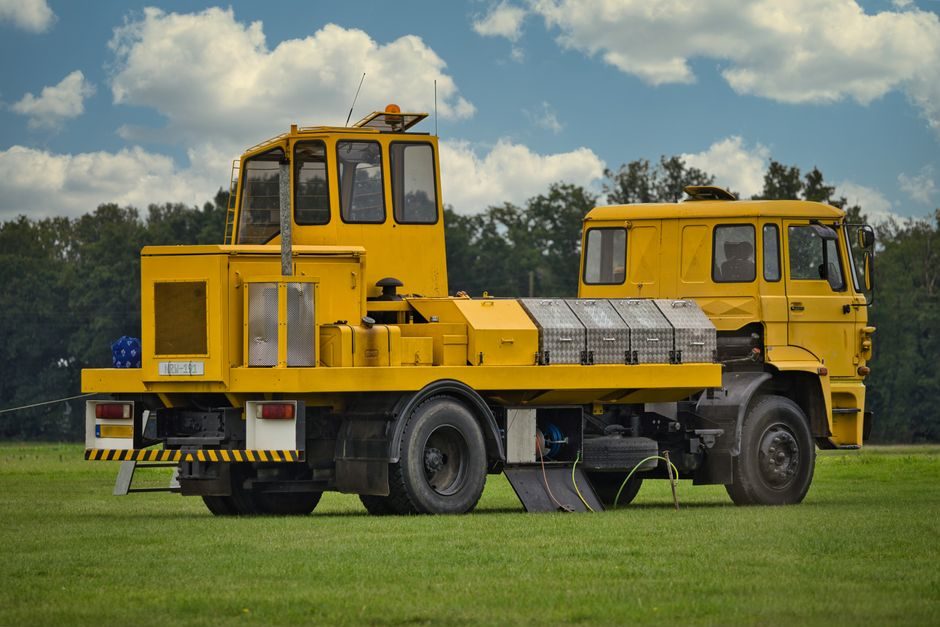
Working height is the single number that drives aerial work truck selection: Shandong FurunKang's OEM catalog lists scissor platforms at 4 m, 6 m and 8 m platform heights, with telescopic boom trucks at 28 m, 30 m, 35 m and 45 m working height on a single product line [S2].
That 4–45 m band is the practical mainstream for truck-mounted units; beyond it, North American rental fleets such as Blade Platforms stock boom trucks from 157 ft to 336 ft (≈48–103 m) for renewable-energy, real-estate and aerospace work [S4]. Bucket-truck body builders classify the same equipment family as "aerial platform trucks," the term used by the US trade portal buckettrucks.org [S3].
Working-Height Bands and What They Match to on Site
Sub-10 m scissor platforms on light truck chassis (4 m, 6 m, 8 m platform height per FurunKang) suit indoor facility maintenance, sign installation and warehouse stock picking where the truck must roll under standard 4 m doorways and the platform is needed for two-person access only [S2]. The "platform height" rating on a scissor lift is roughly 2 m below "working height," so an 8 m platform ≈ 10 m working height, the ceiling at which a Class-2 light truck remains the economical chassis.
Mid-range 12–28 m telescopic boom trucks cover street-light servicing, façade work on 6-storey buildings and tree trimming along distribution rights-of-way; the 28 m boom from FurunKang sits at the upper end of what a standard 6×4 commercial chassis can carry without outrigger pad loads exceeding 100 kN per corner [S2]. Bucket-truck body code typically maps platform height 12–18 m onto a medium-duty chassis (GVWR 11,794–15,000 kg / Class 3–5) and 18–28 m onto Class 6–7 chassis per US vocational-truck conventions cited on buckettrucks.org [S3].
Above 30 m – FurunKang's 30 m, 35 m and 45 m booms, and Blade Platforms' 157 ft (≈48 m) rental entry – the chassis shifts to multi-axle 8×4 or 10×4 configuration with full-width outriggers, and operators must verify ground-bearing pressure at each outrigger pad before setup [S2][S4]. The 45 m (≈148 ft) level is also where most regulators require a secondary fall-protection anchorage point and a load-moment indicator (LMI) on the boom, matching EN 13000 / ASME B30.5 logic for mobile crane work performed in the elevated platform mode.
Boom Type vs Scissor: Geometry, Outreach, Productivity
Scissor platforms give a straight-up lift envelope with zero horizontal outreach, which is what makes them cheap to manufacture and easy to insulate for live-line work; Safi Group's SC 22 tractor-mounted platform uses a hydraulic scissor mechanism sized for agricultural orchard and vineyard maintenance [S1]. The trade-off is productivity: a scissor must be re-levelled every time the truck repositions, so over a 200 m kerbside run the operator typically stops 8–12 times versus 2–4 stops for a telescopic boom with 6–12 m outreach.
Telescopic booms (FurunKang 28 m / 30 m / 35 m / 45 m line) carry the platform on a multi-section arm that elevates and extends simultaneously, giving 6–12 m of horizontal reach at full height and letting two workers straddle an obstacle such as a parapet or tree canopy [S2]. Articulated booms (knuckle-boom) add a knuckle joint below the telescopic section, which buys extra reach over barriers at the cost of a heavier upper structure and a higher centre of gravity; these dominate European utility fleets where 18–25 m working height with 8–11 m outreach is the common spec.
For spec sheets, compare three numbers side by side: (1) platform height (m), (2) horizontal outreach at full height (m), and (3) platform capacity (kg, typically 200–400 kg for two-person + tools on Chinese OEM booms [S2]). A scissor with 200 kg capacity at 10 m working height is the right tool for a warehouse LED retrofit; the same site needing reach over a 4 m conveyor would be a bad match and should be re-specified to a 14 m articulated boom with 7 m outreach and 230 kg capacity.
Chassis Class, Axle Layout and Outrigger Load Path
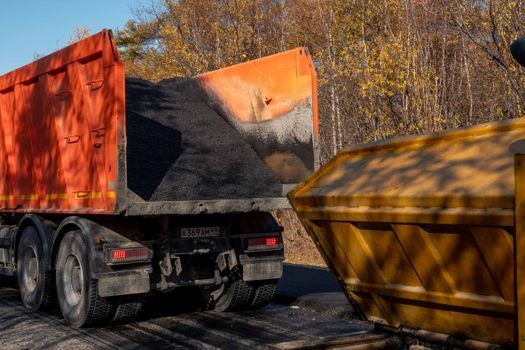
Chassis selection is a load-path problem before it is a manoeuvrability problem. A 4 m scissor platform on a 4×2 light truck (GVWR 6,000–8,000 kg) keeps total vehicle mass under most urban bridge restrictions and needs no outriggers beyond stabiliser legs that lift the rear axle 100–150 mm; a 45 m telescopic boom on a 10×4 chassis (GVWR 40,000–49,000 kg) requires four outrigger beams each transferring 80–120 kN into timber mats or composite pads [S2].
Yangzhou Yixiang and FurunKang both publish complete aerial work trucks built on Dongfeng, Foton and Sinotruk donor chassis, with sub-12 m units commonly on 4×2 light truck platforms, 12–22 m units on 6×4 medium chassis, and 22 m+ on 8×4 or 6×6 heavy chassis [S2][S5]. Jining Baoliwei supplies crane-truck and aerial-work-truck combinations on similar Chinese OEM chassis, often sharing the upper-structure engineering with their truck-crane line, which simplifies parts stocking for fleets that run both [S6].
For US-style bucket trucks, buckettrucks.org maps the same height bands onto Class 3–7 chassis and stresses that the body builder's rated platform height, not the chassis maker's marketing literature, is the figure that must appear on the nameplate and in the operator's manual [S3]. Insulation class (see below) is also stamped on the same nameplate, so the chassis selection and the dielectric rating are decided together, not in sequence.
Insulation, Dielectric Rating and Live-Line Work
Live-line work on overhead distribution needs an insulated aerial device rated to the line voltage; the dominant international standard is IEC 61057, which classifies insulating aerial devices into categories with rated voltage from 46 kV up to 800 kV AC for bare-hand work. Chinese OEM truck-mounted insulated booms (FurunKang, Yixiang) are typically offered in 10 kV, 35 kV and 110 kV dielectric classes on the same boom length, with the higher classes adding a longer FRP insert in the upper boom and a dielectric hydraulic hose bundle [S2][S5].
For substation work above 110 kV, bare-hand work from a boom truck is generally replaced by a dedicated live-line vehicle with a metallic boom and a suit-based equipotential bonding approach.
Non-insulated booms drop the FRP insert and the dielectric hose, which is what makes a 45 m rental boom affordable in the Blade Platforms fleet; that same truck must not be used within minimum approach distance of any energised line and must be grounded before bucket contact if the work is near induced-voltage zones [S4]. This is also why the 4 m / 6 m / 8 m scissor platforms and the orchard tractor-mounted SC 22 from Safi Group are explicitly non-insulated and sold for agricultural and facilities work, not for utility line work [S1][S2].
Drive Layout, Terrain and Site Mobility
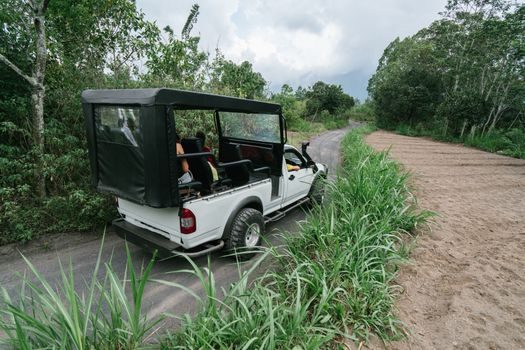
4×2 light chassis with rear-axle steering limit a sub-12 m scissor truck to paved yards and urban streets; 6×4 adds a pusher axle and is the minimum layout for off-road shoulder work on graded gravel because it distributes outrigger reaction into three axles and keeps the truck level when one wheel is in a soft spot [S2]. For unimproved terrain – wind-farm access roads, pipeline right-of-way, mining haul-road shoulders – the 6×6 or 8×8 all-wheel-drive chassis with single or dual rear tyres is the correct layout, at a 20–35% price premium over a comparable 6×4.
Bucket-truck body builders serving the US utility market further segment by jib articulation: a telescopic-only boom is cheaper but cannot reach "up and over" a substation busbar, whereas an articulating knuckle below the telescopic section adds 1.5–2.5 m of vertical knuckle travel and lets the platform land in places the boom itself cannot physically pass through [S3]. For a fleet standardising on 25–35 m working height, the typical spec sheet reads: 6×4 chassis, 9-tonne front / 13-tonne rear axle rating, full-width outrigger spread 5.2 m, four-section telescopic boom with 90° articulating jib, 230 kg platform capacity, 35 kV insulation class.
Sourcing Reality Check: Lead Time, Configurator Logic and Common Mistakes
Lead times from Chinese OEM lines (FurunKang, Yixiang, Baoliwei) for a build-to-order 28 m telesc boom run 45–75 days ex-works depending on chassis donor availability; standard-height scissor units on stocked chassis can ship in 15–25 days [S2][S5][S6]. US rental fleets (Blade Platforms) run 157–336 ft units that are typically late-model used or factory-rebuilt, with availability measured in weeks rather than months for the common 175–210 ft class [S4].
A useful internal checklist before issuing the PO: platform height (m), working height (m), outreach at full height (m), platform capacity (kg), insulation class (kV or "none"), chassis layout (4×2 / 6×4 / 8×4), GVWR (kg), outrigger spread (m), LMI fitted Y/N, and the standard(s) the nameplate will reference.
Where This Connects to Adjacent Equipment Selections
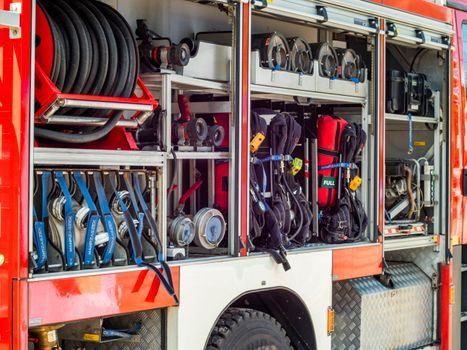
Aerial work trucks sit in the same spec-driven procurement workflow as dump trucks and reach trucks: chassis class, axle load, working envelope and duty cycle are decided before any vendor is contacted, and a wrong class on the first page of the spec usually dooms the whole evaluation. For a deeper dive on the chassis-and-insulation cross-check described above, see the related aerial work platform selection guide. Buyers running mixed aerial-work and crane fleets should also cross-reference their aerial work truck data sheets against dump-truck and reach-truck procurement so chassis spares, brake parts and operator licences stay common across the yard. [S1]
For related coverage, see Concrete Batching Plant Suppliers 2026: China OEM Clusters, Capacity Bands and Sourcing.