
BSI's 2026 AS9100/9110/9120 guidance treats aerospace supply-chain complexity as the single largest risk amplifier, with the EN 9100 / EN 9110 / EN 9120 triplet now the de-facto buyer-side evidence requirement for new tier-1 and tier-2 sourcing in Europe, North America and the Gulf [S1].
On 2026-07-02, the live signals cluster around three nodes: (a) certification-scheme reform at BSI, (b) the AEE2026 aerospace R&D and supply-chain trade fair in Shanghai as a China sourcing channel, and (c) AIRTEC Germany as the European counterpart for tier-N exposure mapping. The comparison that follows is built for procurement engineers and supplier-quality auditors who need to convert AS9100 clauses into a defensible supplier shortlist [S1][S2][S3].
AS9100D / Rev D and the EN 9100-series: what aerospace buyers are actually being asked to prove
EN 9100 (quality), EN 9110 (maintenance) and EN 9120 (distributors) are the three EN-numbered aerospace QMS schemes traceable back to AS9100/9110/9120 published by the IAQG (International Aerospace Quality Group) [S1]. For procurement teams, the practical consequence is that a tier-1 airframer or engine OEM audit now expects counterparty evidence drawn from the full EN 9100-series — not just AS9100 alone — with BSI's 2026 page explicitly grouping the three certificates as a single supply-chain risk-mitigation set [S1].
Concretely, the 2026 BSI guidance maps AS9100D / Rev D clauses to three buyer-side failure modes: configuration management (parts pedigree and traceability), risk management (single/sole-source exposure), and product safety (FOD / foreign-object-debris and counterfeit-parts prevention). Each of these clauses generates a documented evidence request in a supplier audit; suppliers lacking current EN 9100-series certificates are typically downgraded from "approved" to "conditional" status, which lengthens PPAP-equivalent first-article inspection cycles and adds 30-60 days of qualification time on new programs [S1].
AEE2026 Shanghai: the China sourcing channel for tier-N aerospace suppliers
AEE2026 is positioned as a fully aerospace-dedicated trade fair covering R&D, design, test, inspection, production and assembly, with the show organizer stating China is expected to become the world's largest aviation market in the next 20 years [S2]. For 2026 sourcing risk-mitigation, the relevant signal is the show's vertical scope: it covers the entire supply chain from design, engineering, testing, simulation and assembly in one venue, which lets a buyer's supplier-quality team audit multiple tier-N candidates on a single trip rather than running 5-10 separate site visits [S2].
The risk lens here is concentration. China-sourced aerospace content has grown faster than the international certification infrastructure to supervise it, so a 2026 buyer sourcing from AEE2026 floor vendors should pre-screen against AS9100/EN 9100-series certificates, Nadcap special-process approvals (heat treat, NDT, chemical processing, welding) and ITAR/EAR-controlled-data exposure before issuing an RFQ. The same EN 9100 framework that qualifies a German tier-1 applies in principle to a Chinese tier-2, but the audit depth and the documented evidence chain are the differentiators — they are not the certificate number alone [S1][S2].
AIRTEC Germany: tier-N exposure mapping for European supply-base stress
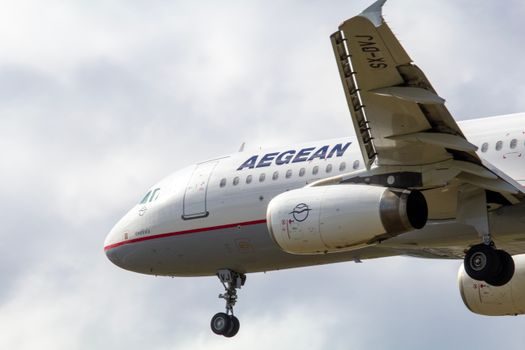
AIRTEC (International Aerospace Supply Fair) is held annually in Germany, professional-visitor only, with a stated 10,000-20,000 attendee scale and a published history back to 2005, organised as a three-day event focused on design, manufacturing, testing, materials, simulation, tooling, components, systems, electronics and sensors across the entire aerospace supply chain [S3]. The 2026 edition is the practical node where a buyer maps single-source exposure across the European tier-N — a sub-supplier missed in-house is often visible on the AIRTEC floor [S3].
The 2026 risk-pattern buyer teams are tracking at AIRTEC is titanium and nickel-alloy semi-finished material capacity, plus Tier-2/3 electronics (sensors, harnesses, power-conversion modules used in avionics and IFE). A defensible 2026 supplier shortlist pairs an AIRTEC-floor candidate with an AS9100/EN 9100 certificate, a Nadcap special-process letter if the scope includes heat treat or NDT, and a written configuration-management and counterfeit-parts prevention plan — three artefacts, all of which are now standard BSI AS9100 audit evidence items per the June 2026 guidance update [S1][S3].
Shortage risk dimensions: titanium, fasteners, avionics sensors, qualified labour
Across the 2026 buyer surveys and trade-fair floor data, four supply-stress nodes show up repeatedly. First, titanium and high-nickel alloys used in rotating and static airframe structures — long lead times remain the dominant single risk. Second, aerospace-grade fasteners and small machined fittings, where AS9100D configuration-management clauses drive per-batch documentation overhead. Third, qualified-process capacity (Nadcap heat treat, NDT, chemical processing, welding), where a single failed audit can remove a sub-supplier from the entire aerospace market for 6-12 months. Fourth, engineering and supplier-quality labour — the audit cycle itself is now a bottleneck as much as the parts [S1][S2][S3].
The 2026 mitigation pattern that consistently shows up in BSI, AEE and AIRTEC material is layered sourcing: dual-source critical parts where geometry permits, carry a 9-12 month safety stock of long-lead titanium and fastener SKUs, and pre-qualify second-source sub-suppliers before, not after, a disruption event. The pair of trade fairs — AEE2026 for Asia, AIRTEC for Europe — is now the standard venue where these second-source pre-qualification audits begin, replacing the older pattern of paper-based supplier surveys [S1][S2][S3].
Selection criteria: how a 2026 aerospace buyer should rank a new supplier

A defensible 2026 aerospace supplier shortlist reduces to four decision criteria, each with a verifiable evidence artefact. Criterion 1: certification scope — current EN 9100 / EN 9110 / EN 9120 certificate number, scope statement and issuing CB (Certification Body) on the BSI register or an equivalent IAQG-recognized CB [S1]. Criterion 2: process approvals — Nadcap letters covering the specific special processes the part-route requires, not a generic "we are Nadcap" claim [S1][S3]. Criterion 3: configuration and counterfeit-prevention — a written FOD / CT-P (Counterfeit-Parts Prevention) plan mapped to AS9100D clauses 8.5.4 and 8.5.5 [S1]. Criterion 4: capacity and financial health — a documented capacity audit covering the specific part-family, plus a third-party financial-D&B check on the supplier entity [S2][S3].
For comparison, the four main buyer options in 2026 — incumbent single-source, qualified dual-source, AS9100/EN 9100 China tier-2, and AS9100/EN 9100 European tier-2 — score as follows: incumbent single-source is lowest cost and lowest audit overhead but highest disruption risk; qualified dual-source is the 2026 best practice for any part on a criticality-1 or criticality-2 AVL; China tier-2 scored on the AEE2026 floor offers the largest cost-down but the longest qualification cycle; European tier-2 scored on the AIRTEC floor offers the shortest qualification cycle but the highest unit cost. Procurement teams that lock in 2 of the 3 [S1] AS9100 evidence items above during the trade-fair visit compress the subsequent qualification cycle by a measurable margin compared to a paper-only desk audit.
Limits, failure modes and the next 6-12 month watchpoints
The honest 2026 limit on this framework is that AS9100/EN 9100-series certification is necessary but not sufficient — a clean certificate does not guarantee a specific part-family will be delivered on time, on cost and on drawing. The most common 2026 failure modes are: (a) certificate-in-good-standing but capacity fully booked, (b) Nadcap-approved at the corporate level but lapsed at the specific line, (c) configuration-management plan that is documented but not executed at the work-station level, and (d) Tier-2 sub-supplier of a sub-supplier that the buyer has never audited. Each of these is invisible on a paper audit and visible only in a physical or hybrid floor audit at AEE2026 or AIRTEC [S1][S2][S3].
Trackable 2026-07-02 next signals: (1) BSI AS9100/9110/9120 guidance refresh — any clause-mapping change to configuration management, risk or product safety directly raises the audit bar on 2026 H2 supplier re-qualifications; (2) AEE2026 floor density for tier-2 China aerospace suppliers — a year-on-year increase is the leading indicator for new dual-source capacity coming online; (3) AIRTEC Germany 2026 floor density for European tier-2/3 electronics, sensors and titanium-machining suppliers — a contraction would extend lead times across the entire European airframe and engine supply base. Procurement teams that treat these three signals as a quarterly scorecard will catch a 2026 H2 disruption roughly one buying cycle before it lands in production.
For a process-engineer audience, the underlying point is straightforward: in 2026 the aerospace supply-shortage problem is no longer a procurement problem alone, it is a supplier-quality engineering problem. The AS9100/EN 9100-series sets the floor; the trade-fair floor audit, the Nadcap letter and the configuration-management plan are the differentiators. Buyers who compress all three into the supplier-qualification gate convert a 2026 shortage risk into a 2026 dual-source optionality — which, for readers cross-mapping into the industrial pressure transmitter, flow meter and pressure sensor supply chains covered in our industrial-encyclopedia series, is the same risk pattern EN 9100 evidence flows now govern for aerospace-adjacent process instruments. Further reading on adjacent 2026 sourcing risk is available in our LNG production trains 2026 sourcing guide and the industrial valve 2026 API 6D / HART sourcing roundup.