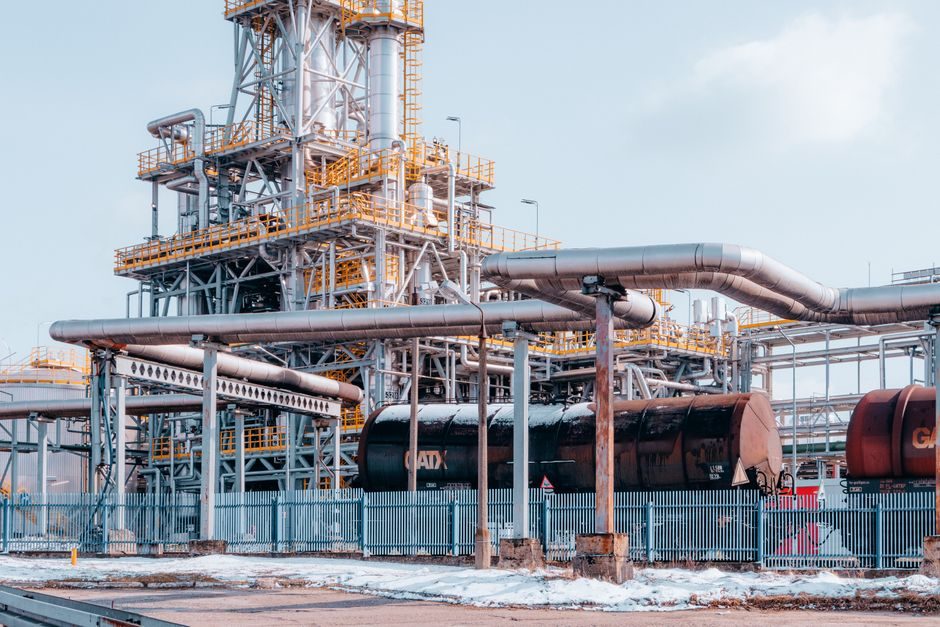
Cooling natural gas to about -162°C (-260°F) shrinks its volume by roughly 600:1, which is the physical reason LNG moves in insulated cryogenic carriers instead of pipelines [S1].
For project engineers, "LNG production technology" almost always means the liquefaction train: feed-gas treating, heavy-hydrocarbon removal, mercury and acid-gas cleanup, then refrigeration to cryogenic conditions. The choice of refrigeration cycle drives CAPEX, driver horsepower, thermal efficiency, and plant availability, which is why the licensed-process vendors dominate the field [S1][S2].
Three Licensed Liquefaction Processes Dominate the 2026 Pipeline
ConocoPhillips' Optimized Cascade is a mixed-refrigerant cascade with a "two-trains-in-one" configuration that delivers approximately 95% plant availability per published process claims [S2]. Its design uses three pressure levels of mixed refrigerant, which simplifies operations when one of the three refrigerant loops is taken offline for maintenance. The cascade layout is energy-efficient at large single-train capacities but carries a higher mixed-refrigerant inventory and more rotating equipment than a single-mixed-refrigerant (SMR) plant [S2].
Air Products' AP-X and the Black & Veatch / Pritchard PRICO SMR design cover the rest of the market. AP-X uses a main cryogenic heat exchanger (MCHE) with a multi-component refrigerant, giving a high single-train capacity. PRICO uses a single mixed refrigerant in one MCHE, which simplifies the plot, lowers CAPEX, and suits mid-scale and FLNG applications, but at a thermal-efficiency penalty versus the cascade and AP-X layouts [S3]. The MCHE itself, usually a brazed-aluminium plate-fin unit from Chart or Linde, is the single most failure-prone block; aluminium diffusion bonding tolerates cryogenic cycling only within tightly controlled cooldown rates.
Feed-Gas Pretreatment Gates the Whole Train
Before gas reaches the MCHE, an amine acid-gas removal unit (ADIP/MEA/MDEA depending on CO₂/H₂S ratio) drops CO₂ to roughly 50 ppmv and H₂S to about 3.5 ppmv, the conventional LNG feed spec to prevent CO₂ freeze-out in the cold box [S1]. A molecular-sieve unit then drops water to under 1 ppmv and removes mercaptans that would otherwise poison downstream catalysts.
Mercury removal is mandatory on most gas fields: a fixed-bed copper-sulphide or silver-impregnated guard drops Hg from tens of µg/Nm³ to under 0.01 µg/Nm³ to protect aluminium MCHE cores from liquid-metal embrittlement. NGL recovery upstream of liquefaction (typically a turbo-expander or JT column) extracts ethane+ to control MCHE freeze margin and to monetize heavies; over-recovery of C₃+ shifts the refrigeration compressor load upward and reduces LNG throughput [S3]. Cryogenic pressure transmitter skids at the cold box feed use Inconel or stainless wetted parts, low-temperature seals, and −196°C-rated impulse lines, and they read sub-atmospheric suction pressures on the low-pressure refrigerant drum with reference accuracy typically better than ±0.075% of span.
Refrigeration Cycle, Drivers, and Why Driver Choice Matters
Most modern baseload trains are driven by large gas-turbine-driven refrigerant compressors: GE LMS100, Siemens SGT-A35/RB211, or Solar Mars class units in the 80–150 MW range per train, depending on capacity. The driver spec cascades into the whole project: power island, gas-turbine exhaust heat can be integrated into a GTG/HRSG combined cycle to drive the gas-turbine drivers and improve overall plant efficiency, but it also locks the project into a single vendor's long-term service agreement [S1].
Electric-motor drives (eLNG), typically fed from a combined-cycle power island or grid, are gaining ground because they decouple the liquefaction throughput from fuel-gas price volatility. They add a flow meter layer on the refrigerant circuit for compressor surge protection and require a high-inertia motor plus variable-frequency drive to soft-start the refrigerant compressor shaft against cryogenic mass-flow transients. The trade-off is straight: e-driver CAPEX is higher, but the plant avoids the gas-turbine exhaust-emission envelope and can run on a higher specific energy consumption per ton of LNG [S3].
Operating Envelope, Boil-Off, and What the Cryogenic Side Demands
LNG ships at near-atmospheric pressure in double-wall, perlite-insulated, nickel-steel tanks (9% Ni or LNG-grade austenitic). Storage tanks at the terminal use the same 9% Ni inner tank with a pre-stressed concrete outer wall and a bottom insulation that includes load-bearing foam glass; instrumentation is the pressure sensor family on the inner tank vapour space, plus a redundant level gauging system (typically two independent servo gauges, often Endress+Hauser or Emerson designs, with ±5 mm accuracy).
Send-out is the forgotten bottleneck: a regasification terminal can move 600–1000 t/h of LNG, which translates into a large LNG submerged combustion vaporiser (SCV) or open-rack vaporiser (ORV) bank. From the instrument engineer's chair, the cold end of the plant is where valve and trim selection bites: industrial valve bodies in cryogenic service are austenitic stainless with extended bonnets, and trim is typically Monel or K-Monel to survive thousands of thermal cycles between ambient purge and −162°C operation.
Project Sourcing Map: Who Licenses, Who Builds, Who Guarantees
Process licensors set the thermodynamic baseline: ConocoPhillips (Optimized Cascade), Air Products (APCI AP-X, C3MR, AP-DUAL), and Black & Veatch (PRICO) cover most baseload and mid-scale projects. EPC contractors — Bechtel, TechnipFMC, JGC, Saipem, KBR, Chiyoda — take the license and wrap it into a fixed-price EPC package; the EPC contractor is the party that absorbs schedule and cost overrun, not the licensor [S1][S2].
Procurement strategy should fix the process licensor first, then let the EPC bid around the licensed design package.
2026 Sourcing Signals and What to Track
Two data points are worth tracking. First, Qatar's expansion programme targets an additional ~50 Mtpa of LNG production coming on stream within a multi-year window, which is the largest swing factor in global LNG supply [S1]. Second, eLNG designs using electric-motor drivers with grid or nuclear heat integration are now bid-spec on several North American and Middle Eastern projects, which is shifting the cryogenic heat-exchanger and PLC control-system spec sheets toward tighter compressor-surge control and redundant SIL-rated trips on the cold box [S3].
Track the next project sanction cycle: monitor FID announcements from QatarEnergy, Venture Global, and NextDecade through Q3–Q4 2026 to see which licensed process wins each train, and watch for the first FLNG redeployment of a PRICO or AP-DUAL unit on a 3+ Mtpa hull. The 2026 buy signal is process-license vintage: trains that lock in cascade or AP-X technology now will dictate spare-parts, servo motor actuator inventories, and cold-box MCHE lead-times for the next 25 years.
For related coverage, see Skid Steer vs Backhoe Loader: 2026 Spec Cut.