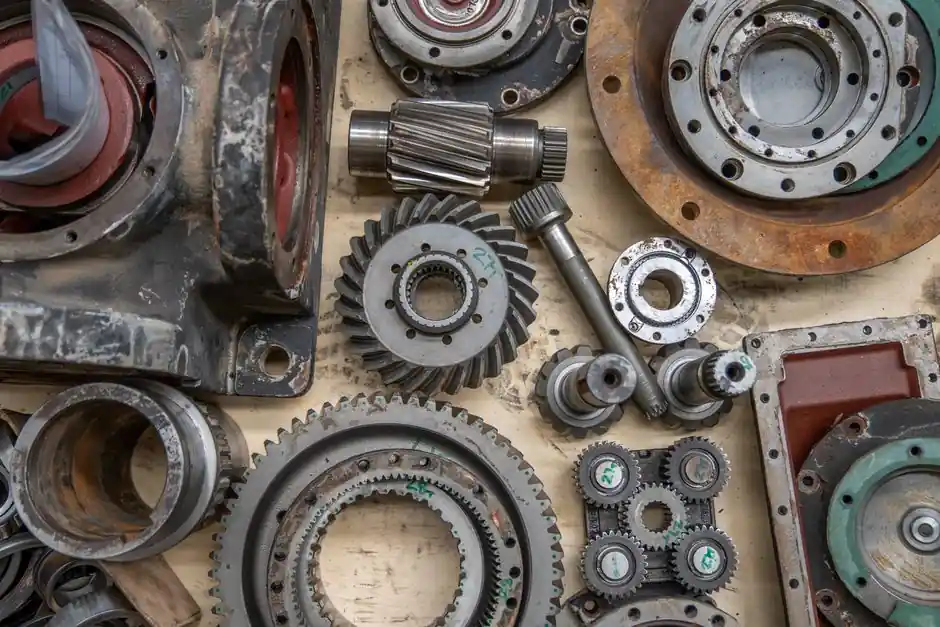
An AGMA service factor is the ratio of gearbox rated horsepower (or torque) to the application's required horsepower (or torque), used by the American Gear Manufacturers Association to communicate the overloading margin a reducer can absorb before its gear surface fails by pitting or bending fatigue [S1][S2][S3].
Typical industrial values sit between 1.0 (Class I, uniform electric-motor driven load) and 2.0+ (Class III, heavy shock), with single-cylinder engines, frequent start/stop cycles, and elevated ambient temperatures pushing the number toward the upper end of published tables [S4][S5].
Service Factor Math: Rated HP, Design HP, and the 8.78 Power Curve
The sizing identity is straightforward: Design HP = Motor nameplate HP x Service Factor [S1][S5]. A 10 kW motor on a conveyor with AGMA Class II service (1.4) therefore specifies a reducer rated for at least 14 kW of continuous mechanical capacity.
The interesting part is what that multiplier actually does inside the gearbox. Per AGMA rating methodology, gear-tooth pitting life scales with the service factor raised to the 8.78 power [S2]. A change from 1.0 to 1.30 (a 30% increase) moves pitting life from 1x to 10x, and a change from 1.0 to 1.50 yields roughly 38x; the relationship is not linear, which is why a small spec bump matters more than procurement teams expect [S2].
Service class and service factor are interchangeable notation: Class I = 1.0, Class II = 1.41 (often published as 1.4), Class III = 2.0, and many catalogs show both columns for the same application row [S4][S5][S2].
Reading an AGMA Service Factor Table: Hours, Power Source, Shock Character
Published tables (AGMA Class I, II, III shown in parallel columns) take three inputs: duration of service in hours per day, character of the prime mover (electric motor, multi-cylinder engine, single-cylinder engine), and shock character of the driven machine (uniform, moderate, heavy) [S4].
For an electric-motor driven, uniform-load machine running under 3 hours/day, the table returns 0.60 at Class I, 0.80 at Class II, and 1.00 at Class III; the same machine running over 10 hours/day with heavy shock rises to 2.00 at Class I, 2.00 at Class II, and 2.50 at Class III [S4]. A single-cylinder engine with moderate shock on a 3-10 hour/day duty reads 1.25 (Class I), 1.50 (Class II), 1.75 (Class III) [S4].
These numbers are minimums. The Superior Gearbox table itself notes: "Divide the horsepower rating by the service factor to obtain the design horsepower" and warns that ratings are generalizations, requiring prototype testing for any non-standard application [S4].
When to Bump the Service Factor Beyond the Table

AGMA tables assume typical conditions. The published service factor is described as the "minimum recommended" for the listed duty, and any deviation pushes the user to escalate the multiplier before sizing [S5][S6].
Conditions that justify an upward adjustment include elevated ambient or gearbox-housing temperatures, extreme shock loads or vibration, non-uniform loads (cutting versus conveying, for example), cyclic loads from frequent starts and stops, and high peak-versus-continuous load ratios [S2][S3]. For applications requiring elevated temperatures or frequent starts, the gearbox service factor must be adjusted accordingly, based on AGMA guidance [S6].
Common operating adjustments in practice: add 0.1-0.2 for ambient above 40 deg C, add 0.2-0.5 for known shock events (crushers, hammer mills, press flywheels), and consult the manufacturer directly when the driven machine is reversible or has high inertia mismatch with the motor [S2][S5][S3].
Service Factor vs. Service Class vs. Application Factor
Three terms are used interchangeably in marketing copy but are not the same number in every catalog. Service factor is the raw multiplier (1.0, 1.4, 2.0). Service class is the Roman-numeral shorthand (I, II, III) mapped to those same multipliers, equivalent to 1.0, 1.41, and 2.0 in some Bonfiglioli-style catalogs [S5].
Application factor is sometimes used as a synonym and sometimes used to refer to a second multiplier layered on top of service factor for thermal capacity or bearing life, which is why two vendors quoting the same duty can land on different gearbox frame sizes [S5]. Always ask which axis the number modifies: torque rating, thermal rating, or bearing L10 life.
For sizing a gearbox on a continuous-duty conveyor, the AGMA service factor governs tooth-bending and pitting capacity; for a high-cyclic indexing drive, the same multiplier understates the real limit because it does not fully capture bearing fatigue from rapid acceleration [S2][S3].
Failure Modes of an Undersized Service Factor

An undersized service factor shows up as gear-tooth pitting (gray or dark spalls on the flank), macropitting (flakes larger than 1 mm), and bending fatigue cracks at the tooth root, all of which progress exponentially once the surface layer is breached [S1][S2].
Undersizing also accelerates bearing failure, lubricant breakdown, and seal blowout, because a reducer running continuously above its rated horsepower dissipates more heat per unit time than the housing was designed to reject [S3]. The downstream cost is downtime: replacement, realignment, and lost production, all of which dominate the purchase-price delta between a correctly and incorrectly sized unit [S1][S3].
Over-sizing has the opposite economic problem: a Class III reducer on a Class I duty wastes capital, increases rotating mass, and may require a different mounting footprint, so the goal is the smallest service factor that still leaves pitting life well above the planned overhaul interval [S1][S3].
Selection Workflow: Five Inputs, One Multiplier, One Rated Unit
The repeatable process: (1) identify the prime mover type (electric motor, multi-cylinder, single-cylinder); (2) list daily operating hours banded as 0.5-3, 3-10, or 10-24 h/day; (3) classify the driven-machine shock character as uniform, moderate, or heavy; (4) read the published service factor at the intersection, escalating for elevated temperature, frequent starts, or non-uniform loads; (5) multiply motor HP by that factor to get design HP, then pick a gearbox whose catalog rating is greater than or equal to design HP at the required output RPM [S2][S4][S5].
Cross-check: confirm the selected unit also passes the peak-torque limit, which is published separately and may govern the design even when the service-factor check passes [S5]. On a related note for motor-driven packages, motor protection relay settings should be coordinated with the gearbox's locked-rotor and peak-torque envelope to avoid nuisance trips on legitimate acceleration transients.
For hydraulic-driven equipment where the gearbox is downstream of a pump, the upstream pressure transmitter sizing and pump control law determine how much torque ripple reaches the input shaft, and a service factor picked on nameplate HP alone will underrate the unit when the HPU produces high-cyclic pressure spikes.
Common Misreads and Trackable Signals
Three pitfalls to flag at the spec review: confusing the gearbox-rated HP (the nameplate) with the application's required HP (the load), forgetting that a service factor of 1.0 is the AGMA minimum for a Class I uniform electric-motor duty, not a generic default, and accepting a vendor's "service class" column without confirming whether it is mapped to 1.0/1.41/2.0 or to the older 1.0/1.4/2.0 buckets [S2][S4][S5].
Trackable signals for an in-service unit: rising housing temperature above the rated ambient, audible gear-mesh whine that drifts downward in frequency (early sign of tooth-surface wear), and an uptick in lubricant particle count above the ISO 4406 limit for the gearbox's specified cleanliness target, each of which suggests the as-installed service factor is below the duty's actual demand [S2][S3][S6].
Component reference pages worth checking: flow meter.