
AI-based image barcode readers decode damaged, smudged, or angled 1D and 2D codes measurably faster than laser raster scanners, with documented labor savings of 50–70 hours per day in a 200,000-unit fulfillment center when read accuracy climbs from 95% to 99.5% [S4].
Laser raster scanners (a red laser diode sweeping via a rotating mirror to build a raster image) still dominate where labels are clean, flat, and well-oriented, but their optical-mechanical decoding principle collapses on the dented, curved, and low-contrast labels that define modern warehousing, pharmaceutical, and DPM-on-metal lines [S1][S2].
How each technology actually decodes a symbol
A laser raster scanner sweeps a single laser line across the symbol and measures the reflected dark-bar/white-space pattern; decoding is essentially analog, with success tied to clean contrast, correct orientation, and a flat target surface [S1]. An image-based reader, by contrast, captures a full 2D frame with a CMOS sensor and runs decoding algorithms on that image, which is why 2D imagers "better compensate for barcode degradation with image reconstruction" when print quality drops [S2].
AI-enabled imagers layer deep-learning inference on top of that image stream, so the decoder no longer depends on a clean edge profile: it recognises the symbol even when bars are torn, low-contrast, occluded, or printed on a curved metal surface [S4]. The same hardware form factor (an industrial code reader) now ships with on-device neural decoders that label confidence per region of interest.
Read-rate math on damaged labels
The operational gap is concrete, not theoretical. Scanflow's 2026 model puts a 2% absolute accuracy loss at 4,000 extra scans per day and 50–70 wasted labor hours in a 200,000-unit fulfillment center; on a 120 parts/minute manufacturing line, a 95% read rate equates to roughly 6 unprocessed parts every minute [S4].
For damaged-symbol work, the trade-off is consistent across vendors: laser-based readers win on clean 1D barcodes at low cost, while 2D imagers and AI imagers win on poor-quality, aged, or otherwise damaged codes, including DPM marks on metal [S2][S6]. Cognex's January 2025 launch of the AI-powered DataMan 290 and 390, and Datalogic's NRF 2025 AI-embedded introductions, are the vendor-side response to that gap, with DHL and Zebra announcing an enterprise AI-scanning rollout in March 2025 [S4].
Selection criteria for a brownfield retrofit

Three criteria drive the right pick. First, label condition: clean, flat, high-contrast 1D on corrugated still favours a laser raster unit, and an industrial barcode scanner in that class remains the lowest-cost per read. Second, symbol mix: any 2D payload (Data Matrix, QR, DPM) immediately requires an imager, since laser raster is fundamentally a 1D line reader. Third, environment: variable lighting, angled hand-holds, and curved/reflective substrates push the math toward AI imaging because the decoder is no longer at the mercy of a single reflected laser line [S1][S4].
Keyence's own 2024/2025 reader catalogue positions AI-based reading of damaged or blurred codes and codes read at an angle as a primary trend, alongside rugged housings for plant-floor deployment [S3]. In practice, this means the decision is rarely "AI versus laser" in the abstract; it is "where does the failure rate of a laser raster unit exceed the total cost of an AI imager upgrade?"
Comparison matrix for the three reader classes
Set against the criteria that matter on a plant floor, the three options line up as follows. Laser raster: lowest unit cost, fastest decode on clean 1D, narrow depth of field, fails on damaged/curved/2D codes, no software upgrade path for new symbologies beyond firmware [S1][S2]. 2D imager (non-AI): mid-tier cost, reads 1D and 2D, robust to label damage via image reconstruction, still struggles on heavy occlusion or extreme angles [S2][S6]. AI-enabled imager: highest unit cost, decodes damaged/low-contrast/angled/DPM symbols with measurably higher first-pass read rates, on-device model can be retrained or updated, requires power and (usually) GigE/M12 data cabling similar to a conventional imager [S3][S4].
The exception that proves the rule: Cognex's eight-reasons framing of image-based readers cites flexibility, performance, and cost savings across industries, which only holds once the application has moved past clean 1D on flat cartons [S7]. Below that line, a laser raster gun is still a defensible spec, and for an assembly line that already runs cleanly it is hard to beat on price per read.
Where AI imagers earn their premium, and where they do not
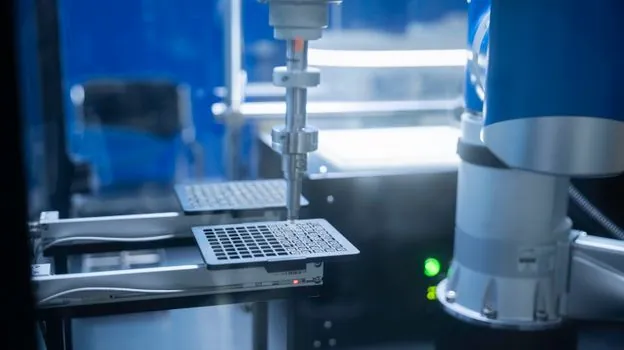
AI imagers earn their premium in three settings: DPM codes on metal automotive or aerospace parts (where laser raster physically cannot image the mark reliably), pharmaceutical and food warehouses with dented or smudged labels scanned at variable angles, and 24-hour fulfillment operations where the labor cost of a misread dominates the hardware amortisation [S4].
They do not earn it for retail POS on clean EAN/UPC labels, for simple WIP tracking on freshly printed codes, or for fixed-mount conveyor reads of flat cartons under controlled lighting, where a basic 2D imager is already overkill and a laser raster unit or non-AI imager is the rational spec [S1][S2]. Cognex, Keyence, and Datalogic all still ship non-AI imagers in 2025/2026 precisely because the cost-per-read curve flattens once label quality is high [S3][S4][S7].
Standards, safety, and integration constraints
Two safety points matter for any reader that uses a laser source. The emitter in a laser raster barcode scanner is a low-power visible or near-infrared laser diode; Apple community guidance and vendor documentation both describe it as infrared (typically 650–670 nm visible red in industrial raster units) at output levels below the threshold for eye or skin injury under normal scanning use [S5]. Industrial laser products must still be classified and labelled per the IEC 60825-1 laser-product safety standard, and Class 2/3R units require the standard "do not stare into beam" labelling and operator training.
On the imaging side, there is no laser classification, but the device is a digital camera with an illuminator: integration effort centres on lens selection, field of view, working distance, and industrial protocols (PROFINET, EtherNet/IP, TCP/IP, RS-232) rather than optical safety. The deeper plant-floor reference for the wider sensor ecosystem, including how an imager pairs with encoders, photoeyes, and reject gates, is captured in the laser marker and laser profiler reference pages, which share the same M12 power and GigE cabling conventions.
Field deployment and failure modes to spec against
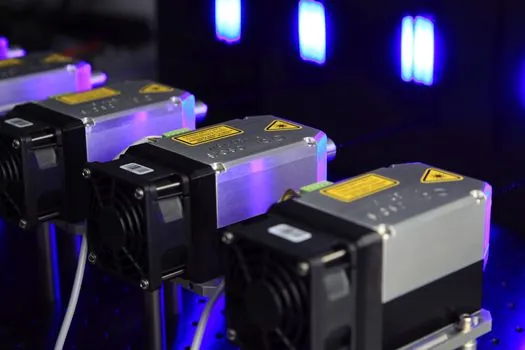
Three failure modes dominate real installations. First, specular reflection on metal DPM marks: a laser raster beam reflects away from the photodiode and the decoder sees a saturated or dead zone; AI imagers fail more gracefully because the convolutional model can classify partial patterns. Second, motion blur on high-speed conveyors: a laser raster sweeps continuously so motion blur is less of an issue than for an imager with a fixed exposure window; spec the imager's exposure time and trigger-to-image latency against the line speed in m/s. Third, label curvature on cylindrical containers: a single laser line only intersects a small angular slice of the curve, while a 2D image captures the full wrap, which is why 2D imagers "win again when faced with poor quality barcodes, or barcodes that have aged or been otherwise damaged" [S6].
A practical sizing rule, consistent with the Scanflow analysis: if your current line is running above 98% first-pass read rate on clean labels, a laser raster or non-AI imager is the right economic call; if it is sitting between 90% and 97% with damaged or angled labels in the mix, an AI imager pays back inside one or two quarters purely on avoided re-scans and labor recovery [S4].
Trackable signals to watch through 2026
Three signals are worth tracking through the rest of 2026. The first is the rate at which AI-decoder firmware is back-ported to existing imager hardware, because that determines whether brownfield retrofits need a new camera or just a model update. The second is the published read-rate delta on standard ISO/IEC 15416 and ISO/IEC 16022 grade-C and grade-D test cards between laser raster, non-AI imager, and AI imager, since those are the only numbers that will settle the spec debate on damaged DPM. The third is whether the laser raster segment in retail and light-industrial scanning continues to contract, which Scanflow reports has been the case since 2022 [S4], and which would in turn reset the price baseline for a 1D-only reader.
Background reading: Ball bearing C vs C0: sizing rules and common spec errors.