
Bucket elevators in air-cargo terminals typically operate in the 80 to 700 m³/h volumetric band with 1.2 to 3.8 m/s belt speed, a fraction of grain-leg capacity but with tighter constraints on ignition control, dust, and discharge geometry [S3].
The selection problem is not capacity alone, it is the intersection of parcel size distribution, lift height to mezzanine or sorter deck, lightweight polymer or recycled-content bag handling, and the fire-class envelope dictated by the surrounding ULD storage [S1][S3]. Compared with a bucket elevator selection for warehouse automation project, air-cargo duty cycles add irregular parcel geometry, mixed soft-pack and rigid-container input, and a much higher rate of foreign-object carry-through.
Throughput band: which Cimbria or Brock model class maps to cargo duty
The Cimbria EC class covers 25 to 80 m³/h at 1.20 to 2.80 m/s and is the only sub-100 m³/h class in that line, suited to small-parcel hub mezzanines where the elevator feeds a single sortation line [S3].
The Cimbria EF class spans 85 to 374 m³/h at 2.10 to 3.65 m/s and is the workhorse for mid-size cargo terminals, while the ED class at 150 to 225 m³/h runs faster belts (up to 3.65 m/s) for the same density envelope [S3]. For higher-volume hubs the Cimbria EE class delivers 570 to 706 m³/h and the EH class reaches 638 to 1209 m³/h, both at 3.00 to 3.80 m/s, the band that overlaps the lower end of Brock's BE361120 grain leg (56 in. / 1,422 mm head pulley, 11 in. / 279 mm boot, 20 in. / 508 mm trunking) at 1,422 mm × 1,422 mm centers [S2][S3]. Cargo facilities rarely need the EH envelope; an EF or ED is the more common ceiling for parcel-and-ULD terminals, because bag break-rate and not capacity is the binding constraint.
Bucket profile and material: AA, AC, C, and the wear-liner decision
Standard profile families used in industrial elevators are coded AA, AC, ACS, C, MF, HF, and SC, with the AA, AC, and C families being the high-capacity spaced-bucket patterns that dominate grain and bulk-mining service, and the HF and SC patterns being the continuous-bucket configurations used on inclined or steep lifts [S6].
For air-cargo service the relevant trade-off is not so much profile as bucket material and liner: Cimbria's ED uses PEHD wear plates in a galvanized trunking, while EE and EH step up to HARDOX wear plates with reinforced top sections and pedestal bearings, the same HARDOX choice used in Brock's grain-leg boot and head sections for abrasive grain service [S2][S3]. Cargo parcels are not abrasive, so PEHD is the default unless the duty includes bulk airmail sacks with grit, in which case HARDOX at the boot is a cheap insurance line item. The reference page on bucket elevator design covers the full bucket-profile catalogue and spacing math.
Drive, brake, and ignition-risk controls: ATEX zones and belt-speed monitoring
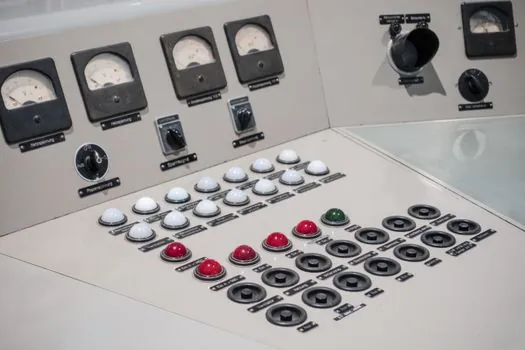
Cimbria offers an Electronic Speed Guard data sheet and a Misalignment Detector XY-81.AT2.11 data sheet as standard accessories, alongside an Explosion Relief data sheet for ATEX-classified sections [S3].
Air-cargo terminals handling packed parcels do not always need full ATEX zoning, but the dust envelope around a ULD deplaning line often crosses into zone 21/22, in which case an electronic belt-speed guard with zero-speed switch, a belt-misalignment detector, and a bearing-temperature monitor are the minimum engineered safety stack [S3][S7]. The reference air quality monitor page covers the dust-side monitoring that should sit alongside the elevator's explosion-relief panels. Brock's BE-series documentation requires the same guard stack on grain legs, so the cargo-side specification is essentially the grain-side spec minus the dust-asperation and minus the larger motor frame [S2].
Layout, discharge geometry, and foundation loads for terminal floors
Layout data delivered to spec must include lift height, head and boot center distances, hopper dimensions, chute angles, motor horsepower, gearbox ratio, head RPM, foundation and support structure requirements, and the loading and discharge arrangements, the seven-item data pack that Ryson publishes as the basis of any submittal [S1].
On a cargo floor the head centerline is typically 4.5 to 9 m above the boot, well below the 30 m-plus grain-leg envelope, so foundation loading is driven by lateral thrust at the boot and the cantilever moment at the head, not by column buckling under self-weight. Floveyor's bucket-elevator guide identifies take-up adjustment and pivoting-bucket discharge as the two mechanisms that most affect layout tolerance on retrofit floors, where the sorter deck elevation is fixed and the boot cannot be moved [S7]. Compare this with the bucket elevator selection for electronics handling map, where ESD and cleanroom boot-geometry constraints dominate the layout pack.
Selection criteria comparison: four cargo-elevator options on three axes

Across the four Cimbria classes relevant to cargo duty, the trade matrix on capacity, belt speed, and wear-liner material is the most useful spec snapshot, and it lines up as follows: EC delivers 25 to 80 m³/h at 1.20 to 2.80 m/s with galvanized trunking (no upgraded liner), ED delivers 150 to 225 m³/h at 2.10 to 3.65 m/s with PEHD wear plates, EF delivers 85 to 374 m³/h at 2.10 to 3.65 m/s with galvanized trunking as standard, and EE delivers 570 to 706 m³/h at 3.00 to 3.80 m/s with HARDOX wear plates [S3]. All four classes share an 850 kg/m³ maximum bulk-density rating, which sets a hard ceiling on any future change of duty to denser bulk airfreight [S3].
The Indian Standard IS 7167 (1974) lists air-dried lignite, ground lime, dried milk flake, sodium nitrate, and broken paraffin cake among materials with documented bucket-elevator duty factors, and the densities there bracket the 850 kg/m³ Cimbria ceiling, which means a cargo terminal that adds any mineral or chemical bulk back-haul must re-verify bulk density against this list before reusing an EF or EE class unit [S5]. The reference pressure transmitter page covers the load-cell and weigh-scale side of throughput verification if a custody-transfer belt scale is added at the discharge.
Limitations, failure modes, and what to verify before sign-off
The dominant failure modes on cargo-duty bucket elevators are bucket-to-belt fastener loosening after polymer-bag contamination, belt-misalignment at the head pulley under uneven parcel feed, and boot-shaft bearing failure from foreign-object ingestion, with belt-speed drift being the leading indicator of all three [S1][S7].
Pre-shipment verification should therefore include a documented belt-speed-guard test, a run-out of the misalignment detector per the XY-81.AT2.11 data sheet, a weigh-scale calibration against the 850 kg/m³ density ceiling, and a foundation-load review against the head-height plus dynamic moment at the boot [S1][S3]. The Cimbria bucket-elevator support-system data sheet is the document that ties the structural package to the drive package, and is the single submittal most often missed on cargo-terminal retrofit work. Two trackable signals: first, the next Cimbria or Brock OEM data-sheet revision in the third quarter of 2026, where HARDEX or PEHD liner grades typically get refreshed; second, any IS 7167 revision activity through 2026 that would re-rate the lignite, lime, and nitrate entries that bracket the 850 kg/m³ ceiling.