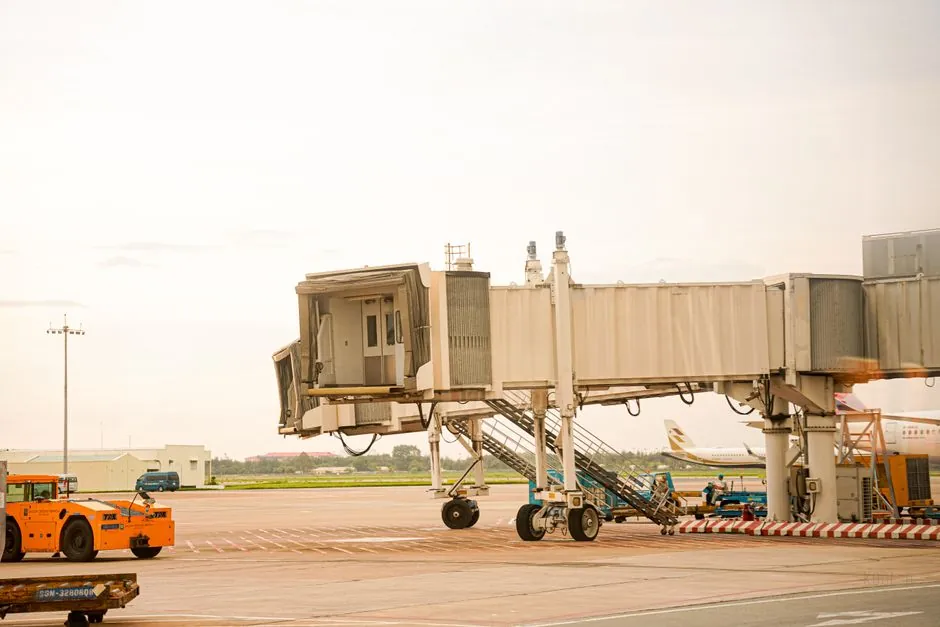
Pneumatic conveying moves dry bulk freight such as cement, fly ash, starch, sugar, salt, plastic pellets, polymers, lime, soda ash, and plastic resin through sealed lines using compressed air or gas, with airflow generated by a fan, blower, or compressor under either positive pressure or vacuum [S1].
Air-cargo terminals, rail-to-truck transload hubs, and intermodal yards increasingly use these enclosed lines to cut dust emissions, reduce product loss, and connect silos, bins, hoppers, and storage vessels without spillage [S1] [S2].
Dilute-phase vs dense-phase operating envelope
Dilute-phase systems suspend material in a high-velocity air stream and are typically the lowest-cost option for short conveying distances and low capacities, with operating pressure held below 1 atmosphere (roughly 0–14.7 psig) [S2]. Common dilute-phase air velocities sit in the 3000–6000 fpm range for lightweight media such as flour, sugar, and plastic pellets [S4].
Dense-phase systems move material as a slower-moving plug or strand at low velocity, high density, and high pressures, which minimizes both particle degradation and pipeline wear for abrasive, fragile, or moisture-sensitive cargo [S2]. For air-cargo use, dense-phase is the safer default when bag integrity, pellet length-to-diameter ratio, or hygroscopic behavior rules out suspension flow.
Pressure mode vs vacuum mode for terminal layouts
Pressure systems push material from a single feeder through a pipeline to one or more receivers, fitting a fixed source-to-destination layout such as a silo-to-truck loadout [S8]. Vacuum systems pull material from multiple pickup points to a single destination, which suits an air-cargo terminal drawing from several ULD-compatible bins or hopper trucks into one receiving filter [S8].
Dynamic Air, a manufacturer with 50+ years in the field and 15,000+ systems delivered worldwide, builds both pressure and vacuum dense-phase and dilute-phase variants, indicating the dual-mode market is mature enough to be specified by application rather than by brand [S2].
Key components and where they fail in service
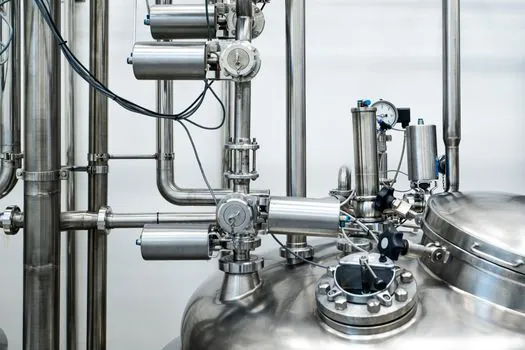
Every conveying line is built from a blower or compressor, a feeder (rotary valve, screw feeder, or hopper), a conveying pipeline (commonly steel or aluminum pipe with smooth-bend geometry), a separator (cyclone, filter, or baghouse), and a control loop monitoring line pressure and airflow [S1] [S4]. Filter selection on the receiving end is non-trivial: pulse-jet, reverse-air, and shaker configurations are offered in snap-band, cuff, or ring-top filter formats built to OEM-spec dimensions [S5].
Three failure modes dominate cargo operations: abrasive media wearing thin elbows and straight pipe, fragile media fracturing at high dilute-phase velocities, and slugging or clogging when moisture or particle size distribution is outside design limits [S4] [S7]. The CED Engineering reference text also flags bearing selection and fan arrangement as critical, since bearings out of the airstream last longer in dust-laden service [S9].
Selection criteria mapped to air-cargo material classes
Five variables drive the spec: material properties, conveying distance, capacity requirement, system complexity, and cost [S2] [S10]. For a 50–200 m run inside a cargo terminal, dilute-phase pressure is usually the lowest first-cost option; for runs beyond that, or for fragile or abrasive freight, dense-phase pressure or vacuum becomes economic once avoided product loss and pipe replacement are priced in [S3] [S6] [S10].
The PNEUMATI-CON® product line, for example, is described as a dilute-phase system engineered to move powders and granules through enclosed pipelines with flexible routing, which matches an air-cargo terminal where bag-to-silo and silo-to-truck paths turn through multiple bends [S6].
Comparison matrix: dilute vs dense, pressure vs vacuum
Four decision criteria line the main options up cleanly: typical air velocity, line pressure, best-fit material class, and distance sweet spot. Dilute-phase pressure runs at high velocity, low pressure (sub-atmospheric to ~1 barg), suits non-abrasive free-flowing media, and is most economic on short runs under ~150 m [S2] [S4]. Dense-phase pressure runs at low velocity, high pressure (above 1 barg, into the tens of barg on long lines), suits abrasive, fragile, or moisture-sensitive media, and is selected for long runs with high product-value [S2] [S3].
Dilute-phase vacuum covers the same material class as dilute-phase pressure but lets one receiver pull from multiple pickup points, which is the natural fit for an air-cargo terminal unloading several ULDs or hopper trucks into a single filtration skid [S8]. Dense-phase vacuum combines the material-protection of dense flow with multi-point pickup, but at lower line pressures than dense-phase pressure, which limits practical run length [S2] [S8].
Adjacent applications and how they inform air-cargo spec
Pharma-grade dense vs dilute, pressure vs vacuum selection logic carries over directly to air-cargo handling of hygroscopic or contamination-sensitive freight; a practical decision map is laid out in Pneumatic conveying for pharma: dense vs dilute, pressure vs vacuum selection map. Where cargo moves through warehouse automation, the broader mechanical-conveying trade-offs (chain, belt, screw) covered in Chain Conveyor Selection for Warehouse Automation: 2026 Spec Map help justify why pneumatic is preferred when dust control or multi-plane routing is needed. [S1]
For terminals that also stage palletized or containerized freight, the design language for overhead and mechanical lines in Overhead Conveyor Types and Classifications: A 2026 Selection Reference sets the baseline against which an enclosed pneumatic line is typically justified on hygiene and spillage grounds.
What pneumatic gives you that mechanical does not

Pneumatic conveying uses airflow through enclosed pipelines, while mechanical conveying relies on belts, chains, screws, buckets, or other moving equipment in open or partially enclosed frames [S7]. The closed pipeline is the differentiator in air-cargo work: it keeps dust inside the line, supports vertical and multi-plane routing without transfer points, and typically carries fewer moving parts than a chain or screw conveyor, which lowers the maintenance burden and the failure rate [S1] [S4] [S7].
For an encyclopedic primer on the broader pneumatic principle and how it intersects with other air-driven equipment such as air impact wrench and air solenoid valve circuits, see the linked reference pages, and review general conveying system definitions for cross-mode comparison.
Track, on the next refresh, whether terminal operators publish duty-cycle data for dense-phase vacuum receivers at >5 t/h on hygroscopic polymers, since that operating window is currently described only at the qualitative level in the public material [S2] [S3] [S10].