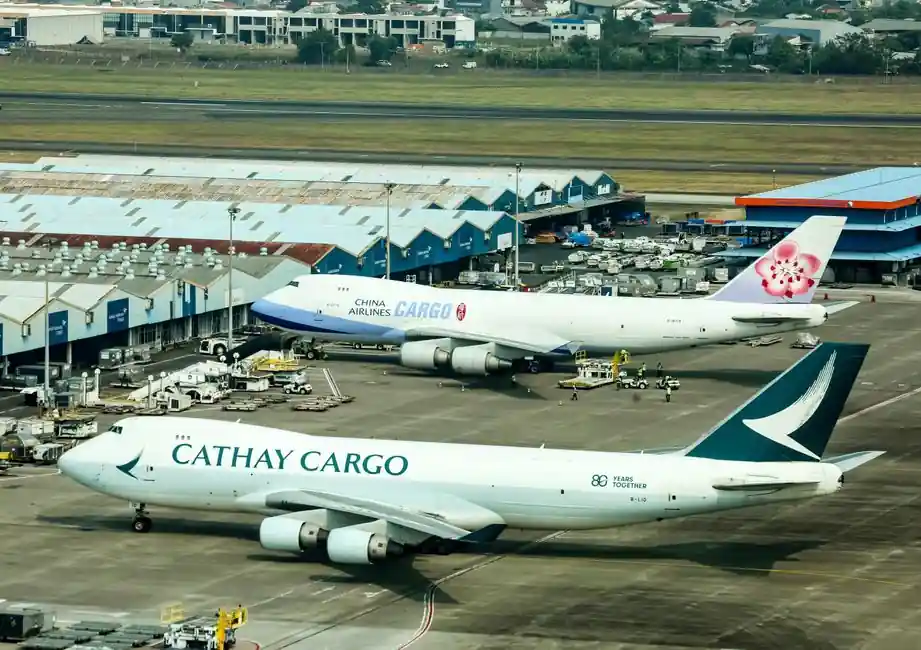
Stretch film for air cargo is most commonly specified in the 80 to 100 gauge (ga) range, with LLDPE construction in either cast or blown extrusion, and gauge mapped to load weight from under 1,500 lb to over 2,400 lb [S3].
Air-freight conditions differ from road or sea in three ways: faster handling with more unit-load device (ULD) transfer events, exposure to rapid cabin-to-tarmac temperature swings, and tighter weight penalties per kilogram, which makes light-gauge, high-clarity cast film attractive for general cargo [S1][S4].
Air cargo stress profile vs road, sea, and warehouse
Air-cargo handling exposes wrapped loads to short-duration but high-acceleration events: conveyor transfer, build-up at the ULD, pushback, and tug towing on the apron, conditions that magnify the risk of load shifting and film tear-off at corners [S4].
Compared with long-haul trucking, which subjects pallets to extended vibration and sudden braking over hours, air-cargo dwell time between wrap and unload can be as short as a few hours, so film selection trades sustained containment force for higher impact puncture resistance and reliable cling under cold-cargo-hold conditions [S4].
Compared with sea freight, which adds humidity and salt exposure over weeks, air cargo sees minimal salt but real UV exposure during tarmac transfer and ramp dwell, so UVI (ultraviolet inhibitor) additives are specified when the wrapped load sits on the apron more than 30 minutes [S2].
Film construction: LLDPE, cast, and blown compared
Most stretch films are LLDPE (linear low-density polyethylene), which provides the elasticity and self-cling that allow wrap to hold a pallet under tension without tape or strapping [S3].
Cast film is the default for roughly 90% of operations: it is quieter off the roll, clearer for barcode scanning, two-sided cling, and lower cost per roll, but its molecular alignment gives lower tear and puncture resistance [S3][S5].
Blown film is produced by extruding a tube inflated with air and chilled on an air ring, which orients the molecules more randomly and yields higher tensile strength, higher tear resistance, and better stretch memory, at a higher price and with more roll noise [S5]. For air cargo with sharp-edged or irregular SKUs, blown is the engineering default; for uniform cartons, cast is the cost default [S3].
Gauge selection by load weight and wrap method
Stretch film gauge (ga) is the thickness in 0.01 mil units; commercial range runs 24 ga (very light) to 120 ga (maximum), and the working range is typically 40-100 ga for hand and 47-90 ga for machine wrapping [S3].
For air-cargo pallets under 1,500 lb, 40 to 60 ga down-gauged cast film is sufficient when loads have smooth, uniform surfaces and no sharp corners [S3].
For the 1,500 to 2,400 lb band that covers most consumer air freight, 80 ga cast for hand wrap or 47 to 50 ga pre-stretched machine film is the industry standard, with pre-stretch heads reducing film consumption per pallet [S3].
For loads over 2,400 lb or any load carrying metal components, building materials, or machinery, 100 ga blown for hand wrap or 80 to 90 ga blown for machine wrap is specified, with additional reinforcement wraps near the pallet base to resist bottom-shift during acceleration [S3][S4].
Specialty films for air-freight conditions
UVI stretch film uses UV-inhibitor additives to resist sunlight during tarmac dwell and is the correct choice when pallets sit outside the warehouse or on the apron for extended periods [S2].
VCI (volatile corrosion inhibitor) film is specified for any air-cargo load containing metal parts exposed to condensation risk, releasing a vapor that passivates ferrous and non-ferrous surfaces during transit [S2].
Anti-static stretch film is mandatory for any air-freight load containing ESD-sensitive electronics, lithium battery packs, or avionics spares, dissipating static charge that can otherwise damage components during handling [S2].
Netting stretch film provides ventilation for plant stock, food, or any load that needs airflow to prevent mold, while still maintaining unit-load containment; it is regularly used for perishable air-cargo [S2].
Reinforced or no-cling films are used for odd-shaped freight where standard cling may transfer to product surfaces or where the load requires strapping underneath the wrap [S5].
Hand vs machine wrap on the air-cargo dock
Hand stretch film is intended for low-volume operations; as a rule of thumb, once a dock wraps more than 15 to 20 pallets per day, a powered turntable or rotary ring wrapper is specified [S2].
For air-cargo hubs where pallet profile changes between ULD types (AKH, AKE, PAG) and operators rotate frequently, machine wrap with a 47 to 50 ga pre-stretched film is the spec that delivers consistent wrap force and minimum film waste, while hand wrap is reserved for ULD build-up, top-up reinforcement, and odd-sized pieces [S3].
Application pattern and load-shape fit
Standard carton loads with consistent dimensions and smooth surfaces are the easiest case: standard cast machine film at 80 ga is sufficient when paired with a normal four-corner wrap pattern [S4].
Tall lightweight loads, common in air-cargo consumer goods and paper products, present a high centre of gravity and lean risk; they require higher-performance film and a wrap pattern that increases overlap at the top of the load [S4].
Irregular and mixed-SKU loads demand enhanced puncture resistance and superior load retention, often with customised wrap patterns; air-cargo forwarders handling consolidations routinely use blown film at 100 ga plus corner boards for these pallets [S4].
Heavy industrial loads, including machinery spares and metal components, generate the highest containment-force demand and benefit from additional reinforcement wraps near the base of the load to resist the inertial forces during apron towing and ULD loading [S4].
Quick spec for an air-cargo pallet
Two trackable signals for spec engineers: monitor ASTM D4649 pallet-stack vibration test data when changing air-cargo lanes, and re-validate film gauge whenever ULD type changes from AKE to AKH, since the taller ULD amplifies top-load sway.
For component-level specifications, see stretch film, air pick, and air impact wrench.
This topic is covered further in Laser Marker Sizing and Selection: Part-First Spec Map for 2026.