
Full air freight from Kuala Lumpur to Los Angeles delivers packaging materials in under one day but at the highest per-kilogram cost in the carrier's portfolio, with a heavy carbon footprint attached [S2].
Ocean on the same lane costs a fraction of air but stretches end-to-end transit into the multi-month range and exposes the load to port congestion, the same port congestion that compounded the 2021-2022 air freight shortage [S4]. The decision for a process engineer is not "air or sea" in the abstract, it is a per-shipment question of how many days of wafer-fab downtime one kilogram of substrate is worth.
Three Modes, Three Operating Profiles
Air logistics is the long-standing staple of the semiconductor supply chain because it offers speed and reliability, with Kuehne+Nagel positioning it as the highest-quality-standard option for time-sensitive components [S2][S3]. Ocean freight is the most economical and environmentally friendly option per tonne-kilometre, but transit times fluctuate with routing, port calls, and weather. Road transport fills the last-mile role for short distances between fab, OSAT, and warehouse [S2]. None of the three on its own solves the cost-speed-stability triangle for high-value semiconductor inputs.
Aircraft selection within air freight changes the cost curve sharply. The Pilatus PC-12 single-engine turboprop and Cessna 406 Caravan II handle short-to-medium-range semiconductor runs from small airfields close to where the cargo is produced [S1]. Mid-range loads move on the Dassault Falcon 20, which takes five pallets and ranges nearly 3,000 miles, or the McDonnell Douglas DC-9 15F, which carries just over 10 tons and accepts shorter runways [S1]. For full-fuselage loads the Boeing 747-400F delivers a wide-body payload with a nose-loading door and integrated cargo handling system [S1].
Cost Versus Speed on the KL-Los Angeles Lane
The 2025 benchmark for a semiconductor packaging-materials move is a clean three-way comparison. End-to-end air from Kuala Lumpur to Los Angeles lands in under 24 hours but at the top of the cost stack. Pure ocean on the same origin-destination pair extends transit into months and adds route-disruption risk. The Kuehne+Nagel Sea-Air hybrid, routing air from Kuala Lumpur to Shanghai and then a fast boat from Shanghai to Los Angeles, trims total transit to 25 days and cuts expenditure versus full air freight [S2].
That 25-day hybrid beats ocean on schedule and beats air on cost, which is why hybrid intermodal has become a 2026 watch-item for OSAT-heavy shippers [S2]. For higher-value cargoes where a fab tool sitting idle costs more than the freight surcharge, pure air remains the only mode that can hold the production line.
What Air Freight Is Actually Used For During Shortages
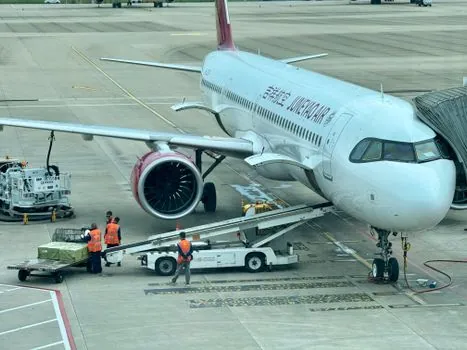
During the 2021-2022 chip cycle, pandemic-fuelled demand collided with constrained air capacity, and congestion at major US seaports compounded ongoing air freight shortages [S4]. The response was to fly the parts that fabs could not buffer: sub-fab tools, bonding wires, substrates, and the spare parts that, if missing, stop a lithography cell cold [S2]. The same playbook applies in any shortage window, with air charter filling the gap when scheduled belly-cargo capacity is already sold out.
Logistics providers counter the shortage risk with pre-booked space, synchronised hand-offs, priority handling at hubs, and end-to-end visibility for proactive rerouting [S2]. DHL's 2022 white paper recorded fab equipment investment near $99 billion in 2022, almost double the pre-pandemic rate, a build-out that itself created parallel surges in demand for capital-equipment airlift to new fabs in regions with thin existing semiconductor infrastructure [S4].
When Air Freight Is the Wrong Tool
Air is a poor choice for non-urgent substrate volumes, low-value consumables, and any load where the freight bill can be measured against a slow-moving inventory line item. Sea-Air only works when both legs of the hybrid have reliable schedules and the hub pair (Kuala Lumpur to Shanghai to Los Angeles in the reference case) lines up with a fast-boat service [S2]. Mismatched hand-offs in a hybrid add days rather than save them.
Carbon cost is the other constraint: air has a heavy carbon footprint per tonne-kilometre compared to ocean, which matters for any semiconductor shipper under a published Scope 3 reduction target [S2]. Specifying a Falcon 20 or PC-12 on a regional lane for a single missing part is defensible; specifying a 747-400F for a 30-day buffer stock is not.
Selection Criteria for a Semiconductor Logistics Decision

Five criteria cover most calls. (1) Part criticality: if a line stops without it, air is on the table. (2) Value density: high-value, low-weight inputs favour air; heavy, lower-value inputs favour sea. (3) Lead-time gap: a hybrid Sea-Air lane like KL-Shanghai-Los Angeles at 25 days sits between pure sea (months) and pure air (under 24 hours), and matches most non-emergency replenishment windows [S2]. (4) Carbon budget: ocean beats air per tonne-kilometre; hybrid sits in the middle. (5) Hub reliability: only use a hybrid if the connecting hub has synchronised priority handling, otherwise buffer at the origin airport.
For fabs and OSATs in regions like San Jose, the standard menu is dedicated air freight, dedicated ground, or a blended air-plus-ground plan, and the carrier picks the mix from the same freight forwarder [S1]. For Asian-to-US substrate flows, the Kuehne+Nagel Sea-Air template is the reference design. For broader fab build-out logistics, the DHL discussion paper recommends visibility, partnership depth, calibrated inventory buffers, and sustainability as the four levers for resilience, in that order [S4]. Engineers weighing new equipment investments can compare capex cycles against the freight-mode decision in this AI server ODM assembly capacity 2026 sourcing map, and review the related fab-tool airlift question alongside the foundry equipment spec by stage.
Trackable Signals Going Into Late 2026
Three datapoints will tell the story. First, average spot air freight rate on TPEB (Taipei-to-Los Angeles) lanes versus the same period in 2025, since that is the index most exposed to wafer-fab emergency lifts. Second, hybrid Sea-Air lane announcements out of Klang and Hong Kong, because each new announced corridor widens the menu beyond the 25-day KL-Shanghai-Los Angeles reference [S2]. Third, sustained Cape and Panama port-call reliability, since any return of seaport congestion immediately re-prices air as the only guaranteed mode [S4].
Detailed specification references: variable speed drive, air pick, and air impact wrench.