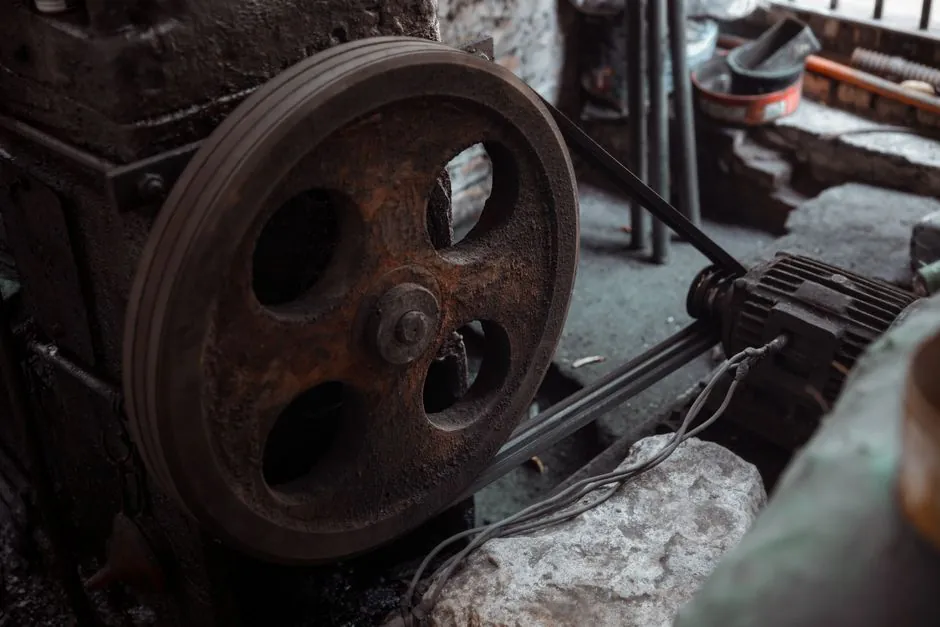
An investment casting foundry's equipment list maps to seven process stages: metal die construction, wax pattern production, ceramic shell building, dewaxing, metal melting and pouring, shakeout, and finishing [S4][S7].
Process capability ranges from a few ounces per casting on the jewelry side to several hundred pounds on the industrial side, with wall thicknesses down to 1/8 in (3.175 mm) on ferrous and non-ferrous alloys including stainless steel, brass, aluminum, carbon steel, and glass [S1][S5].
Wax Pattern Room: Aluminum Dies and Wax Injection Presses
The wax room is the first capital-intensive cell, because every finished casting needs one disposable wax pattern, and pattern shrinkage must be compensated in the master die across wax, ceramic, and metal stages [S4].
Master die construction uses CNC-machined aluminum for production runs, with steel dies reserved for very high pattern counts [S4]. Wax injection presses typically operate at 0.1 to 1.0 MPa (1.5 to 150 psi) melt pressure into heated dies held at 21 to 38 °C (70 to 100 °F), with pattern cycle times of 15 to 60 seconds depending on part size and wall section [S7]. Auxiliary bench equipment includes wax injectors, vulcanizers for rubber mold tryouts, and a range of wax carving tools for one-off and prototype work [S2]. Wax recovery is standard: much of the wax from dewaxing can be reclaimed, skimmed, and re-injected, which materially reduces pattern-material cost per casting [S5].
Ceramic Shell Building: Slurry Tanks, Stucco, and Drying Rooms
Ceramic shell building is the longest cycle step, and it is the cell that drives floor-space requirements in a typical lost-wax foundry [S4][S7].
Primary shell-room equipment includes a primary (face-coat) slurry tank with slow-speed agitation, backup slurry tanks sized 500 to 5,000 L, a fluidized-bed stucco hopper or rainfall sander for fused silica or zircon sand stucco, a humidity- and temperature-controlled drying room held near 22 to 28 °C with 30 to 70 % RH, and a gantry or hoist system rated for cluster weights up to 100 to 500 kg [S7]. Shell thickness is built up by repeated dipping, typically 6 to 10 coats for industrial parts, with progressively coarser stucco at each coat to balance strength and permeability [S4]. Two binder systems are in commercial use: water glass (lower cost, dewaxed in hot water, rougher surface) and silica sol (higher cost, flash-fire dewax, better surface finish) [S5].
Dewaxing and Shell Firing: Autoclaves, Flash-Fire, and High-Temp Furnaces
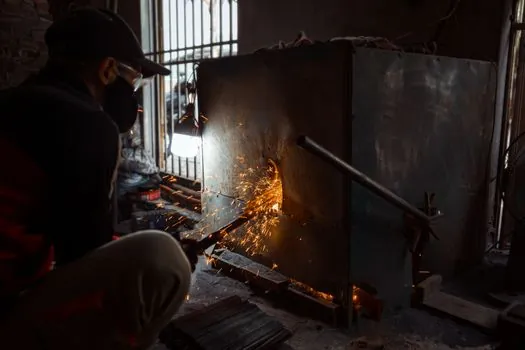
Dewaxing removes the wax pattern from the built ceramic shell and pre-heats the shell to pouring temperature, in one or two vessels depending on binder system [S5][S7].
Water glass shells are dewaxed in a hot-water autoclave typically rated 6 to 8 bar saturated steam at 160 to 180 °C, with a 10 to 15 minute cycle that recovers wax for re-use [S5]. Silica sol shells are dewaxed by flash-fire dewaxing vessels, where the shell is plunged directly into a furnace at 870 to 1,095 °C (1,600 to 2,000 °F) and the wax burns out in seconds [S5]. A separate high-temperature shell-firing furnace (typically gas or electric) at 1,000 to 1,150 °C fires the shell before pouring to remove residual wax and pre-heat the refractory to avoid thermal shock on pour [S7]. Rapid autoclave cycle capability is a common bottleneck; foundries that can dewax more than 200 shells per shift typically run multiple vessels in parallel.
Melting and Pouring: Induction, Vacuum, and Tundish Systems
Melting and pouring capacity sets the alloy range and the maximum pour weight the foundry can bid on [S5][S7].
For ferrous alloys (carbon, stainless, tool, and cobalt-base steels), the workhorse is a medium-frequency coreless induction furnace sized 5 to 500 kg pour weight, with power ratings typically 100 to 2,500 kW at 500 to 3,000 Hz [S7]. For nickel- and cobalt-base superalloys, especially aerospace parts, a vacuum induction melting (VIM) furnace at 10 to 1,000 torr (1 to 133 kPa absolute) and 1,500 to 1,650 °C melt temperature is standard, often paired with a vacuum pour-back chamber [S3]. For non-ferrous work (aluminum, copper, brass), gas- or electric-fired crucible furnaces with silicon-carbide or clay-graphite crucibles are typical, and per-unit pour weights stay small [S5][S7]. Pouring is by hand-ladling for small runs, by bottom-pour or tilt-pour furnace for production, or by counter-gravity vacuum pour for thin-wall aerospace and medical parts [S3][S7]. A robotic pour or programmable ladle improves pouring-temperature repeatability, which is critical to feeding thin-wall investment castings in stainless and tool steel. Compared with aluminum HPDC cell equipment stacks, the investment casting melt cell is slower and more alloy-flexible, trading cycle time for material range and surface finish.
Shakeout, Cutoff, and Cleaning Room
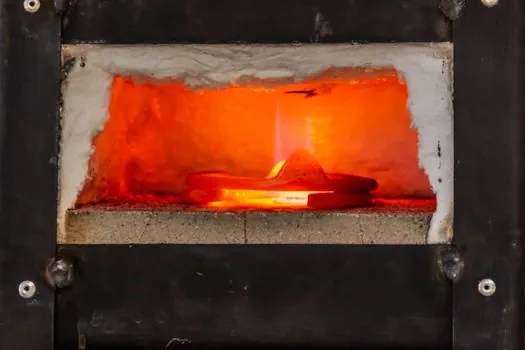
Once the casting has solidified, the ceramic shell is removed and the part is cut from the gating tree, then cleaned for inspection [S4][S7].
Shell removal is typically mechanical: a vibrating shakeout table or a hammer-knock station, sometimes paired with a high-pressure water blast (typically 100 to 350 bar) to strip residual ceramic from intricate internal passages [S7]. Cutoff options are a frequent differentiator in a foundry's equipment list. Common options include abrasive cutoff saws (for steel and nickel alloys), band saws (for aluminum and small steel sections), and abrasive waterjet or plasma tables for larger clusters [S1]. Gate and riser grinding is done on dual-station pedestal or swing-frame grinders with aluminum-oxide or ceramic belts, often inside a dust-collection booth to meet airborne particulate limits. Final cleaning steps include shot blasting with steel or stainless shot, and pickling in an acid bath (typically 10 to 20 % HF/HNO3 mix for stainless, or a milder caustic wash for tool steels) to remove the last surface scale [S4][S7].
Finishing, Heat Treatment, and Quality Lab
Finishing and inspection close the loop and feed the data used for first-article qualification and lot release [S1][S7].
Welding repair stations (typically GTAW/TIG on stainless and nickel alloys) handle minor surface defects, with a documented weld-procedure specification for each alloy family. Heat treatment is usually outsourced for high-temperature nickel and cobalt superalloys (vacuum or atmosphere furnaces at 1,150 to 1,260 °C with argon or nitrogen backfill and solution-anneal cycles), while in-house batch furnaces handle lower-temperature stress relief and precipitation hardening for tool and martensitic stainless steels. Quality lab equipment spans non-destructive testing modalities: liquid penetrant (PT per ASTM E1417), magnetic particle (MT per ASTM E709), radiographic testing (RT, with either Ir-192 or X-ray sources), and ultrasonic testing (UT per ASTM A609 for heavy castings), plus hardness and tensile machines for mechanical qualification [S1]. Foundries that serve aerospace and medical markets additionally run coordinate measuring machines (CMM) with 3 to 5 µm repeatability and surface-roughness testers (Ra typically 1.6 to 6.3 µm as-cast) for first-article reports [S1][S3].
How the Equipment List Maps to Market and Material Choices
The equipment stack a foundry invests in should follow the alloy range and end market it intends to serve, because each segment has a distinct capability profile [S3][S6].
A jewelry- and art-focused foundry runs a compact list: small wax injectors, 1 to 5 kg gold-melting furnaces, vacuum or centrifugal casting units, and bench tools for hand finishing, with burnout ovens replacing the larger autoclave [S2]. An industrial general-alloy foundry (carbon, stainless, duplex, tool steels) leans on the full seven-stage list above, with medium-frequency induction melting and water glass or silica sol shell building [S1][S5]. An aerospace and medical superalloy foundry adds VIM, vacuum pour-back, and an in-house NDT lab, and qualifies under customer-specific approvals such as AS9100 and ISO 13485 [S3][S6]. The two binder routes also drive equipment: water glass shops emphasize autoclave throughput and accept rougher surfaces, while silica sol shops invest in flash-fire dewax and shell-firing furnaces for tighter as-cast tolerances and finer surface finish [S5]. Per-unit cost falls with volume, so capital choices should also reflect the expected cluster count per pattern tree and the annual pour weight the facility is sized for.
Track the silica sol versus water glass split, the shift toward VIM and vacuum counter-gravity pouring for aerospace and medical work, and the growing use of in-line shell-thickness and pouring-temperature monitoring to drive first-article yield in the next 12 months.
Component reference pages worth checking: foundry, and anti static equipment.