
Atlas Copco's industrial air-tools installation pocket guide is the de-facto field reference for pneumatic-tool commissioning, and every step it lists — air treatment, hose sizing, lubrication, and acceptance test — applies directly to an air pick [S1].
An air pick is a handheld, reciprocating pneumatic hammer used for descaling, weld spatter, concrete chipping, foundry sand removal, and foundry cleaning; proper installation is the difference between a tool that lasts a single shift and one that runs thousands of hours [S1].
Pre-Install Audit: Air Supply, Compressor, and Hose Specification
Compressed-air quality is the dominant variable in pneumatic-tool service life, and the Atlas Copco pocket guide mandates an FRL (Filter-Regulator-Lubricator) on the drop line as a non-negotiable element of any air-tool installation [S1]. For an intermittent-duty air pick, 6.3 bar (90 psig) at the tool inlet is the typical operating point; drops below ~5.5 bar (80 psig) starve the piston and accelerate seal wear, while sustained over-pressure above 8 bar (120 psig) trips OEM warranty exclusions on most pick models.
Hose ID is a frequent silent killer: a 1/2 in (13 mm) ID hose is the practical minimum for a single standard pick, and any run over 8 m (26 ft) should be stepped up to 3/4 in (19 mm) ID to keep pressure drop under 0.3 bar at rated free-air consumption (typically 200-450 l/min for hand-held picks). Mount the FRL within 5 m of the tool and set the regulator to the nameplate pressure, not the compressor tank pressure.
FRL Setup, Lubrication, and the Inline Mist Unit
Filter element rating should be 5 µm or finer, with an auto-drain bowl sized for the line condensate load; a manual drain left un-tended is the single most common cause of water ingestion that ruins an air pick's valve block [S1]. Regulator set-point accuracy of ±0.1 bar is achievable with diaphragm-type units and is worth the small cost premium over piston regulators for pick applications where under-pressure is felt immediately as lost stroke energy.
Lubrication: oil-fog injection at 1-2 drops per minute per 100 l/min of free-air flow keeps the rotor vanes and valve piston wetted; picks that run dry show scored cylinder walls within 50 hours. For food, pharma, or clean-room service, specify a non-fogging pick variant and an FRL with an activated-carbon exhaust stage instead of the standard oil-mist unit.
Tool Mounting, Vibration Isolation, and Ergonomic Setup
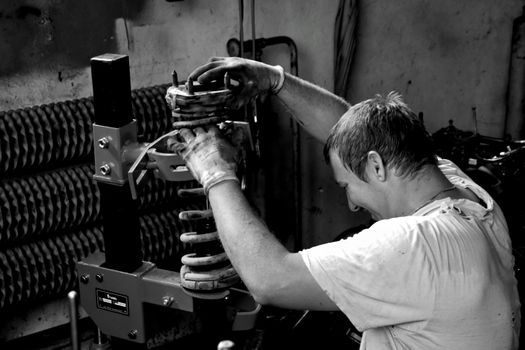
An air pick delivers 1,200-2,000 blows per minute at the chisel end, and that vibration must be decoupled from any fixture or bench the tool is mounted to; even a small bench-mount bracket transfers enough energy to loosen M8 fasteners within a shift. Use rubber-bonded isolation mounts (Shore A 40-55) between the tool retainer and any rigid bracket, and route the air hose with a whip loop of at least one coil diameter to absorb reactive thrust. [S1]
Chisel selection is part of installation: a flat chisel for descaling, a moil point for concrete, and a scaling needle for tube bundles — each must be the OEM shank size (typically 12.7 mm / 1/2 in hex or 17.5 mm round). A chisel that is short-stroking by 5 mm or more is a sign of low inlet pressure, not a worn tool; fix the air supply before replacing the pick.
First-Pick Commissioning: Leak Test, RPM Check, and Acceptance Run
Commissioning procedure per Atlas Copco's pocket guide: pressurise the line with the pick disconnected, soap-test every fitting for 30 seconds, then connect the pick and run it free (no chisel) for 60 seconds to confirm steady RPM and absence of piston slap [S1]. Recheck the regulator under load — droop greater than 0.2 bar indicates undersized supply line or restricted filter element.
Acceptance criteria: chisel stroke visibly full at working pressure; exhaust ports clear of oil pooling (more than ~5 drops/min indicates over-lubrication); tool surface temperature below 60 °C after 10 minutes of intermittent duty; and noise level, measured at the operator position, below the OEM-published dB(A) figure (typically 95-105 dB(A) for picks — hearing protection is mandatory above 85 dB(A) per most regional OH&S rules). For facility-level air-tool fleet economics, see the Air Impact Wrench TCO breakdown, and for the parallel impact-tool installation sequence, the Air Impact Wrench commissioning walkthrough is a useful cross-check.
Failure Modes, When to Repair vs Replace, and Sourcing Signals
Three failure modes dominate the in-service record: (1) loss of stroke — root cause is almost always low inlet pressure or a clogged 5 µm filter element, corrective action is regulator/filter service, repair not replace; (2) piston seizure from water ingestion — root cause is failed auto-drain or compressor condensate carryover, corrective action is full tool strip, cylinder hone, and seal kit, repair only if caught within first 100 hours; (3) valve-block sticking — root cause is oil starvation or contaminated inlet air, corrective action is lubrication kit install and air-audit; replace the pick if the valve lands are visibly pitted. Acceptance threshold for re-install: 30-second free-run with no audible hesitation and measured free speed within ±5% of the OEM nameplate figure. [S3]
Trackable signals for the rest of 2026: Atlas Copco's ServAid portal continues to host model-specific dimensional drawings, safety information, and product instructions for industrial air tools [S1], and updates to the linear guide and crossed-roller guide product pages carry a parallel engineering-hub refresh that buyers of pneumatic fixtured tools often cross-reference when qualifying a new pick model.
Component reference pages worth checking: air pick.