An air pick is classified by three operating parameters — inlet air volume in cfm (or L/min), inlet pressure in psi (or bar), and effective working distance from nozzle to target — because those numbers together determine cutting aggressiveness, compressor sizing, and safe use near utilities [S2]. The reference MBW Soil Pick family ships three sizes (SP80 / SP125 / SP160) that share weight (6.2 lb / 3 kg), length (52 in / 132 cm), barrel diameter (1.25 in / 3 cm), airstream velocity (1475 mph / 2375 km/h) and effective cutting depth (4 in / 10 cm), and differ only in air volume: 80, 125 and 160 cfm (2265, 3540, 4531 L/min) at 100 psi (6.9 bar) tool-inlet pressure [S2].
Beyond the pneumatic-excavation class, the term "air pick" overlaps with the air pick entry covering pneumatic-percussion hand tools used in foundry, mining and light demolition, and the broader compressed-air tooling family that includes the air impact wrench. All three share a 100 psi-class shop-air supply, quick-connect claw fittings, and a compressor sized in real cfm rather than nameplate peak cfm. The MBW Soil Pick documentation, dated 2024-03-22, is the cleanest public spec sheet for the pneumatic-excavation variant and is the working reference used throughout this article [S2].
Class 1 — Pneumatic-Excavation Air Picks (Soil / Utility Picks)
Pneumatic-excavation air picks are converging/diverging-nozzle tools that accelerate compressed air to supersonic speed and rely on the violent decompression of that jet at the cutting edge to fracture and displace porous or semi-porous material [S2]. They are non-sparking and non-conductive when fitted with a brass nozzle (the Soil Pick's brass nozzle weighs 4.2 oz and is threaded and cemented into the barrel to prevent it becoming a high-velocity projectile), and the cutting edge is deliberately held to about 4 in (10 cm) so the jet decompresses before it can damage a buried utility [S2].
Sub-classification inside this group is by cfm class: SP80 (80 cfm / 2265 L/min) for light soil and crack-cleaning work, SP125 (125 cfm / 3540 L/min) for general trench daylighting, and SP160 (160 cfm / 4531 L/min) for the heaviest porous-soil and backfill work [S2]. All three run on 100 psi (6.9 bar) tool-inlet pressure, accept a 3/4 in supply line, and ship with a quick connector as standard plus an optional 3/4 in Dual Lock connector [S2]. A 45°-bent extension tube (42 in / 107 cm long), a 21 in (53 cm) extension, and a 7.5 in (19 cm) crack-cleaning nozzle are common accessories that change working posture without changing the tool class [S2].
Class 2 — Pneumatic-Percussion Air Picks (Foundry, Mining, Demolition)
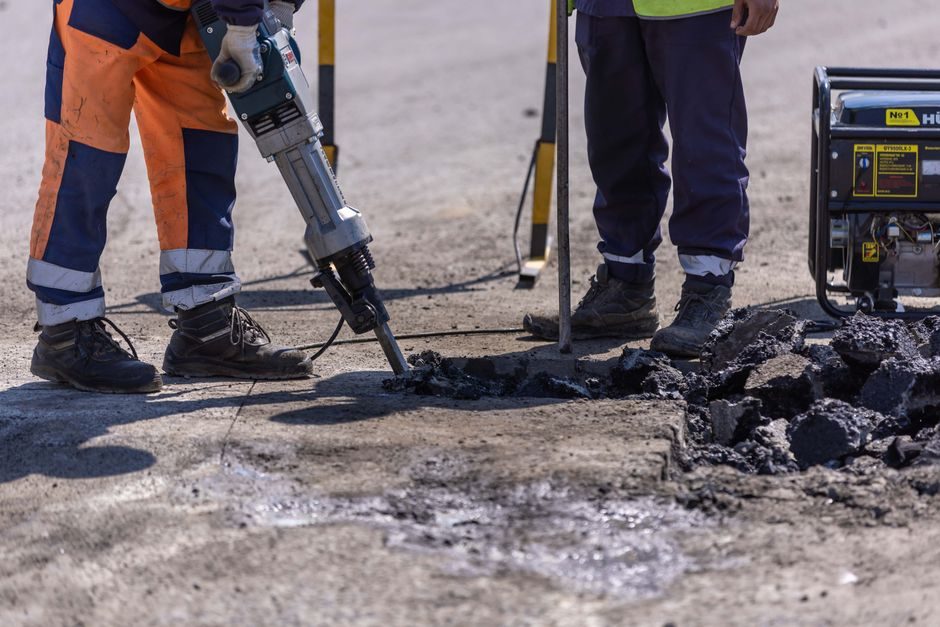
Pneumatic-percussion air picks are hand-held reciprocating tools driven by an internal piston struck repeatedly by a compressed-air motor, used to chip concrete, break foundry sand, scale boilers, and dress stone. Unlike the converging/diverging excavation class, the cutting action here is mechanical: a chisel or moil point delivers repeated impacts, while the air supply only powers the reciprocating mechanism. This is the family that most non-specialist readers picture when they hear "air pick," and it is also the family covered by the air pick encyclopedia page on SourceBySpec. [S2]
Spec differentiation inside this class is by piston bore and stroke, blows per minute (bpm), and weight, not by air volume alone. A small 1/2 in-bore demo pick may run 3000+ bpm at 90 cfm (2550 L/min) and weigh 5-7 lb (2.3-3.2 kg); a heavy 1-1/8 in-bore foundry pick may run under 1500 bpm at 50-60 cfm (1420-1700 L/min) and weigh 25-35 lb (11-16 kg) for one-handed horizontal work. Selection is governed by ISO 11148 part 4 (hand-held non-electric power tools — safety, percussion tools) and by OSHA 29 CFR 1910.243 for guarding and air-hose whip restraint, both of which apply regardless of brand.
Selection Criteria: Matching Air Pick Type to Job

Five criteria separate the usable tool from a frustrating purchase: (1) target material — porous soil, frozen ground, concrete, or slag; (2) compressor capacity in real cfm at 100 psi (6.9 bar), not nameplate; (3) cutting action — supersonic jet vs reciprocating piston; (4) distance from non-target assets (live utility, gas line, operator's hand); and (5) operator posture, which dictates whether a 45°-bent extension tube is needed [S2].
A direct comparison of the three MBW Soil Pick variants illustrates how a single spec axis (air volume) maps to duty cycle:
• SP80 — 80 cfm (2265 L/min), 100 psi (6.9 bar) inlet, 4 in (10 cm) effective cutting depth; sized for the smallest portable compressor class and crack-cleaning work [S2].<br/>• SP125 — 125 cfm (3540 L/min), 100 psi (6.9 bar) inlet, 4 in (10 cm) effective cutting depth; the default for utility daylighting and is the size most rental yards stock [S2].<br/>• SP160 — 160 cfm (4531 L/min), 100 psi (6.9 bar) inlet, 4 in (10 cm) effective cutting depth; chosen for dense clay, compacted backfill, and high-production trenching [S2].
All three hold weight, length, barrel diameter, airstream velocity and cutting depth constant; air volume is the only variable MBW exposes at the spec-sheet level, which tells the spec engineer the rest of the design envelope is fixed and the cfm class is the buying decision [S2]. For pneumatic-percussion picks, the same five-criteria matrix applies but the air-volume axis is replaced by bpm × stroke-energy at a fixed inlet pressure.
Who an Air Pick Is For — and Who It Is Not For
A pneumatic-excavation air pick is the right tool for utility-locating crews, gas-leak responders, and municipal water-department operators who must expose a buried pipe or cable without cutting it, and for arborists and landscapers who must move soil around tree roots [S2]. It is the wrong tool for cutting rock, removing concrete at production rate, or excavating more than a few cubic feet per shift — those jobs belong to a hydraulic breaker, a vacuum excavator with a larger spoils tank, or a backhoe.
A pneumatic-percussion air pick is the right tool for foundry shakeout, boiler-scale removal, concrete chipping, and road-repair patch work where a 5-15 lb (2.3-6.8 kg) hand tool is faster than rigging a breaker. It is the wrong tool for production concrete demolition, where a 30-90 lb (14-41 kg) breaker on a mini-excavator moves ten times the material per shift. Inside the broader material-handling environment, the Forklift Types and Classifications: Spec-Driven Selection Map is the right parallel reference for the warehouse-equipment decision tree; the Pneumatic Nail Gun Installation: Compressor Sizing, Air-Line Setup and Duty-Cycle Match is the right parallel reference for matching cfm to duty cycle on a 100 psi (6.9 bar) shop-air supply.
Operating Limits, Failure Modes, and Standards

The MBW Soil Pick is rated to a 4 in (10 cm) effective cutting depth, dependent on soil type — that value is the manufacturer's own envelope, not a generic industry number [S2]. Pressure at the tool inlet is specified at 100 psi (6.9 bar), and a handle-mounted pressure gauge tells the operator whether the compressor is keeping up [S2]. Below the rated pressure, the jet never reaches the 1475 mph (2375 km/h) supersonic regime the tool is designed for and excavation rate collapses; above it, hose-burst risk and nozzle-erosion rate rise sharply.
The three documented failure modes are (a) nozzle detachment (a brass nozzle becomes a high-velocity projectile if it leaves the barrel — MBW threads and cements the nozzle in place rather than offering a quick-change version), (b) over-extension of the cutting edge past 4 in (10 cm), which increases both personal-injury risk and over-aeration of backfill beyond the target utility, and (c) loss of inlet pressure from an undersized compressor, which masks itself as a "dull" tool [S2]. For pneumatic-percussion picks, the dominant failure modes are air-hose whip on coupling failure, hand-arm vibration syndrome (HAVS) on extended use without anti-vibration gloves, and silicosis exposure when chipping concrete without local exhaust ventilation — all addressed under ISO 11148-4 and OSHA 29 CFR 1910.243.
Compressor Sizing and Air-Line Setup
Compressor sizing for an air pick is governed by real cfm at 100 psi (6.9 bar), not by the nameplate "peak" or "free air" cfm a rental yard quotes. An SP80 at 80 cfm (2265 L/min) needs a compressor that can sustain at least 80 cfm at 100 psi (6.9 bar) continuously, which in practice means a 185-250 cfm diesel portable or a 7.5-10 kW electric rotary screw; an SP160 at 160 cfm (4531 L/min) needs a 375-450 cfm diesel to avoid the pressure-drop and duty-cycle derating that comes with a marginal supply [S2].
Air-line setup uses 3/4 in ID hose as standard (the Soil Pick's supply-side spec), with quick-connect or optional 3/4 in Dual Lock fittings [S2]. Hose length should be held to the minimum the site allows: every 50 ft (15 m) of 3/4 in hose drops roughly 3-5 psi (0.2-0.35 bar) at 160 cfm, which is enough to push an SP160 below its rated inlet pressure and cost the operator an entire day of productivity. A 10% pressure margin between compressor discharge and tool inlet is the rule of thumb most rental-fleet operators use, and it lines up with the 100 psi (6.9 bar) tool-inlet rating MBW publishes [S2]. The same compressor-sizing logic that drives air-pick selection also drives Air Impact Wrench TCO: Five Cost Lines That Decide 10-Year Fleet Spend for fleet tooling decisions, and the same cfm-at-100-psi (6.9 bar) discipline that drives pneumatic nail-gun selection drives pneumatic-percussion pick selection on a 100 psi (6.9 bar) shop-air supply.
Sourcing, Standards, and a Verifiable Next Check

Public spec data on the pneumatic-excavation class is dominated by MBW's Soil Pick brochure (2024-03-22, model codes SP80 / SP125 / SP160), which is the cleanest working reference for the converging/diverging-nozzle family [S2]. Public spec data on the pneumatic-percussion class is fragmented across OEM catalogues and falls under ISO 11148-4 safety and OSHA 29 CFR 1910.243 guarding, neither of which carries a publicly published revision date in the materials reviewed for this article. Two trackable signals for the next spec revision: (1) MBW's nozzle-options note — interior nozzle profile changes cfm, airstream velocity and cutting edge, and the next public brochure revision will publish the SP80/SP125/SP160 numbers against specific soil classes rather than the current "dependent on soil type" asterisk [S2]; (2) the next OSHA 29 CFR 1910.243 amendment cycle will be the verifiable point to confirm whether the hand-arm-vibration exposure limit is restated against the newer ISO 5349-1 threshold values.
Spec-level background on the components involved: air quality monitor.