
An air pick sized to a 10-30 kg class with 25-35 bpm strike rate, fed by a 0.6-1.2 m³/min portable compressor, covers most chipping, scarifying, and light demolition work on cured concrete and air-entrained slabs on residential and light commercial sites [S1][S2].
Selection in practice is driven by three concrete-side variables: entrained-air content (4-7% of mix volume for exterior flatwork), aggregate hardness and rebar presence, and dust-control duty on respirable crystalline silica below 0.3 microns [S1][S2][S5]. Each variable pushes tool class, blow rate, and downstream extractor sizing in a specific direction.
Concrete Substrate: What the Tool Is Hitting
Air-entrained concrete contains billions of microscopic air cells per cubic foot, with target entrained air typically 4-7% of the mix volume, varied with aggregate size and exposure condition [S1][S2]. Those cells act as pressure-relief pockets when pore water freezes, but they also make the matrix easier to chip and more prone to surface scaling when an air pick is over-rated for the job.
Common exterior applications (driveways, sidewalks, patios, steps, exposed slabs) are where air-entrained mixes get specified, and they are also where air picks get used for demolition, scabbling, and texturing [S2]. Interior slabs, garage floors, basement floors, footers, and any surface scheduled for steel-trowel or polishing are typically non-air mixes, denser, and respond to lighter chipping duty [S2].
A compliant field test reads entrained air against the 4-7% target; a good meter lands within plus/minus 1% of target in roughly 10-15 minutes, and any result outside that band flags the mix design (not the tool) before chipping starts [S3].
Tool Class and Air Consumption Map
For chipping and small demolition on cured concrete, air picks in the 10-30 kg weight class paired with 25-35 bpm (blows per minute) are the default specification on US rental and contractor-supply lists [S4]. Smaller picks (under 10 kg) suit plaster and mortar removal; heavier breakers (above 30 kg) belong to pavement and foundation demolition, not finish-prep work.
Air supply scales with class: a mid-size pick typically wants 0.6-1.2 m³/min at 6-7 bar working pressure. A 0.6 m³/min portable compressor covers one light pick; a 1.2 m³/min unit supports a pick plus a dust extractor running in parallel [S5]. When two picks run off one machine, the compressor has to be sized for the combined demand plus a 30-50% margin for filter loading on the dust side [S5].
Material factor matters as much as weight class. Sand, aggregate size, rock type, and the presence of rebar or reinforced steel change pick point geometry and stroke energy: harder aggregate and rebar call for a heavier class or a moil/point with a wider shank, while a clay-tile or lightweight substrate can be serviced by a narrower chisel and lower bpm setting [S4].
Dust Control and Filter Sizing for Pick Operations

Concrete dust from grinding, demolition, or cutting carries respirable crystalline silica (RCS) particles smaller than 0.3 microns, plus larger abrasive quartz fragments that wear filter media like sandpaper [S5]. Capture therefore takes a two-stage approach: a coarse pre-filter for the bulk fraction and a fine filter (Teflon-coated polyester or equivalent non-moisture-absorbing media) for the submicron fraction that drives silicosis risk [S5].
Air pick duty is intermittent compared with grinding, so peak dust load arrives in short bursts. Spec the extractor at a nominal capacity 30-50% above clean-filter airflow and select a fan with a steep pressure curve so airflow holds up as the cake builds on the cartridge [S5]. Cyclone pre-separation ahead of the cartridge extends filter life on aggregate-heavy work; a stainless or corrosion-resistant coated casing plus a moisture drain handles the calcium-oxide-to-alkali reaction when airborne concrete dust contacts any water in the airstream [S5].
For interior concrete-prep work where a laser level is also being used to set grade, dust load on the extractor tends to spike during the chipping pass before screeding, so the dust unit must be on a separate air feed from the pick when the compressor cannot cover both [S5].
Mix-Driven Tool Choice: Air-Entrained vs Non-Air Concrete
Air-entrained concrete (4-7% entrained air) is the right substrate for exterior flatwork exposed to freeze-thaw, and it is softer under a chisel point than a non-air mix of the same strength class, so a mid-weight 10-30 kg pick with 25-35 bpm covers most exterior scabbling and surface-prep tasks without over-penetration [S1][S2].
Non-air concrete, used for interior slabs, garage floors, basement floors, footers, and any surface scheduled for steel-trowel or polished finish, is denser and demands more point energy per square meter; in practice that pushes the spec toward the upper end of the 10-30 kg class or a heavier breaker, with a narrower chisel to control spalling into the finished surface [S2].
Strength is not the deciding factor: both air-entrained and non-air mixes can be ordered to meet 3,000-4,000 PSI at 28 days, with the batch plant adjusting the mix design to hold strength after the air is added [S2]. The tool-side decision tracks density and finish, not the PSI number on the batch ticket.
Selection Criteria Compared
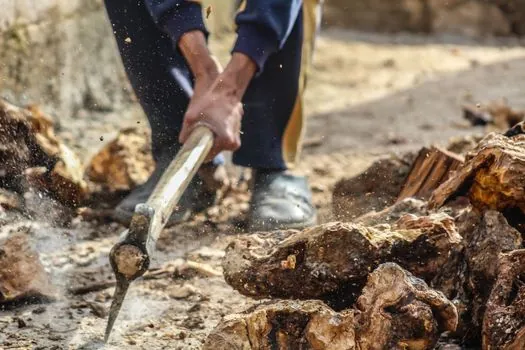
Four criteria separate the practical pick choices on a concrete site. Tool class is the dominant lever: a 10-15 kg pick handles plaster, mortar, and thin surface texturing; a 15-25 kg pick is the workhorse for chipping 100-200 mm of cured concrete and light rebar; a 25-30 kg pick pushes into slab reduction and beam haunch removal; anything above 30 kg is pavement-class. [S1]
Air use and strike rate track class: 0.4-0.6 m³/min suits under-15 kg picks at 20-30 bpm; 0.6-0.9 m³/min covers 15-25 kg picks at 25-35 bpm; 0.9-1.2 m³/min is the band for 25-30 kg picks at 30-40 bpm. Dust extractor pairing sets the third variable: high-volume two-stage units with pleated cartridges handle pick-plus-grind duty, while smaller single-stage units are only acceptable for short-duration, low-dust chipping [S5]. Substrate fit is the fourth: air-entrained exterior slabs sit in the mid class with a wide chisel, while non-air interior slabs scheduled for a concrete groove cutter or polish stay in the upper class with a narrow point to control breakout at joint lines [S2][S4].
Limitations, Failure Modes, and What an Air Pick Will Not Do
An air pick is not a cutter. Joint work, control joints, and decorative scoring belong to a purpose-built grooving tool, not a chipping hammer; using a pick at joint lines causes random cracking and raveling at the cut edge, which then has to be repaired before the joint saw goes in [S4].
Air picks also stall on heavy rebar mat. Where the rebar fraction dominates, switching to a hydraulic or electric breaker with a bushing tool is faster and cheaper per meter; the air pick is for matrix removal, not bar cutting. On steel-troweled or polished finishes scheduled for later work, the pick should be replaced by a grinder or scabbler to keep the surface plane, since the chisel point leaves a chip pattern that no amount of troweling will hide [S2].
Compressor undersizing is the most common field failure. Running a 25 kg pick off a 0.4 m³/min compressor starves the tool, drops bpm, and overheats the inline lubricator; the symptom looks like a worn tool but the cause is on the air side. A drain on the receiver, an inline lubricator set to the tool maker's drip rate, and a compressor matched to the upper end of the pick's stated air range are the three field fixes.
Sourcing, Standards, and Field Signals
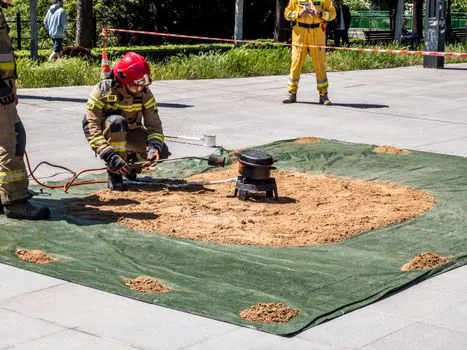
Concrete-side references for mix design and entrained-air testing are the American Cement Association working-with-concrete guide and ASTM C231 / C173 air-content test methods, the latter being what the 4-7% target on a batch ticket is measured against [S1][S3]. Silica-dust exposure on the tool side sits under OSHA 1926.1153 in the US, which is why two-stage extraction with a 30-50% capacity margin is the default site specification rather than a nice-to-have [S5].
Trackable signals for the next 3-6 months: rental fleet mix shifting toward 15-25 kg mid-class picks as concrete cutting and dust-control specs tighten, and more spec sheets calling out 0.3 micron filtration explicitly on pick-and-grind jobs. For interior finish-prep crews running a pick alongside a laser level for grade, watch for paired compressor-and-extractor sizing in the same equipment submittal, which is the cleanest indicator that the dust side is no longer an afterthought on concrete chipping work.
The underlying component specifications are covered under aerial work platform, and aerial work truck.