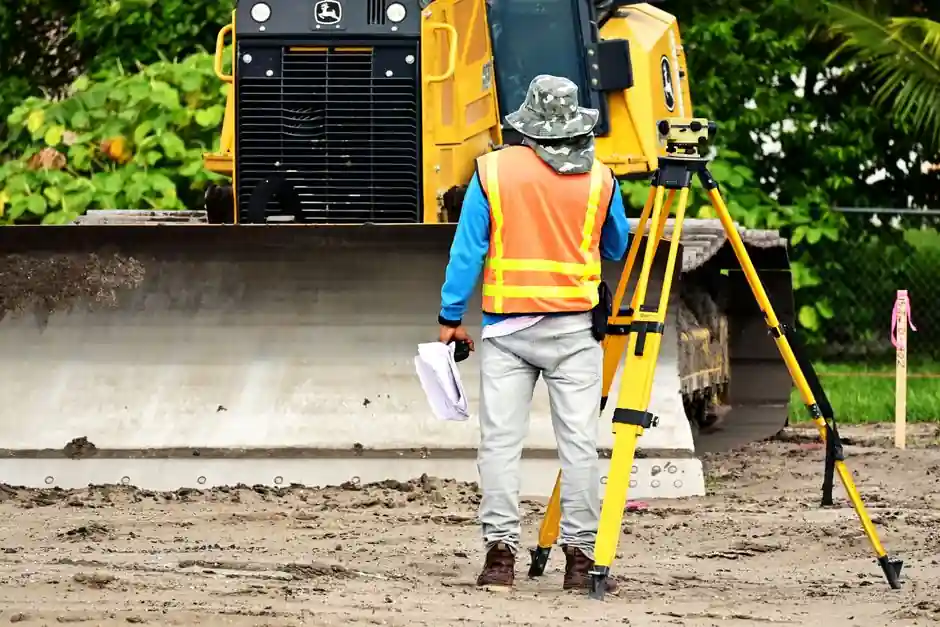
Steel-construction theodolite selection for plumbing work converges on a tight spec envelope: 2" to 10" angular accuracy, 30x erect-image optics, IP54 ingress protection, and an optical plummet capable of focusing inside 1.3 m, the same envelope that wraps the Spectra Precision DET-2 and the Nikon NE-100/NE-101 [S2].
Plumbing in the construction sense, meaning the vertical alignment of columns, anchor-bolt templates, base plates, and riser pipework, is a short-range, verticality-critical job; the Nikon NE-100/NE-101 datasheet explicitly lists concrete form alignment, anchor-bolt positioning, and steel column erection as target use cases, and the instrument class also traces back to optical plumbing devices built into the vertical axis of historical universal theodolites such as the Wild T1 [S2][S3]. For site engineers building a spec, the decision is less about brand and more about four numbers: angular accuracy, magnification and image orientation, IP rating, and optical-plummet near focus.
Accuracy tier that matches plumbing work
The Nikon NE-100 delivers 10" (3 mgon) accuracy to DIN 18723, and the NE-101 tightens that to 7" (2 mgon) using the same 79 mm circle diameter and a photoelectric incremental encoder reading system [S2]. The Spectra Precision DET-2 pushes further to 2" angular accuracy with 1" or 5" selectable minimum reading, suited to layout where a missed angle compounds across a welded frame or a welded pipe spool [S2].
For column plumb, base-plate leveling, and anchor-bolt template setting, 7" to 10" instruments are the workhorse tier and command lower capital cost; a 2" digital theodolite earns its keep on high-rise steel cores, pre-fab module alignment, and QA checks against tight fabrication tolerances [S2]. Minimum digital reading on the NE-100 is 10/20", 2/5 mgon, 0.05/0.1 mil, and on the NE-101 it steps to 5/10", 1/2 mgon, 0.02/0.05 mil, so crews can dial display resolution to the connection tolerance budget rather than over-spec'ing the read-out [S2]. The trade is not subtle: roughly a 5x accuracy step from NE-100 to DET-2, and a price step that follows, with the right pick driven by the tolerance written into the connection detail, not by marketing. The relevant comparison is concrete: a 12 m column that drifts 10 mm at the top is 0.048 degrees off vertical, or 170", so a 10" theodolite is comfortably adequate, while a pre-fab module with a 3 mm top-of-module tolerance at 8 m height (0.021 degrees, or 77") pushes the spec into the 2" instrument class.
Optics, magnification, and the erect-image question
Both the DET-2 and the NE-100/NE-101 ship 30x magnification with a 45 mm objective aperture, erect image, and a stadia ratio of 100 with additive constant 0 for distance estimation from a single sighting [S2]. The DET-2 focuses from 1.35 m to infinity with a 1 degree 30 minute field of view, and its optical plummet is 3x erect with 0.5 m to infinity focusing [S2]. The NE-100/NE-101 minimum focus is 0.7 m and the optical plummet is 2.2x with a 1.3 m fixed-focus range, a tighter near-focus that suits shop-floor layout where the instrument sits almost on top of the anchor-bolt template [S2].
For plumbing crews, erect image is not a luxury. Inverted optics force the operator to mentally flip the crosshair, which slows down when plumbing a 12 m column to a base-plate template, and both product lines deliver erect image as standard and back the reticle with illumination for low-light indoor erection or dawn-shift work on outdoor decks [S2]. Field of view on the Nikon pair is 1 degree 20 minutes (2.3 m at 100 m), a useful target-acquisition figure when sighting across a bay to the far column line [S2]. The optical-plummet discipline matters just as much: a laser plummet is faster in bright sun, but an optical plummet has no battery fade and no laser-class eye-safety paperwork, which is why universal theodolites have carried built-in optical plumbing devices in the vertical axis since at least the Wild T1 generation [S3]. For pipework risers in mechanical rooms, where the instrument is set on a floor above the target and sighting distances can drop below 2 m, the 0.7 m near-focus of the NE-100/NE-101 is the practical advantage over the 1.35 m near-focus of the DET-2.
IP rating, temperature, and power budget for site conditions
IP54 is the common floor for steel-construction theodolites: dust-protected and resistant to water splashes from any direction, matching the typical yard environment of rebar, crane wash-down, and intermittent rain [S2]. Operating temperature spans -20 to +50 degrees Celsius (-4 to +122 degrees Fahrenheit) on both the DET-2 and the NE-100/NE-101, covering hot-rolled steel assembly in summer sun and cold-weather erection alike [S2].
Power is a meaningful differentiator. The Nikon NE-100/NE-101 runs on six 1.5 V AA cells for 48 hours of continuous operation at 20 degrees Celsius, a field-friendly spec because site teams can source alkalines locally [S2]. The Spectra DET-2 ships with a NiMH rechargeable pack and charger plus an alkaline pack, at the cost of a longer recharge cycle but with the option to run on disposables when a charging point is not on site [S2]. Instrument mass clusters around 4.5 kg (9.8 to 9.9 lb) for the class, light enough for one-person setup on a tripod but heavy enough to stay stable in a crosswind on a deck [S2]. For plumbing work specifically, the IP54 floor is non-negotiable: a base plate sitting in a wet grout bed is a constant splash source, and an instrument rated only IPx4 or lower fails the moment grout water hits the circle housing.
Comparison: NE-100 vs NE-101 vs DET-2 for plumbing work
The three reference instruments line up against the four plumbing-critical criteria as follows. Angular accuracy: NE-100 at 10" (3 mgon), NE-101 at 7" (2 mgon), DET-2 at 2" [S2]. Minimum reading: NE-100 at 10/20", NE-101 at 5/10", DET-2 at 1"/5" selectable [S2]. Optical-plummet near focus: NE-100/NE-101 at 1.3 m fixed focus (2.2x), DET-2 at 0.5 m to infinity (3x), which gives the DET-2 the edge on tight inside corners and pipe-riser shafts [S2]. Power: NE-100/NE-101 on six AA cells with roughly 48 h runtime, DET-2 on NiMH plus alkaline-pack fallback [S2]. Operating temperature: -20 to +50 degrees Celsius on all three [S2]. Mass: roughly 4.5 kg across the class [S2].
The decision rule is direct: specify the NE-100 when 10" accuracy is on the drawing and the job is anchor-bolt layout plus column plumb on a single-storey frame; step up to the NE-101 when the spec calls for 7" or the crew wants finer minimum-reading resolution; move to the DET-2 when the tolerance budget demands 2" angular accuracy, the optical plummet has to focus below 1 m inside a shaft, or the work is QA verification against a tight fabrication tolerance [S2]. What the DET-2 does not buy is weather-proofing or temperature range beyond what the NE-100/NE-101 already provides, since IP54 and -20 to +50 degrees Celsius are common to all three [S2].
Where theodolites fit, and where they don't
Theodolites remain the workhorse for vertical alignment tasks where the line of sight is clear and the target is a fixed prism, a plumb bob, or a column edge, and the optical-plummet design that has been built into the vertical axis since at least the Wild T1 confirms the instrument geometry is mature for plumbing work [S3]. They are not the right tool when the layout line is a long horizontal run with no line of sight, when the target is moving (a formwork slider), or when the crew is one surveyor deep and needs both horizontal and vertical angle plus distance from a single setup; in those cases, a total station pulls ahead because the EDM removes the tape-and-stadia step, a trade-off worth weighing against a dedicated theodolite on the bench. For interior pipework risers in tight shafts, an infrared line laser can complement or substitute for short-range vertical alignment, and a spec map for that tool class is worth cross-checking alongside any theodolite decision, as covered in detail for infrared line laser selection for plumbing installation. For interior finishing and trim layout where range and crew fit dominate the choice, a total station selection for interior finishing comparison frames the EDM-versus-theodolite trade-off more sharply.
Limitations, failure modes, and when to escalate
The three reference instruments are field tools, not laboratory instruments. The NE-100's 10" accuracy is the accuracy of a single angle observation, and a real plumbing job averages two faces and rejects outliers, so practical column-plumb error on a single 12 m column is on the order of 5 mm at the top in still conditions, larger in a crosswind or on a vibrating deck. The erect-image and 30x magnification of both product lines is a daylight-and-dusk spec, not a no-light spec; in a dark shaft, the operator needs the reticle illumination on, and even then the practical range drops below the 1.35 m DET-2 near-focus on black pipework [S2].
When plumbing work is in a tight mechanical room with line of sight shorter than 1.5 m, the optical plummet, not the telescope, is the limiting component, and an instrument with a 0.5 m optical-plummet near focus (DET-2) is the right pick over a 1.3 m fixed-focus plummet (NE-100/NE-101) [S2]. When the connection tolerance is below 3 mm at 8 m height, a 2" theodolite becomes mandatory, and a 7" to 10" instrument should be replaced, not re-used, because angle error compounds with sighting distance and the job will fail QA. The escalation path is direct: 2" digital theodolite, then motorised total station with auto-tracking, then robotic total station for one-person layout, with the EDM step adding roughly 1.5 to 3 kg and a battery pack but removing the tape-and-stadia workflow. In all three cases, the optical plummet built into the vertical axis remains the geometry anchor, the same arrangement validated on universal theodolites in the field for decades [S3].
Trackable signals for the next spec revision: confirm whether project specifications are moving from a 7" to a 5" floor for high-rise steel cores, since 2" instruments keep getting cheaper, and watch for the next IP66-rated construction theodolite launch, which would lift the current IP54 floor and remove the grout-splash failure mode. For related selection criteria in steel-core construction above the theodolite envelope, the climbing formwork selection for steel-core high-rise construction map covers the formwork-system side of the same column-plumb workflow.
Spec-level background on the components involved: pressure transmitter, and flow meter.