AISI D2 tool steel contains 1.40–1.60 wt% carbon and 11.00–13.00 wt% chromium, with 0.70–1.20% Mo, 1.10% V, 0.60% Mn, 0.60% Si, and trace Co, Ni, Cu, P, S, per the published composition table [S2].
The grade is officially designated UNS T30402 and classified as a high-carbon, high-chromium, air-hardening cold-work tool steel under the AISI/SAE D-series (D2, D3, D4, D5, D7), of which D2 is the most widely used [S2][S5].
Carbon Content Range and Why It Sits Above 1%
The AISI carbon-steel definition places plain carbon grades at 0.05 up to 2.1 wt% C; D2 sits at the upper end of that band at 1.40–1.60 wt% C, well above mild steel (0.05–0.30%) and clearly into high-carbon territory [S2][S4]. A common nominal figure cited by stockists is 1.50 wt% C, exactly the midpoint of the AISI window [S3].
That carbon level is what allows D2 to develop large volumes of hard chromium-rich carbides during tempering. During heat treatment, the high carbon and high alloy content drive precipitation of secondary M7C3 carbides, where M is mostly chromium because of the steel's 12% Cr base [S1]. Higher carbon directly raises attainable hardness and wear resistance, but it also reduces weldability and ductility, a trade-off that defines the entire high-carbon tool-steel family [S4].
Chromium Content: 11.00–13.00% and the Stainless Threshold
D2 specifies 11.00–13.00 wt% chromium, with 12.00% used as the typical nominal value in mill data sheets [S2][S3]. This places D2 far above plain carbon steel and into the alloy-steel category the moment Cr exceeds the trace limits set by the AISI carbon-steel definition [S4].
Despite the high Cr number, D2 is not a stainless steel. With 1.55% C in the matrix, chromium in solid solution maxes out near 9.3 wt% at typical austenitizing temperatures around 2050°F (1121°C); roughly 16.6% total Cr is required to keep the matrix passive at that temperature, and 17.5% is the threshold for 1900°F (1038°C) austenitizing, so the extra 2.7–6.7% Cr in D2 ends up tied up as M7C3 carbides rather than dissolved in the matrix [S6]. This is why D2 is described as offering "mild corrosion resistance" rather than true stainless behavior [S5].
Comparison: D2 vs A2 vs S7 Carbon and Chromium Levels

Three common air-hardening or shock-resisting tool steels illustrate how the Cr/C ratio shifts the application space. D2 carries 1.40–1.60% C and 11.00–13.00% Cr, A2 carries 0.95–1.05% C and 4.75–5.50% Cr, and S7 carries 0.45–0.55% C and 3.00–3.50% Cr [S5].
The key selection criteria line up as follows:
Wear resistance: D2 highest, A2 medium, S7 lowest. Toughness: S7 best, A2 intermediate, D2 lowest. Dimensional stability during heat treatment: D2 and A2 high, S7 also good. Hot-hardness retention: D2 best of the three, S7 rated "decent" [S5]. This trade-off is why D2 dominates blanking, forming, trimming, and thread-rolling dies where wear life matters more than fracture toughness, while S7 wins for shock-loaded tooling like concrete breakers and bull riveters [S5].
How Carbon and Chromium Translate to Hardness and Density
With 1.50% C and 12.00% Cr nominal composition, D2 reaches 62 HRC (748 HV, 769 HK) at room temperature after standard austenitizing at 1850–1875°F (1010–1024°C) and tempering in the 300–350°F (149–177°C) range for maximum wear resistance, or 500–550°F (260–288°C) for the optimal wear-toughness balance, yielding 58–60 HRC [S2][S3]. The carbon-chromium carbide network that produces this hardness also forces the density down slightly: 7695 kg/m³ (0.278 lb/in³, specific gravity 7.70) versus roughly 7850 kg/m³ for mild steel [S2][S3][S4].
Elastic modulus sits at 190–210 GPa (27,557–30,457 ksi) with a Poisson's ratio of 0.27–0.30, and thermal expansion is 10.4 × 10⁻⁶/°C over 20–100°C, all consistent with the heavily alloyed, carbide-rich microstructure [S2].
Why D2 Is Group D, Not a Stainless or High-Speed Steel
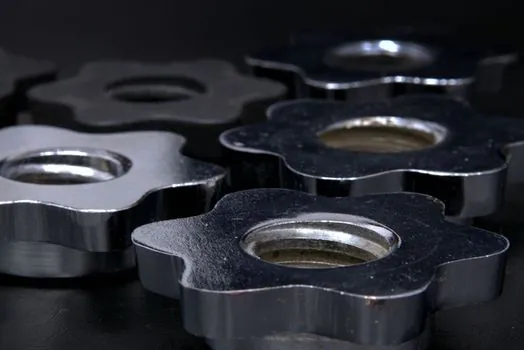
The D-series designation groups D2, D3, D4, D5, and D7 steels as "high-carbon, high-chromium cold-work tool steels" carrying 1.5–2.35% C and about 12% Cr as the family baseline [S2]. D3 is the exception, oil-quenched rather than air-hardened, and tends to be brittle during hardening, while D2, D4, D5, and D7 all include roughly 1% Mo for air-hardening response [S2].
Although D2 is sometimes sold under the "high-speed steel" label by service centers, the metallurgy is different: it lacks the tungsten or cobalt levels that define true M-series or T-series high-speed steels, and it cannot hold hardness at the red-hot cutting temperatures those grades are designed for. Its 54–61 HRC tempered range and 275–319 ksi compressive yield strength place it firmly in the cold-work category [S3][S5]. For a broader look at how material grade selection feeds into die life and downstream equipment choices, the process-engineering read on band-saw-blade selection for cutting non-ferrous risers touches similar selection logic, and the carbon-steel encyclopedia entry frames the plain-carbon baseline that D2 departs from.
Heat-Treatment Implications of the 1.5% C / 12% Cr Mix
Bright-hardening trials on AISI D2 (60% KOH / 40% NaOH alkaline salt bath) produced a tensile strength of 1764 MPa, impact toughness of 3.7 J, and hardness of 792 HV, versus 1608 MPa, 3.2 J, and 710 HV for conventional oil-quenched samples, a direct consequence of finer, more uniformly distributed carbides and lower retained austenite [S1].
Two practical heat-treat rules follow from the chemistry. First, austenitize at 1850–1875°F (1010–1024°C) and air or pressurized-gas quench to 125–150°F (51–66°C); sections up to 4 in. (101.6 mm) through-harden from 1575°F (857°C), and up to 6 in. (152.4 mm) from 1625°F (885°C) [S3]. Second, double or triple temper because the carbon-supersaturated fresh martensite plus retained austenite would otherwise leave the as-quenched structure brittle, with each temper cycle converting retained austenite to martensite while precipitating secondary M7C3 [S1]. For shop floor comparison, the adhesive selection reference for dissimilar-metal joints covers a related joining-side trade-off where carbon content drives weldability limits.
Where the 1.5% C / 12% Cr Spec Actually Matters in Production
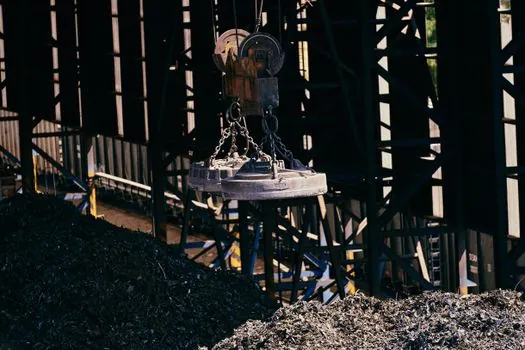
Typical D2 applications include rolls, punches, blanking and forming dies, trimming dies, thread-rolling dies, shear knives, food-processing knives, and gauges, all parts where the chromium-carbide network resists adhesive and abrasive wear from sliding contact [S3]. The compressive yield strength of 275–319 ksi and 54–61 HRC working hardness make D2 a default for cold-work tooling, but the same chemistry rules out applications requiring impact toughness above roughly 3.7 J (Charpy unnotched Izod 77.0 J per published data) or any service where true corrosion resistance is required [S1][S2][S5].
Two trackable signals confirm the spec is still active. AISI/SAE designation continues to list D2 under UNS T30402 in current tool-steel references, and the published 1.40–1.60% C / 11.00–13.00% Cr window is reproduced unchanged across manufacturer data sheets updated through 2025 [S2][S7].
Spec-level background on the components involved: carbon fiber, and checking and testing apparatus.