Automotive aluminum selection in 2026 is driven by three converging constraints: mass reduction targets, battery enclosure crashworthiness, and forming-line yield for 6xxx body sheet. The working palette for passenger vehicles and commercial trucks resolves to 5xxx (Al-Mg) and 6xxx (Al-Mg-Si) series for sheet and extrusion, with 2xxx and 7xxx held back for forgings and high-strength suspension links [S2][S3].
Within the 5xxx family, 5052, 5083, 5182, 5454, and 5754 cover semi-trailer panels, liquid tanks, and body-in-white (BIW) inner panels; the 6xxx family, especially 6016, 6014, 6061, and 6082 in T5/T6 tempers, handles extrusions, battery trays, and structural crossmembers. For high-temperature or fatigue-critical parts, 2xxx alloys (2014, 2024, 2618) and the 4032 Al-Si family remain specified for pistons, compressor scrolls, and brake rotors [S3].
Body Sheet and Closure Panels: 5xxx + 6xxx Bake-Hardenable Grades
5182, 5754, 6016, and 6014 are the four grades most often quoted for automotive body sheet, with 6016-T4 and 6014-T4 dominating hoods, doors, fenders, and roofs on European and Chinese EV programs [S2][S3]. Bake-hardenable 6xxx variants such as the UACJ designations SG712 and TM30 (roughly 6016-class) are formulated for high bake-hardenability and hemmability, the two properties that determine dent resistance after paint-cure [S3].
For inner panels and reinforcements where deep drawability matters more than final strength, 5182 and 5454 are the default picks; 5022 (UACJ GC45) is used where low coat-baking proof-stress reduction is needed to keep springback controlled. Van and light-truck bodies typically step down to 3003 and 3105 for non-structural skin panels, accepting lower strength for formability and cost [S2][S3].
Extrusions, Battery Trays, and Structural Crossmembers: 6061 / 6063 / 6082
6005, 6060, 6061, and 6063 in T5 and T6 tempers are the workhorse extrusion grades for automotive applications, with 6061-T6 carrying the bulk of chassis and battery-tray floor specification [S2]. For crash-management systems, 6061 and 6082 are preferred because T6 yields a typical UTS in the 310–340 MPa range, and the alloys are readily MIG-welded with 5xxx filler wire. The same T6 temper appears on most 6061-T6 sheet used for refrigerated-truck floors and forklift sidewalls [S2][S3].
For battery enclosures specifically, the selection logic in 2026 favours extruded 6061-T6 or 6082-T6 sills and crossmembers paired with 5083 or 5182 sheet covers, balancing extrudability of complex crash geometries against sheet formability for the top cover. Where higher strength is required, 7000-series forgings enter the spec for suspension links and subframe mounts, and 7075/7050 are the dominant forging alloys for knuckle and control-arm service [S2].
Commercial Vehicle, Tank, and Trailer Applications
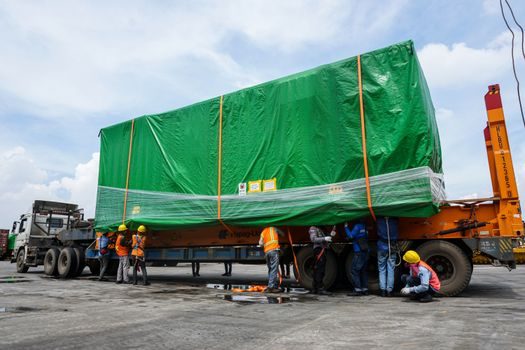
Heavy-truck and trailer selections diverge from passenger-car logic. 5052-H32 is the common semi-trailer floor and side panel grade; 5083, 5182, 5754, and 5454 are quoted for liquid tank and pressure-vessel service where weld integrity and corrosion resistance outweigh strength [S2]. 5A05 is held specifically for dump-truck bodies, where its higher magnesium content resists the abrasion of hot aggregate loading [S2].
Refrigerated-truck and reefer bodies are predominantly 5052 / 5083 / 5454 in H32 and 6061-T6, with 6061-T6 reserved for high-load floor rails. For van bodies, the spec is 3003 or 3105 in H14/H16, paired with 5xxx inner-frame extrusions. 5083 is the strongest non-heat-treatable alloy in this group and is the default choice for welded structural tank rings [S3].
Forgings, Pistons, and High-Temperature Components
Aluminum forgings in chassis and powertrain draw on 2014, 2024, 5754, 6061, 6082, 6063, and 7075, with 7075 and 7050 carrying the highest static strength in the forging family [S2]. 2014 and 2024 serve where high specific strength and elevated-temperature performance outweigh their lower corrosion resistance; 6082-T6 is the common European forging-grade alternative when weldability plus strength is needed [S2].
For pistons, compressor scrolls, and AT valve bodies the 4xxx Al-Si family dominates: 4032 is the long-standing piston alloy because of its low thermal expansion and high-temperature strength, and UACJ's SC100, SC300, TF06B, TF08, TF10B, and TF12B represent lead-free highly-machinable or hypereutectic upgrades used in power-steering housings, valve lifters, and compressor rotors [S3]. 2618 forgings supply compressor wheels and pistons where temperatures exceed the operating envelope of 4032 [S3].
Additive Manufacturing of Aluminum Automotive Prototypes
Selective Laser Melting (SLM) of AlSi10Mg is now a standard rapid-prototyping route for aluminum automotive brackets, fluid manifolds, and prototype housing features, with the alloy chosen for its combination of thermal conductivity, post-process machinability, and weight reduction [S1]. AlSi10Mg is the default SLM-grade casting analog and tolerates HIP and T6-like heat treatment to recover ductility lost during the rapid-solidification build cycle. SLM is specified for prototype and low-volume structural parts where conventional tooling lead time is the binding constraint; for serial automotive body sheet, conventional rolled coil remains dominant on cost and surface-quality grounds [S1].
For process engineers comparing forming routes, the relevant trade-off is sheet-metal formability of 5xxx/6xxx against the geometric freedom of SLM AlSi10Mg; the two routes are complementary rather than competing, with SLM covering topology-optimized brackets and 5182/6016 sheet covering closure panels. The same AlSi10Mg chemistry is also used for additive manufacturing material builds in industrial heat-exchanger prototyping, and the resulting parts can be welded to conventional 6xxx extrusions with appropriate filler selection.
Selection Criteria Compared: 5xxx vs 6xxx vs 2xxx vs 7xxx
Choosing among the four families comes down to four engineering criteria: formability, weldability, achievable strength after paint-bake or T6, and corrosion resistance. The 5xxx series (5052, 5182, 5754) delivers the best weldability and corrosion resistance but cannot be precipitation-hardened, so its strength is set by the H-strain temper. The 6xxx series (6016, 6061, 6082) provides the best balance of extrudability, weldability with 5xxx filler, and bake-hardenability for body panels, making it the dominant choice for structural extrusions and EV battery enclosures [S2][S3].
On strength-per-mass alone, 2xxx (2014, 2024) and 7xxx (7075, 7050) lead, with 7075-T6 forgings reaching the highest UTS in the automotive aluminum inventory; both families carry corrosion or stress-corrosion-cracking penalties that limit their use to forgings, suspension links, and brake components rather than body sheet. Cost-per-kg runs the opposite direction: 5xxx and the common 6xxx grades are widely stocked, while 7075 forgings carry a meaningful surcharge and longer forging lead time [S2][S3]. For body-side outer panels the working answer remains 6016/6014-T4, for chassis extrusions 6061-T6 or 6082-T6, for pistons 4032 or SC100, and for high-strength forgings 7075-T6 [S2][S3].
Sourcing and Standards Reference
Specifying automotive aluminum reliably requires three reference points: the AA/UACJ designation for alloy and temper, the ISO 9001 plus IATF 16949 quality system at the mill level, and the OEM-specific material standard on top. Major Chinese mills such as Haomei and Chalco publish IATF 16949 and ISO 9001 certification and supply the 3003/3105/5052/5083/5182/5754/5454/6061/5A05 plate-sheet range and 6005/6060/6061/6063 extrusion range directly to tier-one and OEM programs [S2][S3]. For high-temperature parts, the UACJ alloy table remains the most cited cross-reference between AA and JIS H4000 designations in 2026 sourcing specifications [S3].
Trackable signals to watch in the next sourcing cycle: any 2026 release updates to IATF 16949 audits covering 6xxx-T6 battery tray extrusions, and any extension of the 6016/6014 supply base to second-tier mills as EV battery enclosure volume scales. Engineers comparing alloy families against stainless and high-strength steel options for similar structural roles can cross-reference the stainless steel selection map for the corrosion-resistant baseline, and the shot sleeve selection map for high-pressure die-casting tooling that often pairs with 383.0 / A384 aluminum cylinder heads.
For the relevant spec sheets and selection criteria, see aluminum alloy, and aluminum ladder.