
Extruded aluminum profile selection is governed first by alloy-temper, then by dimensional tolerance, surface finish standard, and fabrication scope — not by price-per-kg. The 6000-series (Al-Mg-Si) dominates 95% of architectural and structural profile orders, with 6063-T5/T6, 6061-T6, and 6082-T6 covering nearly every industrial duty [S1][S3][S8].
Buyers specifying profiles for curtain walls, machinery frames, or heat sinks must lock the alloy designation, temper, surface-treatment standard, and slot-dimension standard at the RFQ stage, because post-quote swaps force re-tooling of the die and add 15-30 days lead time. Chinese extruders typically quote 500 kg MOQ with PE-film + PVC-shrink packing and 3,500 t/month capacity [S4].
Alloy-Temper Map: 6063 vs 6061 vs 6082 vs 6005
6063-T5 yields a tensile strength of at least 160 MPa with elongation ≥8% and is the default choice for architectural and decorative profiles — window, door, curtain wall, and furniture — because of its superior surface finish after anodizing [S3][S9]. 6061-T6 raises tensile to at least 265 MPa with elongation ≥8% and is specified for structural frames, machinery bases, and load-bearing T-slot assemblies where higher strength is required [S3][S8][S9].
6082-T6 is the European-preferred structural alloy with tensile ≥295 MPa, while 6005-T5/T6 sits between 6061 and 6063 for medium-duty applications. Common stock-alloy options quoted by Foshan and Anhui extruders include 6063, 6061, 6060, 6005, and 6081/6082, with temper T4, T5, T6, or special status per customer spec [S3][S8]. For deeper alloy fundamentals the aluminum alloy reference covers the Mg-Si precipitation-hardening mechanism behind these tempers.
Mechanical Thresholds for T-Slot and Structural Profiles
Published property tables for T-slot extrusion give specific decision thresholds: 6061-T4 reaches 180 MPa tensile / 110 MPa yield, 6061-T6 reaches 265 MPa tensile / 245 MPa yield, and 6063-T5/T6 typically lands near 160-205 MPa tensile with elongation ≥8% [S9]. Width is normally held below 300 mm with wall thickness above 0.8 mm for standard architectural sections [S8].
Standard T-slot section sizes of 20×20, 30×30, 40×40, 45×45, 50×50, 60×60, 80×80, and 100×100 mm cover the framing and 3D-printer/CNC gantry market, with off-the-shelf 2020/2040/2060/2080/20100 rails in 100-1000 mm lengths common on the DIY market [S2]. The 60×60 European-standard 6060 anodized profile is the most quoted architectural framing SKU in export channels [S1].
Surface-Treatment and Thermal-Break Standards
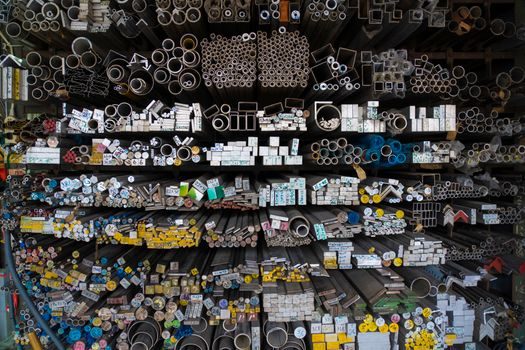
Architectural profiles under GB/T 5237 must pass anodic-oxidation, electrophoretic-coating, powder-coating, or fluorocarbon-spray surface treatment, with layer thickness controlled per the standard's table 3.2.2 [S3]. Single Ni-salt dyeing plus electrophoretic coating produces a porcelain-like texture and replaces older nickel-acetate processes on premium window and door lines [S7].
Insulated thermal-break profiles produced by strip process must use PA66GF25 (polyamide 66 + 25% glass fibre) and are explicitly forbidden to use PVC; pour-process thermal-break profiles must use PUR (polyurethane), with shear strength of the joint verified against design load [S3]. For finish-level behaviour, the aluminum veneer panel reference covers PVDF and wood-grain transfer-coating performance. Powder-coating lines and 12-metre anodizing baths are standard equipment at tier-one Chinese extruders, alongside 12 CNC machines, 5 melting lines, and 2 spectrum scanners for in-house QA [S3].
Certification, Capacity, and Supplier Vetting
ISO 9001 is the baseline quality-system requirement quoted by most export-oriented extruders, and full-process capability (melt, extrude, anodize, powder-coat, CNC, weld, assemble) in one factory cuts transit damage and tolerance stack-up [S3]. Tier-one suppliers run 7 extruders with two 6 m anodizing lines and one 12 m line, plus 5 melting furnaces, 10 argon-arc welding stations, and a metallurgical microscope for inclusion control [S3].
FOB-China pricing for finished anodized architectural profiles typically lands in the USD 2,800-3,800/t range for 6063-T5 with powder coat, while raw 6063-T5 mill-finish billet trades USD 2,200-2,600/t on bulk contracts [S4]. Per-piece pricing for short T-slot rails (100-550 mm) starts around USD 0.99-5.20 on retail channels, illustrating the unit-cost gap between DIY volumes and industrial MOQs [S2]. Profiles used in aluminum window & door assemblies must additionally comply with GB/T 8478 (doors) and GB/T 8479 (windows) [S3].
Application-to-Profile Shortlist Logic

For curtain-wall and window/door mullions specify 6063-T5 with GB/T 5237 anodizing or PVDF fluorocarbon spray; for 3D-printer/CNC gantries and modular framing specify 6061-T6 or 6082-T6 in 2020/2040/2060/2080/20100 T-slot, verified against the published tensile/yield table [S2][S9]. For LED heat sinks specify 6063-T5 with anodized or CNC-machined fin surfaces, since 6063's tighter as-extruded surface finish improves thermal-emissivity coatings [S1].
Skip 6063-T5 for any duty where sustained dynamic load or impact is expected, and skip 6061-T6 for visible architectural trim where surface cosmetics dominate — 6061 anodizes less uniformly than 6063. A practical sourcing map for downstream aluminum window and door buyers is outlined in Cast Aluminum Alloy vs Aluminum Window and Door: Spec-First Decision Map, and for processors weighing rolled stock the Aluminum Sheet vs Aluminum Window & Door: Spec Decision Map is the natural counterpart.
Final selection gate: confirm alloy + temper, GB/T 5237 surface spec, ISO 9001 certificate, dimensional tolerance class, and thermal-break material (PA66GF25 or PUR) on the PO. Track the next revision of GB/T 5237 and any new EU CE/EN-AW updates through the supplier's test-report batch numbers; mismatched lot certificates are the most common rejection cause at European ports.