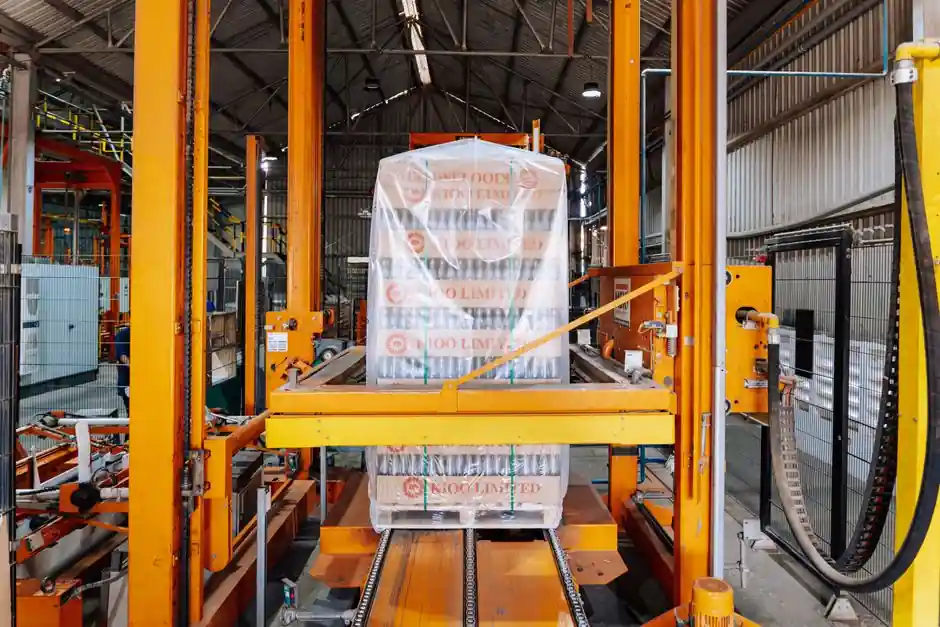
An aluminum high-pressure die casting (HPDC) cell is centered on a cold-chamber machine, whose clamp force typically falls between 250 and 1600 tons for most North American job shops, and 250 to 6000 tons across the global installed base [S4][S5].
The cell is more than the press. Production rate, alloy flexibility, and casting soundness all depend on the matching furnace, ladle, die-spray robot, trim press, and inspection stack, as illustrated by public equipment lists from US die casters [S3][S4].
Press and Clamp Force Selection
Clamp tonnage is set by projected casting area and required metal pressure, with 380-series aluminum alloys dominating production runs and the 1600-ton Buhler Carat representing the upper end of common US shop capacity [S4][S5]. Real shop rosters confirm 600-, 630-, 800-, 1200-, and 1600-ton work centers running side-by-side, each trimmed to a part-size sweet spot [S3].
Modern cold-chamber HPDC machines use four tie-bars; a 900-ton press therefore loads each bar with 225 tons at maximum lock, and strain gauges on every tie bar feed process-monitoring systems [S5]. This instrumentation is what makes real-time tie-bar tension curves a routine SPC variable in any serious HPDC cell.
For a practical primer on how the cold-chamber cycle differs from a hot-chamber or low-pressure setup, see the HPDC process walkthrough and the cold-chamber aluminum machine reference.
Melting and Metal Delivery
Molten aluminum is held in gas- or electric-fired crucible furnaces, with holding capacities from roughly 8,000 lb up to 27,000 lb and melt rates of 1,500-3,000 lb/hour in mid-sized shops [S3]. A typical breakdown furnace pairing on a US floor: one 27,000 lb unit at 3,000 lb/hour running 380 alloy, one 13,000 lb at 1,500 lb/hour, plus 11,000 lb and 8,000 lb back-up units [S3].
Each HPDC cell carries its own gas-fired portable furnace for standby melt, and a 2000 lb portable crucible furnace often services zinc-alloy or special-alloy runs, moving between machines as needed [S3]. Ladling is normally automated, with auto-ladle units on every 600-ton and up work center on a modern rosters [S3].
Alloy selection clusters on 360, 380, 390, and 413 for pressure-tight and dimensionally complex parts, and squeeze-pin plus vacuum-assist is added on top of the cold-chamber cycle when leak-free castings are required [S4]. More on the die-side of the process shows why the die cost alone drives minimum run sizes.
Die Spray, Extraction, and Trimming
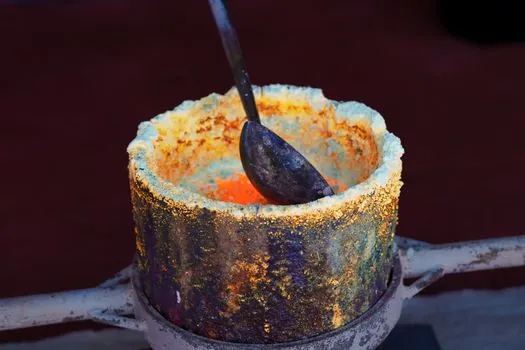
Die spray, ladle, and extraction are the three automations that define a modern cell, with ABB and Fanuc robots dominating extraction and Rimrock or integrated spray units handling lubrication [S3]. On a current 800-ton work center line, every machine runs auto-spray plus auto-ladle and either Fanuc or ABB extraction; the same pattern holds at 600-, 630-, and 1200-ton centers [S3].
Trimming downstream of the cell uses hydraulic trim presses, with one press typically co-located per cast cell, plus a pool of stand-alone trim and punch presses for off-line work [S3]. A 9-of-18 hydraulic press share is usually paired to live cells, the rest dedicated to standalone trim/punch of overflow castings.
For comparison against gravity and low-pressure cells, the gravity die casting machine overview and the low-pressure die casting reference are worth reading alongside this stack.
Heat Treatment, Blasting, and Finishing
Heat treatment uses batch tempering ovens with nitrogen atmosphere capability, an example being a Lindberg horizontal unit with 1,300 lb load capacity in an 18"H x 24"W x 36"D work zone [S3]. For higher-end specs, an Ipsen T2 horizontal bath carburize furnace with integral oil quench and automatic programmable atmosphere control runs 250 lb loads in a 12"H x 13"W x 22"L zone [S3].
Surface prep uses tumble blasters (Pangborn) and hanging blasters (Goff), backed by vibratory bowl tumblers, with 20 ft³ ceramic-media units in cylinder or triangle configurations handling deburr of trimmed castings [S3]. Three Despatch heat-treat ovens round out the temper/T6 capacity on a typical multi-cell floor [S3].
Inspection, Metallurgy, and CNC Machining
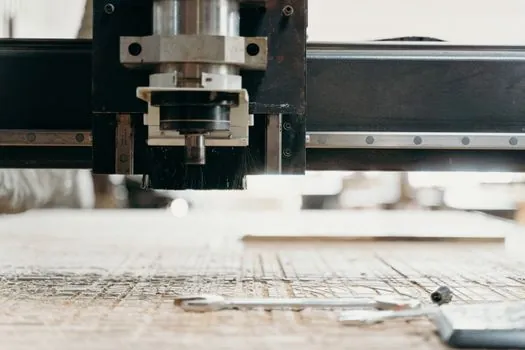
Inspection stacks combine CMMs (Numerex with Metrmec software, Zeiss with Calypso), a Spectro spectrometer for alloy chemistry, an optical comparator, and a microscope with camera image, plus real-time and computed radiography plus MAGMA simulation upstream of the cell [S3][S4]. CMM and NDT coverage is what lets an HPDC cell ship safety-relevant castings rather than only as-cast parts.
Machining is split between lathes (Miyano JNC 35, Haas ST-15Y, Doosan Puma 240GL with auto gantry loader), 40-taper horizontal machining centers (Doosan HP 4000, Mazak HC 5000, Mitsubishi H-H4B), and 40-taper verticals (Mori Seiki Dura 5080 with 4th axis, Okuma 3VA, Daewoo ACE-V35), with spindle rpms ranging 6,000-14,000 depending on taper and axis count [S3]. For secondary operations, a sand casting foundry line spec map shows the contrast in downstream equipment density versus an HPDC shop.
Cost Bands, Standards, and Process Trade-offs
Die cost is the dominant capital line: a transmission die is on the order of US$ 1,000,000 and an engine block die can hit roughly US$ 2,000,000, which sets the practical HPDC volume threshold at thousands of parts per year [S5]. Comparable squeeze casting of wrought 6061 aluminum trades die cost for slower cycle times and better mechanical properties, useful when a part is too critical for as-cast HPDC porosity.
Quality systems are typically registered to ISO 9001:2015, with Visi-Trak process monitoring, MAGMA flow / solidification simulation, and X-ray (real-time digital, CR, and conventional film) as standard shop capabilities [S4]. Compared with gas-fired crucible furnaces for cast iron melting, the same furnace hardware handles aluminum melt, but the burner trim and refractory choice shift because aluminum melt holds at 1,200-1,400 °F versus 2,300 °F+ for cast iron.
Trackable signals to watch next: Buhler SCD/66 commissioning on 800-ton work centers, continued ABB and Fanuc robot extraction standardization across 600-1200 ton cells, and wider roll-out of vacuum-assist plus squeeze-pin retrofits on legacy 600-800 ton presses for leak-tight automotive structural castings [S3][S4].