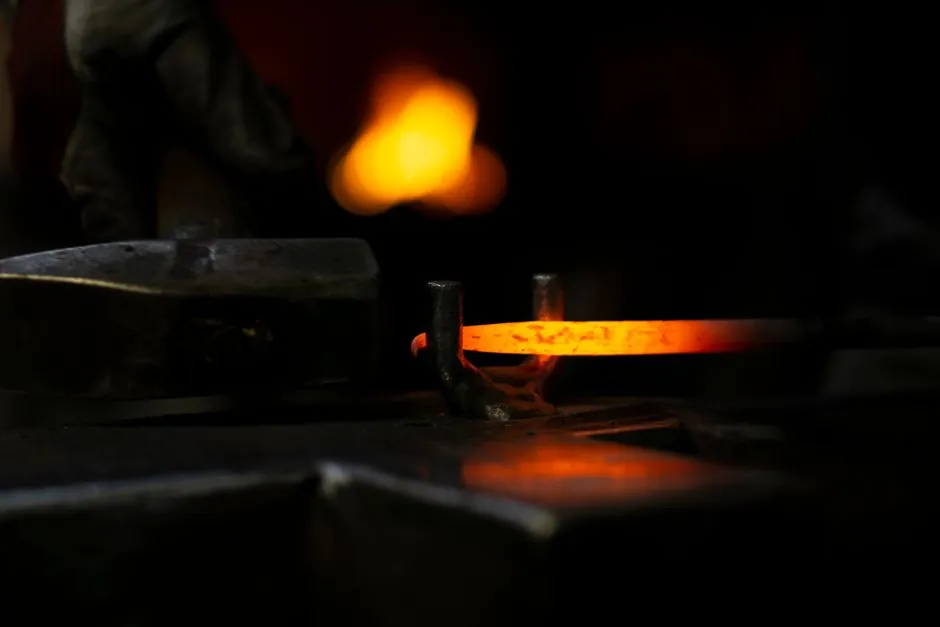
A gas-fired crucible furnace is technically capable of melting cast iron when its refractory lining, crucible grade, and burner input are sized for the 1200-1400°C duty window [S1]. Cast iron at roughly 4.3% carbon begins to melt at about 1147°C, with grey and ductile grades commonly poured between 1250°C and 1400°C depending on section size and inoculation practice [S2].
Most stock gas crucible units, however, are designed and marketed for non-ferrous charges: aluminium at 660°C, brass up to roughly 950°C, and bronze near 1000°C. A standard small-shop gas furnace rated for brass will not hold the steady-state heat needed for iron without a refractory upgrade and a higher-BTU burner [S4].
What Cast Iron Asks of the Furnace
Cast iron is a family of Fe-C-Si alloys with 2.5-4.5% C and 1-3% Si; the eutectic composition melts just above 1147°C, but foundries routinely superheat to 1300-1400°C before pouring to feed thin sections and maintain fluidity [S2]. The charge mass for a typical jobbing shop sits in the 5-50 kg range, which a gas crucible can technically swing, though the burner duty climbs sharply versus brass [S4].
Two process constraints dominate the spec. First, oxidation losses rise above 1300°C; a neutral-to-slightly-reducing flame is preferred, and a sealed lid helps. Second, sulphur pickup from combustion gases is a real problem for ductile iron, so gas-fired iron melting is normally paired with low-sulphur fuel and desulphurisation at the ladle. Castable refractories such as high-alumina or magnesia-based mixes rated above 1650°C are the practical floor for the lining [S1][S3].
Crucible Selection for Iron Duty
Crucible choice is the single most important sub-spec. Clay-graphite crucibles (the A-series Morgan pattern) handle grey iron in short campaigns but oxidise quickly above 1300°C if the burner aims directly at the wall. Silicon carbide crucibles tolerate higher steady-state temperatures and resist thermal shock better, at a higher unit cost [S1][S4].
Pure graphite crucibles survive iron temperatures but are reserved for special alloys because carbon saturation can alter the iron's carbon equivalent. For a gas-fired unit, the standard practice is an A30 or A40 clay-graphite crucible for grey iron batches under 30 kg, replaced every 30-50 heats; larger or more continuous iron work pushes users toward a gas aluminum melting furnace architecture with a high-alumina lining instead of the lighter castable rated for brass [S1][S4].
Burner Sizing and Thermal Budget
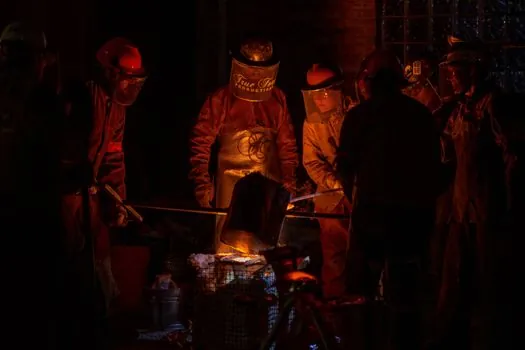
The thermal math is unforgiving. A 25 kg brass charge to 920°C rise with 8.9% furnace efficiency demands roughly 350,000 BTU/hr (about 103 kW) and consumes roughly 8 kg/hr of propane [S4].
In practice, a 250,000 BTU/hr burner that comfortably melts 12 kg/hr of brass will struggle to keep a 25 kg iron charge above 1350°C, and a 400,000-500,000 BTU/hr upgrade is the usual retrofit. Fuel-air ratio matters: a stoichiometric 24:1 air-to-propane mass ratio gives the hottest neutral flame, and a tangential burner port keeps the flame off the crucible wall to avoid the 20-30-heat failure mode described in field reports [S4].
Gas vs Induction vs Resistance for Iron
For ferrous melting, induction dominates because it stirs the bath, hits temperature faster, and is cleaner. Gas crucible units compete on capital cost (often 30-50% of an equivalent induction line), simplicity, and the ability to hold iron molten over a weekend on a small pilot burner, a documented practice for crucible inductor pours in foundry handbooks [S3].
For a 50-200 kg daily iron pour, a gas-fired crucible furnace is a defensible budget choice, provided the lining is upgraded and the burner is sized for iron, not brass. Above that throughput, scrap yield loss and labour costs erode the capital advantage versus induction, and most foundries migrate. The cast iron end-use case is also a deciding factor: art-iron and small-batch foundry work tolerates gas; high-volume automotive ductile iron does not [S1][S3][S4].
Common Failure Modes When Pushing Gas Units to Iron
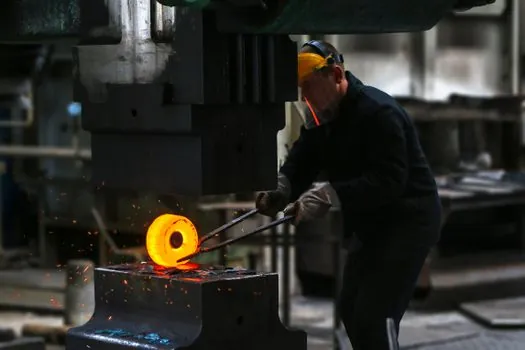
Three failure patterns repeat in the field. First, crucible cracking from thermal shock: a cold iron charge into a pre-heated crucible can shatter clay-graphite if the pre-heat is rushed. Second, refractory spalling from trapped moisture: a castable lining must cure 24 hours at room temperature, then ramp over 8 hours, or the water flashes to steam and blows chunks off the hot face [S4].
Third, fuel-side contamination: rich-burn conditions produce soot that insulates the crucible, while lean-burn introduces oxygen attack and hydrogen porosity in the iron, an outcome that downstream machining and pressure testing will catch [S4]. None of these are exotic problems; all are spec drift from the brass-melting baseline. For shops considering a retrofit, related casting-process choices such as brass squeeze casting output per hour for small valve bodies demonstrate how the same throughput-vs-capital trade-off plays out in adjacent non-ferrous lines.
Spec Checklist Before Committing a Gas Furnace to Iron
Verify four items before the first iron charge. (1) Refractory rating: castable or firebrick rated to at least 1650°C with 75-100 mm wall thickness, dry-cured per the schedule above. (2) Crucible: SiC or high-quality clay-graphite in the A30-A40 range for 25-40 kg iron batches. (3) Burner: tangential-firing, propane or natural gas, sized at 400,000-500,000 BTU/hr for a 25 kg iron charge, with a calibrated air-fuel ratio. (4) Atmosphere control: low-sulphur fuel and a tight-fitting lid to limit oxidation and sulphur pickup [S1][S3][S4].
Compare those numbers against the original brass-melting spec on the same unit. If the burner is below 300,000 BTU/hr and the lining is rated to 1400°C, the unit is not iron-capable without an upgrade, and the right move is to spec a melting furnace purpose-built for ferrous duty rather than overshoot a non-ferrous design. One standard to note in any retrofit spec is the fired-brick classification: confirm the hot-face fired brick grade carries a documented pyrometric-cone equivalent at or above the planned iron pouring temperature, typically cone 10 or higher.
Trackable signals for the next quarter: propane burner manufacturers releasing higher-BTU tangential units in the 400-500k range, and refractory vendors publishing iron-grade castable cure schedules for retrofit shops. Both would close the gap between hobby-grade brass equipment and light-production iron melting on gas.