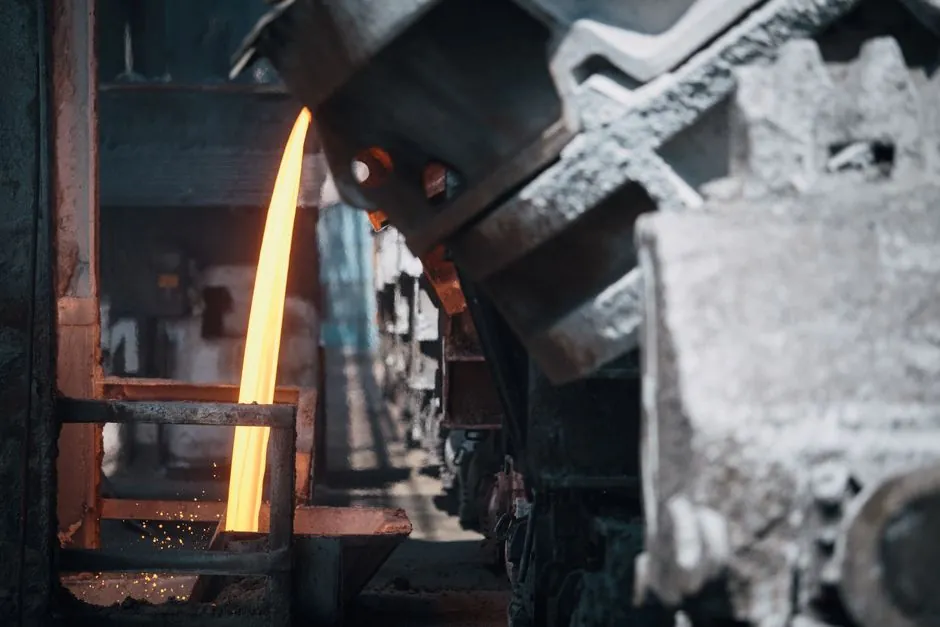
A full green sand or resin sand foundry line is a chain of linked stations, not a single machine: melt supply, sand mixing, mold forming, core making, pouring, cooling, shakeout, cleaning, heat treatment, and QA instrumentation, and each station has to be specified against throughput, flask size, and alloy class [S1][S2][S4].
The reference configuration used in this article is a documented iron foundry with 5 T/h and 3 T/h cupolas, 400 kW electrical holding furnaces, 28 molding lines ranging from 60 to 300 molds per hour, plus 19 shell core machines, two tunnel heat treatment furnaces, shot blast, spectrometer, CMM, and metallographic microscope [S2].
Melting and metal handling: cupolas, holding furnaces, pouring ladles
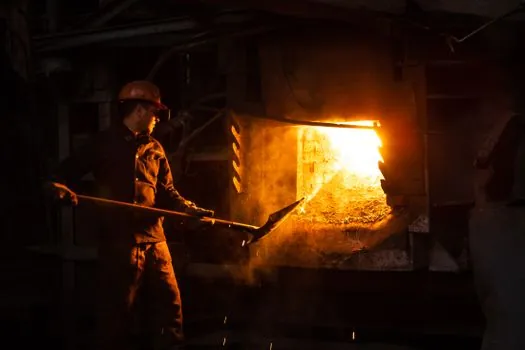
Melting capacity sets the tonnage ceiling for any sand casting line, and iron foundries typically pair a cupola with an electric holding furnace for temperature and composition trim [S2]. The reference line runs a 5 T/h Korea-built automatic cupola on hot blast at 1500 °C and a 3 T/h normal-hot-blast cupola, backed by a 400 kW, 3 T/h Korean electrical holding furnace for ladle-to-ladle composition and temperature equalisation [S2].
Foundry buyers comparing electric induction vs cupola for the same casting weight class should check power supply stability, refractory cost per ton, and the ability to swing between ductile iron (e.g. ASTM A536 60-40-18, 65-45-12) and gray iron (ASTM A48 No. 20 to No. 50) without long alloy changeover losses [S2]. Holding furnace kW rating scales with ladle size: 400 kW is typical for 3 T ladles, and a smaller 1 T unit commonly uses 150 to 200 kW.
Sand preparation and reclamation: mixers, return-sand cooling, dust collection
Sand preparation is the throughput bottleneck most often missed at the procurement stage, and it has to deliver consistent moisture, binder, temperature, and grain distribution before the molding station can run at rated speed [S1][S4]. The reference line uses three Japan/Korea-built sand mixing lines rated 1500 to 3500 kg per batch, with continuous return-sand cooling and dust extraction typically co-located [S2].
Sand system choice follows part size and surface finish. Green sand (clay-water binder) is reusable and dominates high-volume iron work, dry sand uses resin or sodium-silicate binders for higher strength and is often discarded or reclaimed once, and shell or resin-coated sand is used for cores and thin-wall iron castings [S1][S2]. Base sand selection is typically silica for general iron, chromite or zircon where high refractoriness is needed, and olivine for steel work where silica-metal reactions must be controlled [S1].
Molding lines: flaskless, automatic, and semi-automatic options
Molding is the single line item that most decides flask size, mold-per-hour, and labor headcount, and a sand casting line typically runs a mix of automatic, semi-automatic, and hand bench stations matched to part weight [S2][S4]. The reference line carries four molding technologies at once: 23 Korean PC semi-automatic lines at 300 molds/h with 300 × 380 × 100/100 mm flasks, two Japan-built RMB-2016 automatics at 120 molds/h with 410 × 510 × 150/150 mm flasks, one German KW368 automatic at 240 molds/h with 410 × 570 × 130/110 mm flasks, and two Chinese 148C lines at 60 molds/h with 800 × 600 × 250 mm flasks for larger castings [S2].
Modern flaskless molding platforms, e.g. the Sinto FBO type, drop the flask and let the mold itself ride on the conveyor, which is now a common build choice for new aluminum lines where tight flask handling was eating into cycle time [S1]. A typical aluminum spec guide rates capacity, melt handling, cooling, automation, and layout as the five decision buckets for a new line, not the machine brand [S4]. The foundry equipment encyclopedia entry gives a station-by-station map for laying these out side by side.
Core making: shell, cold-box, and automatic core sand mixing
Cores form the internal passages and shaped cavities that the pattern cannot draw, so core-making capacity has to be sized to the most complex part in the production mix, not the average [S1][S2]. The reference line runs a single 4 T/h Korean automatic core sand mixer feeding 19 Korean shell core machines with a 1.4 to 2.0 minute cycle per core, sized to support the 28 molding lines without queueing [S2].
Shell core machines suit small-to-medium iron cores with good dimensional repeatability; cold-box and hot-box lines add resin chemistry flexibility for water-soluble or larger section cores. A resin-bonded sand casting line is the typical build for foundries that need higher mold strength than green sand but still want to keep pattern cost low relative to shell molding. For buyers comparing methods, sand casting mold design and parting is the right starting reference because core placement, draft, and parting line drive which core machine is the right call.
Pouring, cooling, shakeout, and casting handling
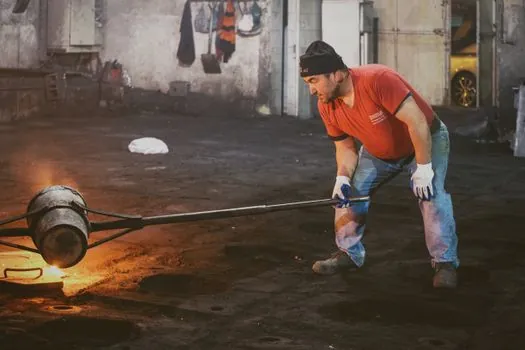
Pouring station sizing is tied to ladle capacity and cycle time, and a 3 T ladle on a 5 T/h cupola typically needs a pouring time window of 8 to 12 minutes per batch to keep the holding furnace from overflowing. The reference configuration does not list an automated pouring robot, which is common for jobbing iron shops; high-volume automotive and plumbing lines instead specify servo pouring ladles or robotic arms for repeatability [S4].
Shakeout separates the casting from the sand mold, and a 1 to 1.5 T shot blast unit in the reference line runs on a 20-minute cycle, which is a useful benchmark for sizing a new line [S2]. After shakeout, gates, risers, and feeder heads are cut off, usually by oxy-fuel, abrasive saw, or hydraulic press, and the casting moves to cleaning before heat treatment or final machining [S2]. Sand falls onto a return conveyor, gets cooled, dedusted, and re-fed to the mixer, which is the reclamation loop that keeps a green sand line economic over the long run [S4].
Heat treatment, surface treatment, and QA instrumentation
Heat treatment and QA are often treated as auxiliaries, but they determine whether a casting can ship against a given spec, and they belong in the same capacity model as melting and molding [S2][S4]. The reference line runs two Korean continuous tunnel-type heat treatment furnaces with a 26000 × 2240 × 1800 mm workspace, 1300 kg/h throughput, plus a five-station Korean shot blast line rated 1 to 1.5 T per 20 minutes for surface treatment [S2].
QA instrumentation is a non-negotiable for any line claiming certified output: a Swiss ARL3460 spectrometer for raw-material chemical analysis, a Brown & Sharp CMM for tooling and finished-part dimensional checks, and a Japanese metallographic microscope for microstructure prints are the three instruments the reference line calls out by name [S2]. For an iron foundry serving ductile iron grades such as ASTM A536 60-40-18 and 65-45-12, the spectrometer and metallograph are the two that catch grade-mix errors before they reach the customer.
Selection criteria: matching the equipment list to the part and the volume
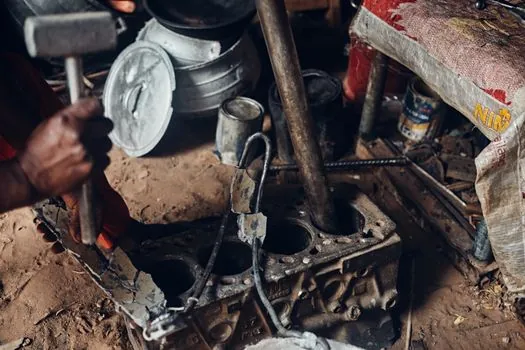
Foundries that pick stations in isolation, fastest molding here, cheapest cupola there, end up with a line that is balanced on paper and unbalanced on the floor, so procurement should anchor the list to four decision criteria: part weight and alloy, annual volume, dimensional tolerance, and automation level the team can sustain [S4]. A flexible jobbing shop handling many patterns needs more hand bench molding and a wider sand mix range; a high-volume line on a few patterns benefits from flaskless molding, automated pouring, and conveyorised shakeout [S1][S4].
The same logic applies to coring: a shell core line is the right call for small, repeatable cores under about 5 kg; a cold-box or hot-box line is needed once section size or draft angles go beyond shell's comfort zone. Buyers comparing alternate methods like lost foam casting line should treat the choice as a downstream question of pattern strategy, not a single machine spec [S4]. Aggregate and silica supply for the sand system is now a live risk for new greenfield builds, and aggregate and sand supply pressure is increasingly factored into long-term sand sourcing contracts.
Layout, utilities, and what to verify before signing a PO
Equipment datasheets quote peak capacity, not sustained capacity under real shift patterns, so the last pass before signing should be a layout review covering forklift paths, pattern storage, sand storage, inspection space, and maintenance access for each station [S4]. The reference line's flask sizes (300 × 380 mm up to 800 × 600 mm) span both small- and mid-volume patterns, and the pattern changeover cost between those two ranges is the single biggest driver of labor hours per shift [S2].
Buyers should also verify utility sizing: a 5 T/h cupola plus 400 kW holding furnace plus continuous heat treatment is a 1.5 to 2.0 MVA electrical load, plus significant compressed air for shot blast and dust collection, plus water for cooling the cupola shell and the sand system. Ask the supplier for a clear division between automatic functions, operator tasks, and manual recovery, including changeover time, pattern handling, and what happens when a downstream station pauses, since this turns a brochure capacity into a realistic production plan [S4].
Trackable signals over the next two quarters: how many new greenfield iron foundries in 2026 specify flaskless molding over conventional flask lines, and whether Chinese-made molding lines continue to displace European and Japanese lines in the 60 to 120 mold/h bracket for medium-volume work. Watch also the penetration of automated pouring and robotic shakeout in 200 to 400 mold/h mid-tier iron lines, where labor cost is now the binding constraint.