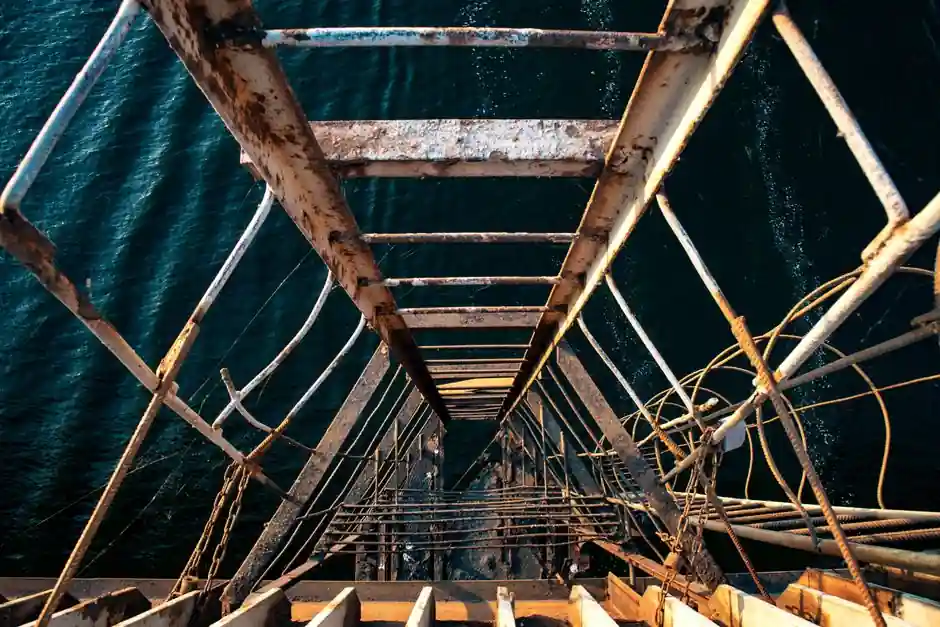
Bridge jobsite access splits into three aluminum equipment families: EN 131 single straight ladders (2-6 m, 390 mm wide, 6063-T5) for vertical pier climbs, crossover bridge ladders (CBL, 4-12 steps, 150 kg, 50-60 deg incline) for crossing conveyors, pipes and rebar mats, and aluminum ladder beams (0.45/0.75 m wide, 6082-T6, 2-8 m) for horizontal spanning of formwork and gantries [S2][S3][S4][S7].
Specifying engineers should match the family to the access geometry first, then to the alloy/rating, because the wrong family is the most common rejection mode on bridge piers, deck soffits, and launching gantries. The reference values below are pulled from manufacturer datasheets published 2025-12 through 2026-06, and they line up with EN 131, D.lgs 81/2008, AS/NZS 1576.3, EN 1004, and ISO 14122 fixed-access references cited in the same datasheets [S1][S6][S7].
Alloy and load rating: the two numbers that gate every spec
Aluminum crossover ladders for bridge sites are commonly rated to 150 kg working load on a 50 deg or 60 deg climb angle, with platforms up to 1800 x 800 mm and total heights up to 4065 mm on the 11-step configuration [S4]. The Cotterman standard crossover line ships with a 50 deg climb angle, 8 in (203 mm) step rise, 42 in handrails of 1-1/2 in round tube, 24-1/8 in wide x 7 in deep stair treads, and 4 in toe boards on the top platform [S6].
For straight climbing on pier rebar cages, EN 131 single straight ladders in 6063-T5 with 390 mm width, lengths 1-6 m, and a 150 kg max loading cover the common 2 m, 3 m, 4 m, 5 m, 6 m range [S2][S3]. The 6063-T5 grade is the volume pick for portable construction ladders because it extrudes cleanly and takes anodizing; 6082-T6 ladder beams are specified where the beam sees bending, not just climbing, because 6082-T6 has higher tensile strength under span loads from 2 m through 8 m [S7]. For more on why 6082-T6 dominates horizontal-span members, see the aluminum alloy reference page.
Incline angle and step geometry: where bridge ladders differ from straight ladders
Fixed bridge ladders on bridge construction sites are typically set at a 45 deg incline to satisfy D.lgs 81/2008 and ISO 14122 for fixed industrial access, with extruded aluminum non-slip steps and integrated handrails [S1]. Crossover ladders used to pass over conveyors, pipe racks, or rebar runs sit at a steeper 50-60 deg climb angle because the vertical drop being crossed is short, and the platform has to clear the obstacle plus a toe board [S4][S6].
The step interval on a typical 5-step CBL is 305 mm with a 200 mm step width, a 1500 x 800 mm checker plate platform, and a 1300 mm platform height giving a 2215 mm total height [S4]. The 11-step version extends the platform to 1800 x 800 mm and lifts the platform to 3150 mm with a 4065 mm total height, still on the same 305 mm step interval [S4]. Cotterman's standard crossover bridges use a 50 deg climb angle with 8 in (203 mm) rise, 42 in (1067 mm) handrails of 1-1/2 in (38 mm) round tube, and 5/8 in diameter floor mounting holes on each leg plate [S6]. Ladder Technology offers customization across AA6061, AA6063, AA6082, and AA6005 alloys with mill finish, anodized, powder coated, or wood grain surface options, with shipment Ex-works or FOB Port Klang [S4].
Standards map: which code governs which ladder
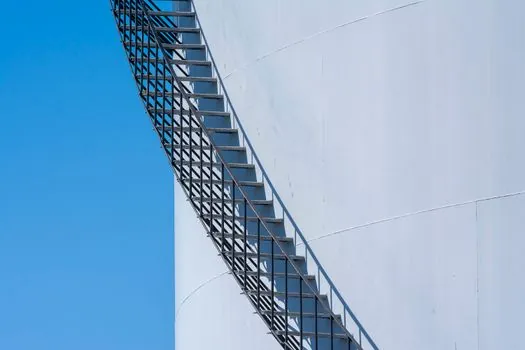
EN 131 is the European portable ladder standard, cited directly on EN 131 single straight ladder datasheets and covering duty rating, rung strength, and slip resistance for 1-6 m aluminum straight ladders [S2][S3]. ISO 14122-1 through 14122-4 is the international fixed-access standard for industrial machinery, and D.lgs 81/2008 (Italian Decree 81) is the Italian implementation of the EU Framework Directive 89/391/EEC, both cited on 45 deg fixed aluminum bridge ladders with extruded non-slip treads [S1].
AS/NZS 1576.3 (Australia/New Zealand scaffolding) and EN 1004 (European mobile access towers) both appear on aluminum ladder beam datasheets, alongside SGS and CE marking for the 48.3 x 4 mm tube size used in 0.45 m and 0.75 m wide beams [S7]. The 48.3 x 4 mm tube is the BS 1139/EN 74 scaffold tube dimension, which is why ladder beams couple to standard system scaffolding without adapter fittings. For engineers working on a wider construction machinery and equipment layout, that compatibility is what lets a ladder beam drop into a ringlock or cuplock bay without a transition plate.
Selection matrix: straight, crossover, or beam for each bridge task
For vertical access up a pier shaft, the spec is an EN 131 single straight ladder, 6063-T5, 390 mm wide, 150 kg load, 2-6 m length, with non-slip rungs and a sling or tie-off at the top [S2][S3]. For crossing a pipe rack, conveyor, or a 2-4 m wide rebar mat on the deck, the spec is a CBL or Cotterman-style crossover with 50-60 deg climb angle, 150 kg load, 4-12 steps, checker plate platform, 42 in handrails, and 4 in toe boards [S4][S6].
For spanning between two scaffold towers under a deck soffit or across a pier cap, the spec is an aluminum ladder beam in 6082-T6, 0.45 m or 0.75 m wide, 48.3 x 4 mm tube, 2-8 m length, AS/NZS 1576.3 and EN 1004 compliant, with a per-length weight of 8.5 kg (2 m, 0.45 m wide) up to 33.50 kg (8 m, 0.45 m wide) [S7]. For a site without a permanent walkway, Vestil COL-AL crossover ladders in the COL-AL-5-46-44 or COL-AL-6-56-14/33 sizes ship as fixed bolt-down units for permanent crossover points over machinery or pipes [S5]. For comparison-style spec work on a parallel use case, the Aluminum Ladder Selection for Electrical Installation article lines up non-conductive fiberglass vs aluminum for substation work, which is the main crossover decision when the ladder is near live conductors rather than rebar.
What bridge ladder specs do not tell you: the four failure modes

First, the 150 kg working load is a single-user rating with tools; two workers plus a 30 kg rebar bundle on a 4-step CBL is a real over-load case, and datasheets do not flag it [S4]. Second, the 50-60 deg climb angle is set for crossover height, not for vertical pier climbs; on a 6 m pier shaft, a 45 deg fixed bridge ladder per ISO 14122 is the code-compliant pick over a 60 deg straight ladder [S1]. Third, mill finish aluminum oxidizes; for coastal or de-icing-salt exposure, anodized (NA) or powder coated finish should be specified, since plain mill finish (MF) will pit within a season [S4].
Fourth, ladder beams are not the same as scaffold planks: a 0.45 m wide 6082-T6 beam at 8 m spans a deck soffit for a single worker with tools, but two workers plus a beam trolley exceeds its published ratings even though the tube diameter (48.3 x 4 mm) looks identical to BS 1139 scaffold tube [S7]. For broader construction tools context, the beam is one option among span members, and engineers should verify the duty case rather than assume a BS 1139 tube rating transfers. A reference walkthrough of overhead bridge crane access also uses the same 45 deg fixed-incline logic for cab and runway access, which is why the same ISO 14122 framework shows up on both equipment types.
Material traceability and documentation: what to demand at handover
Mill certificates for 6063-T5 (straight ladders) and 6082-T6 (ladder beams) should be requested at order entry, since both alloys can be subbed for lower-temper alternatives that look identical but fail the EN 131 rung-strength test or the AS/NZS 1576.3 beam-bending test [S2][S3][S7]. Ladder Technology publishes EPD-verified aluminum documentation, which is the level of traceability that public-infrastructure bridge owners (state DOTs, rail authorities) typically require [S4].
For European projects, CE marking under EN 131 and, where the ladder is fixed machinery access, the Machinery Directive 2006/42/EC conformance referenced via ISO 14122, should appear on the nameplate or in the declaration of conformity [S1][S2]. For Italian sites, D.lgs 81/2008 is the operative occupational safety reference, and a 45 deg incline with extruded non-slip treads is the minimum the inspector will accept [S1]. For Australian/New Zealand bridge projects, AS/NZS 1576.3 on the ladder beam datasheet is the matching reference for the span members, and SGS audit reports back the CE-equivalent claim [S7]. For facade or deck-edge work where the ladder sits against an aluminum veneer panel rainscreen, the same alloy-traceability rule applies, since the panel and the ladder beam often ship from the same extrusion mill.
Sourcing channels and lead-time signals for the next procurement cycle
Watch the 6082-T6 ladder beam weight ladder published by TS Scaffold: 8.5/13.10/17.00/21.20/25.50/33.50 kg across 2/3/4/5/6/8 m lengths at 0.45 m width, because that ladder is a reliable price-density proxy for AS/NZS 1576.3 / EN 1004 compliant beams [S7]. Cross-reference that against EN 131 single straight ladder offerings in 1-6 m at 390 mm width and 150 kg load, which is the volume SKU from Chinese OEM exporters and the lead-time bellwether for portable construction ladders [S2][S3].
For bridge crossover specifiers, the Cotterman standard crossover line (50 deg, 8 in rise, 42 in handrails, steel or aluminum, 5/8 in mount holes) and the Vestil COL-AL family (COL-AL-5-46-44, COL-AL-6-56-14, COL-AL-6-56-33) cover the bolt-down permanent-access case, with COL-AL drawings published as a 7.9 MB PDF for engineer review [S5][S6]. For job-specific geometry, Ladder Technology's CBL 4-12 step range with AA6061/AA6063/AA6082/AA6005 alloy options, MF/NA/powder/wood-grain finish options, and Ex-works or FOB Port Klang shipment terms is the OEM customization path, with CKD packing available on request [S4]. Verify the next two signals: alloy/temper on the mill cert at PO entry, and the climb-angle compliance line on the nameplate, since those two items reject at goods-in and force a re-spec.