
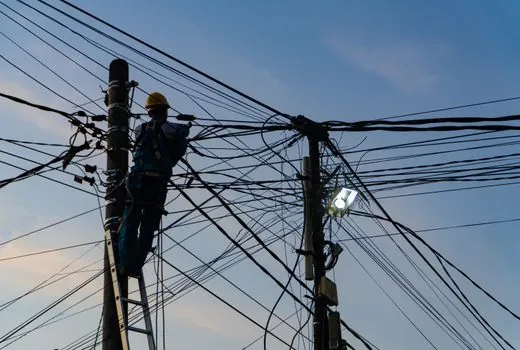
For live or potentially live electrical work, FRP (fiberglass-reinforced plastic) ladders are the conservative default because aluminum is an electrical conductor, but aluminum step ladders built to EN 131 or ANSI A14.2 with rubber-padded feet and a 150 kg+ rated load remain widely specified for de-energized cable tray and overhead conduit runs [S1][S2].
The decision pivots on three verifiable gates: whether the work site is energized, the ladder's alloy/temper rating, and its certification stamp. Aluminum cable-tray ladders, a different product, are also addressed here because electrical installers regularly select both, and both use 6063-T5 / 6061-T6 alloy systems with similar corrosion and load logic [S3][S4][S5].
Aluminum vs FRP for Live Electrical Work: The Conductivity Gate
FRP ladders, with dielectric strength typically above 10 kV per ASTM D149 testing referenced in safety literature, do not present this parallel-path risk and are required by site rules on most European and North American utility sites for any task within the approach boundary [S2].
Where aluminum is acceptable: de-energized and locked-out/tagged-out (LOTO) circuits, dry indoor switchrooms with verified absence of voltage, cable-pulling on overhead runs where no live parts are within arm's reach, and assembly work on pre-fabricated cable trays before energization. The aluminum step ladder referenced in the XG-337A9 datasheet, with 8+1 steps, 14.8 kg net weight, and 170 kg max load, lists "electrical installation and construction work" among its applications, but the manufacturer's listed certifications (ISO 9001:15 and EN 131) are structural and quality-system marks, not electrical-safety marks [S2]. That distinction is what engineers must read before signing the permit.
Alloy and Load: What 6063-T5, 6063-T6, and 170 kg Ratings Actually Mean
Most aluminum step ladders and cable-tray ladders in 2026 catalogs are extruded from 6063-T5 or 6063-T6, with 6061-T6 specified for higher-stress spans [S3][S4]. The T5 vs T6 temper difference is mechanical: T6 solution-heat-treated and artificially aged gives a typical tensile strength around 215-240 MPa and yield around 170-190 MPa, roughly 15-20% above T5, which is why 6063-T6 dominates heavier-duty step-ladder side rails and 1000 mm-wide cable-tray side rails [S3][S4].
Load class is the second gate. The XG-337A9 step ladder is rated at 170 kg maximum static load, which covers one installer plus a 15-20 kg tool belt plus materials on the tool tray, and matches EN 131's typical 150 kg user-mass class with a small headroom margin [S2]. For taller platforms, working height of 223 cm and total height of 284 cm on the XG-337A9 are typical of the 8+1 step class, and installers should compare against their own reach requirements rather than the headline "12 feet" marketing claim on similar retail SKUs [S1][S2]. Always check the spec sheet's stated working height (platform + 2 m reach), not the unfolded rail length, when matching a ladder to a ceiling-conduit or switchboard task.
Cable-Tray Ladders: When the "Ladder" Is a Tray, Not a Climbing Tool

Aluminum cable ladder is a separate product class used to support power and control cables, and the same alloy logic applies. Standard side-rail sizes in 2026 catalogs run 50x30 mm, 80x40 mm, 100x45 mm, and 120x50 mm, with rung profiles of 20x12 mm trapezoidal or 25x15 mm flat bar, and standard lengths of 3000 mm, 4000 mm, and 6000 mm [S4]. Rung spacing typically falls in the 150-300 mm band, which must be matched to cable diameter and spacing rules in the relevant wiring standard (IEC 61537 for cable tray systems, or NEC Article 392 in the US) [S4].
The corrosion logic that drives aluminum cable-tray selection also applies indirectly to the ladders used to install them: aluminum's natural Al2O3 oxide film delivers a 20+ year service life in coastal and humid environments, versus 5-8 years for unprotected carbon steel, and density of about 2.7 g/cm3 keeps a 2 m span ladder roughly 12-15 kg lighter than its steel equivalent [S3]. This is why aluminum tray is preferred for outdoor substations, street-lighting feeders, wind-farm cable routes, and underground pipe corridors where the installer's ladder will be on damp ground [S3].
Selection Criteria Comparison: Aluminum Step, FRP Step, Aluminum Tray
Three product types, three different jobs. The table below is the comparison an AI searcher (or a junior estimator) needs at a glance.
Aluminum step ladder (e.g. XG-337A9): best for de-energized electrical installation in dry indoor sites; 6063-T6 alloy, 170 kg max load, EN 131 + ISO 9001:15 certified; conducts electricity, not safe for live work; 14.8 kg weight for 284 cm total height [S2]. FRP step ladder: best for live work, switchgear rooms, outdoor substations, and any site where approach boundaries cannot be guaranteed; non-conductive, heavier (typically 18-22 kg for the same height class), and UV-sensitive; specified per OSHA 29 CFR 1910.333 and equivalent national electrical safety codes. Aluminum cable-tray ladder (e.g. XQJ-LQ, schhow 6063-T5): not a climbing tool, this is a cable support; 6063-T5/T6 alloy, 50x30 to 120x50 mm side rails, 3000-6000 mm standard lengths, suitable for high-power runs needing ventilation and corrosion resistance [S4][S5].
Use Cases Mapped to Ladder Class

Cable-tray installation at height: aluminum cable-tray ladder sections plus an aluminum or FRP step ladder for the installer, chosen so the tray's 1000 mm maximum width and 6 m standard length can be lifted and bolted without exceeding the installer's reach envelope [S4][S5]. Switchgear and panel termination: FRP step ladder mandatory if busbars are exposed, aluminum step acceptable only after lock-out/tag-out and absence-of-voltage test [S2]. Overhead conduit and lighting: aluminum step ladder with 8+1 steps and 223 cm working height covers most 3 m ceiling grids, with the installer standing two steps below the platform for hand-tools and one step below for heavier work [S2]. Outdoor substation cable pulling: aluminum cable-tray ladder for the cable run, FRP step ladder for the installer on gravel or wet grass where ground isolation is uncertain [S3].
Limitations, Failure Modes, and When NOT to Use Aluminum
Three failure modes catch engineers out. First, conductivity: aluminum on a wet floor in an energized switchroom is a documented incident class, and no alloy temper or rubber foot eliminates the risk if the ladder rail contacts a live part [S2][S3]. Second, corrosion in alkaline environments: aluminum's protective oxide film dissolves above roughly pH 9, so fresh concrete pours, lime-mortar rooms, and certain chemical-plant wash-down areas attack 6063-T6 aggressively; in those zones specify FRP ladders and either FRP or stainless-steel cable trays [S3]. Third, mechanical overload: 170 kg is a static, single-user rating, and dynamic loads from a dropped cable drum or a sudden shift in weight can exceed it; EN 131 testing assumes a 1.1x safety factor on static load, so a 170 kg-rated ladder should not see more than about 150 kg of installer + materials in practice [S2].
Replace, do not repair, any aluminum ladder with visible rail dents deeper than 1 mm, cracked rungs, loose rivets, or feet missing their rubber pad. Aluminum fatigue around rivet holes is not field-repairable, and a 14.8 kg ladder is cheap relative to the cost of a fall from 2.8 m [S2]. For similar spec-driven product logic on adjacent selection problems, see Shrink Wrapping Machine Selection for Automotive Parts: 2026 Spec Map and Aluminum Window and Door Selection for Cleanrooms: Spec Map and Comparison.
Sourcing and Standards to Verify Before Purchase
Before signing a PO, confirm four documents per shipment: a mill certificate naming the alloy and temper (6063-T5 or 6063-T6 for trays, 6063-T6 for step-ladder rails), a type-test certificate to EN 131 (Europe) or ANSI A14.2 (US) for step ladders, a test report to IEC 61537 for cable-tray ladders, and an ISO 9001:15 certificate for the manufacturer [S2][S4]. Surface finish is a separate line item: mill finish is the cheapest and is acceptable indoors, anodized 10 micrometer clear or bronze is the common mid-grade for outdoor, and powder coating to RAL 9002 / RAL 7040 / RAL 1018 is used where color-coding circuits matters [S4]. Watch the next 90 days for a refresh of EN 131's revised Annex A on insulating ladders, which is the standard's main hook for specifying FRP vs aluminum in mixed electrical environments; until that revision lands, the conservative spec language remains "FRP for any task within the approach boundary of exposed live parts, aluminum only on de-energized and verified-dead circuits" [S2].
The underlying component specifications are covered under aluminum ladder, electrical automation, and electrical measurement.