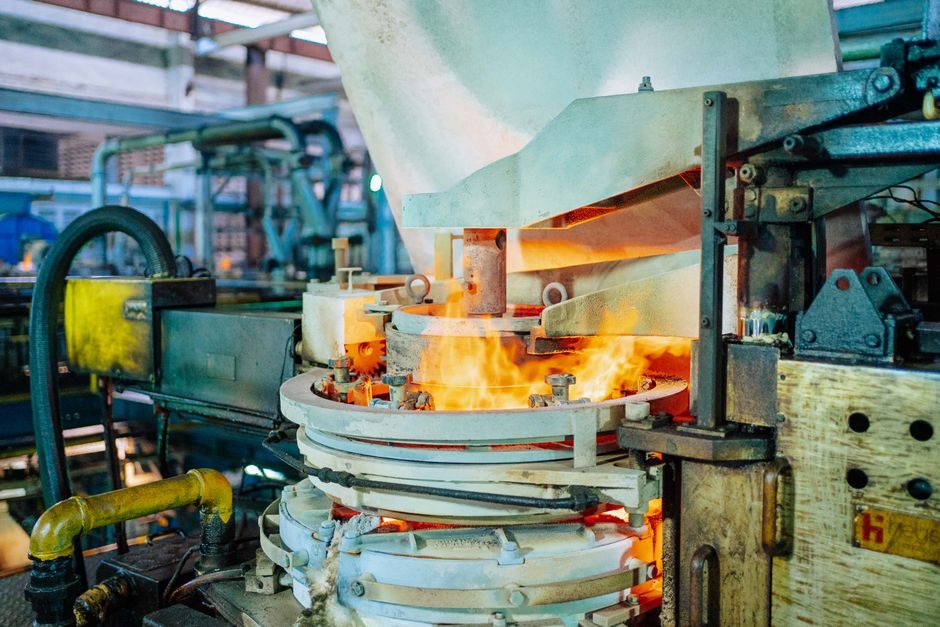
World primary aluminum production is concentrated in 11 countries, with China at 23,300 thousand tonnes leading the table, followed by Russia (3,500 kt), Canada (2,940 kt), the United Arab Emirates (2,400 kt), India (2,100 kt), the United States (1,720 kt), Australia (1,680 kt), Norway (1,200 kt), Brazil (960 kt), Bahrain (930 kt) and Iceland (8 kt) [S1].
That 11-country footprint is the upstream half of a value chain that runs from bauxite mining and alumina refining, through cryolite-based electrolytic smelting, into molten-metal casting, billet/ingot homogenization, and finally extrusion or rolling into stock for architectural, transport and electrical end-use.
Bayer Refining and Alumina Feedstock Quality
Bayer-process alumina refineries dissolve crushed bauxite in caustic soda at roughly 140-250°C and 3-5 bar, precipitate aluminium hydroxide, then calcine at around 1,000-1,100°C to drive off water of crystallization and yield smelter-grade alumina (SGA) with typically 98.5% Al2O3 content and controlled Na2O, SiO2 and Fe2O3 impurities [S3].
SGA is the direct feed to reduction cells, and its particle size distribution, attrition index and alpha-Al2O3 fraction directly affect the cell's bath chemistry, current efficiency and dust generation; finer particles dissolve faster but raise stack emissions.
Hall-Héroult Smelting and Inert/Inert-Side Anode Research
Commercial smelting still uses the Hall-Héroult cell, in which alumina (Al2O3) is dissolved in a molten cryolite-based bath composed of Na3AlF6, AlF3, CaF2, and Al2O3 at about 960°C, with a NaF/AlF3 molar ratio of 2.2 [S3].
Inert-anode research on Ni-Fe-oxide cermets tested in a cryolitic melt at 960°C under 0.8 A/cm² anodic current density has shown the electrochemical degradation mechanisms that still block commercial deployment, including metal-phase oxidation and Cu-Ni-Fe dissolution into the bath [S3]. The practical payoff would be elimination of the carbon anode (no CO2 from anode consumption) and oxygen evolution in its place.
Carbon Anode Quality, Coke Properties and the Petroleum Link
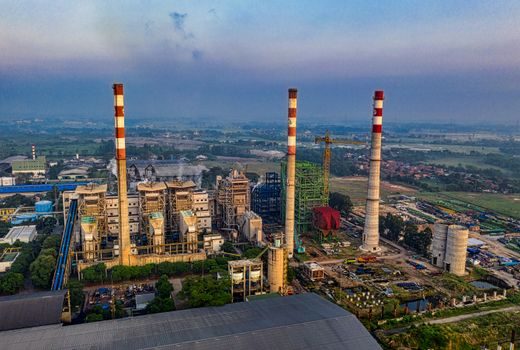
Anode performance inside the cell is governed by calcined petroleum coke (CPC) and coal-tar pitch binder properties, including sulfur content, coefficient of thermal expansion, real density, and the reactivity ratio to CO2 measured per industry-standard methods [S4]. Sulfur above roughly 1.5-2.0% is widely avoided because it raises cell bath contamination and corrodes collector bars, while vanadium above a few hundred ppm poisons anode reactivity.
For a deeper look at how carbon-grade selection cascades into cell life and energy consumption, see the analysis of Hydrogen Fuel Cell Production: Stack Architecture, MEA Build and 2026 Spec Gates, which covers the analogous carbon-electrode quality gates that govern stack life in adjacent electrochemical systems.
Foundry, Billet Casting and Homogenization
After tapping at ~960°C, molten aluminum is fluxed with chlorine or argon-chlorine to remove hydrogen and non-metallic inclusions, then cast by either direct-chill (DC) casting for extrusion billets up to 600-700 mm diameter or by continuous strip casting for rolling slab [S5].
Foundry-side equipment, including the gas aluminum melting furnace selected by mid-tier Chinese extruders, typically runs in the 50-150 t/h melt rate class for extrusion plants in the 5,000-30,000 t/yr range, with regenerative burner recuperators targeting fuel consumption below 60 Nm³ natural gas per tonne of liquid metal.
Billet homogenization at 575-620°C for 4-8 hours dissolves β-Mg2Si and other intermetallics in 6xxx-series alloys, while ingot preheating for extrusion is done in forced-air or induction furnaces at 480-520°C with temperature uniformity held within roughly ±10°C across the billet length.
Extrusion Press Selection and Quench System Design
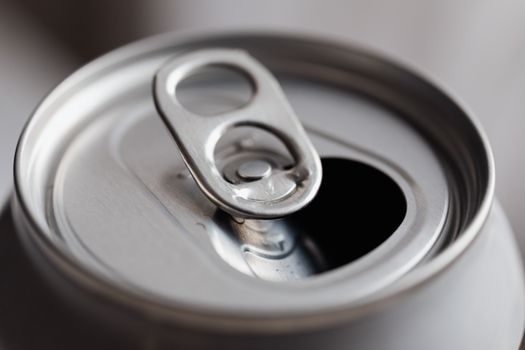
Direct extrusion presses for architectural and industrial profiles range from ~800 t to 5,500 t hydraulic and 1,000-4,000 t oil-hydraulic, with container diameters from 130 mm up to ~300 mm, and exit speeds for 6063 alloy hollow profiles typically 15-50 m/min. [S1]
The downstream air-water or water-quench system at the die exit is critical for 6xxx-series T5/T6 temper, with water flow rates of 1-3 m³/h per profile and cooling rates of 50-150°C/s required to retain Mg and Si in solid solution for artificial aging at 175-200°C for 6-10 hours [S2].
Inline aluminum alloy profile producers that own both press and quench capability typically achieve a 6xxx-profile yield of 1.05-1.10 kg/kg billet after scalping losses of 0.5-1.5% by weight, with profile straightness held under 1 mm/m by stretcher and aging-line control.
Die-Cast, Powder-Coat and Downstream Conversion Routes
Not all aluminum parts come from extrusion: high-pressure die casting with aluminum die casting machine cells in the 200-1,600 t clamping-force range produces thin-wall automotive housings, junction boxes and motor end-shields, with typical shot weights of 0.5-15 kg per cycle and cycle times of 60-180 s [S6].
For architectural and solar-frame stock, powder-coating lines apply polyester or PVDF resin at 60-80 µm dry-film thickness, with chemical pre-treatment (chrome-free or trivalent chromium conversion), curing at 180-200°C for 10-15 min, and accelerated weathering of 1,000-2,000 h QUV/QUB exposure per AAMA 2603-2605 specifications.
The downstream conversion map also feeds finished products such as the aluminum ladder, aluminum window door and aluminum veneer panel categories sold through industrial catalogs, each with its own tolerance, surface-finish and structural-load spec.
Process Comparison Across the Four Main Conversion Routes
Process selection against four decision criteria is laid out below. Extrusion wins on profile flexibility and tooling lead-time (4-6 weeks for simple dies, 8-12 weeks for hollow dies) but loses on minimum wall thickness compared to die casting, which routinely hits 1.5-2.5 mm walls in AlSi10Mg or AlSi9Cu3. [S2]
Casting routes (sand, gravity, die) score higher on part complexity than extrusion, but lower on mechanical-property consistency in the longitudinal direction; rolling-mill plate and sheet leads on surface quality and strength-to-weight in flat stock, while powder-metallurgy aluminum remains a niche for porous bearings and high-purity thermal-management parts.
Energy Intensity, Emissions and the Recycling Lever
Primary aluminum sits at roughly 13-15 kWh/kg DC-specific energy consumption, which translates to ~13-15 MWh/t of metal and 1.5-2.0 t CO2/t Al on a scope-1+2 basis, dominated by the carbon-anode reaction 2Al2O3 + 3C → 4Al + 3CO2 and grid electricity. [S3]
Secondary aluminum from scrap, by contrast, uses only about 0.7-1.0 MWh/t and 0.4-0.6 t CO2/t, which is why Chinese secondary capacity has expanded rapidly and why extrusion plants in China now routinely run 30-50% post-consumer scrap input through side-well-feed melting furnaces [S2].
Trackable signals for the next 12-18 months include inert-anode pilot-line output at the 10-50 kt/yr scale, primary capacity commissioning in Indonesia and Guinea, and tighter scope-2 emissions reporting against CBAM carbon-border adjustment as it phases in through 2026. The IAI- and CRU-style global production tables for 2025 are the next verifiable data point most buyers will use to lock long-term extrusion-billet contracts.