
Data center facades increasingly use architectural aluminum veneer panels for equipment screens, entrance canopies and irregular custom details, while 3105 and 3003 alloy sheet at 0.5-3.0 mm gauges cover containment panels and 5052 alloy handles structural containment components [S4][S5].
Specifiers building hyperscale, edge or AI training facilities now treat aluminum cladding as a coordinated system: ACP for economical large-area coverage, aluminum veneer for shaped architectural features, and aluminum honeycomb panels for premium entrance and ceiling zones, all sourced through a single supply chain to keep multi-phase campus builds on schedule [S2][S4].
Where Aluminum Veneer Fits on a Data Center Envelope
Aluminum veneer panels are the right answer where a façade element is shaped, curved, perforated, or has irregular reveals that ACP or coil-stock cannot form cleanly in one piece [S4]. Typical envelope applications on a data center campus include equipment screens around chillers and generators, entrance canopies, sun-shading fins, parapet caps, soffit details, and decorative feature walls at visitor entrances [S4][S1].
Plain flat field cladding over hundreds of meters of data-hall wall is usually cheaper to do with aluminum composite panel or coil-coated sheet, but shaped transitions, returns, column wraps, and equipment-yard screens are where single-skin aluminum veneer earns its place because it can be folded, routed, and welded into three-dimensional forms that ACP cannot match for rigidity [S4]. The same logic is why aluminum alloy extrusions dominate hot-aisle and cold-aisle containment frames inside the white space: precision, repeatable tolerances, and easy reconfiguration as layouts change [S5].
Alloy, Thickness and Finish Criteria for Exterior Veneer
For exterior aluminum veneer on data center envelopes, 3003, 3105 and 5052 alloys dominate the published supply list, with 1100, 1145 and 1235 available for specialty forming [S5]. 3003 and 3105 are the workhorse panel alloys for formed cladding and equipment screens, while 5052 is the go-to choice where higher strength or structural duty is required, for example stiffened equipment-screen framing or structural containment components inside the data hall [S5].
Finish selection follows exposure and warranty intent. Anodized, polyester, PVDF and SMP coil-coated options are the four standard finish families offered for data center sheet and veneer [S5]. PVDF is the default for exterior aluminum veneer on building envelopes because of its UV and chalk resistance over a 20-30 year service life; anodized is common where a metallic look is wanted and where the panel can be kept away from aggressive alkaline runoff; polyester and SMP fit interior or sheltered exterior applications where the UV load is lower [S5].
A practical spec-first minimum data set to request from any vendor on a data center veneer inquiry is: alloy and temper (e.g. 3003-H14 or 3105-H24), thickness (commonly 1.5-3.0 mm for solid veneer, 2.0-4.0 mm for perforated screens), panel flatness tolerance, finish system and DFT (PVDF typically 25-35 microns total), fire classification (Class A per ASTM E84 is the usual benchmark for North American data centers), and PVDF coil-coater warranty terms [S4][S5].
Veneer vs. ACP vs. Honeycomb vs. Coil: A Criteria Comparison
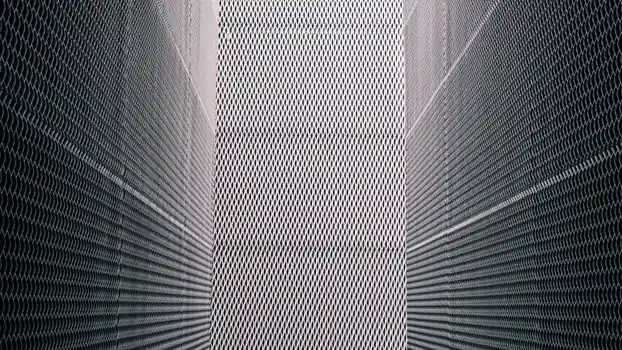
The four common aluminum envelope products are not interchangeable, and the right choice depends on which criterion dominates the design intent. Aluminum composite panel (ACP) is the lowest cost per square meter for flat field cladding over large wall areas, but its plastic core limits shape and fire performance options. Aluminum veneer is a single solid sheet, formable into curves, returns and perforations, ideal for shaped architectural details. Aluminum honeycomb panel gives the best flatness over very large premium spans (entrance lobbies, large ceilings) because the honeycomb core resists oil-canning. Aluminum coil is supplied to local fabricators who cut, fold and finish secondary components on site [S4].
On a per-mission-critical data center campus the typical split is ACP for administration building and large flat data-hall field cladding, aluminum veneer for equipment screens, entrance canopies and irregular details, aluminum honeycomb panel for large premium entrance ceilings or wall features, and aluminum coil feeding local sheet-metal shops that build screen frames, coping and flashing [S4]. This split lets one supplier coordinate colour, finish and delivery across several product families, which matters because multi-phase data center campuses often run a 2-5 year build-out where colour drift between phases is a recurring problem [S4].
Mechanical, Thermal and Fire Performance Requirements
Data center aluminum veneer must meet the same envelope performance criteria as any commercial cladding: wind load, deflection limits (commonly L/175 to L/240 for face panels), water penetration under differential pressure, and a fire classification matching the local building code for the wall type [S4]. For North American data centers, specifying Class A flame spread per ASTM E84 on the finished panel, and confirming the core material behaviour (solid aluminum is non-combustible, ACP with FR core is needed for code-compliant exterior use on most Type I-A data center construction), keeps the fire submittal straightforward.
Thermal performance is less about R-value on the face sheet and more about the back-ventilated rainscreen design behind the veneer. The aluminum sheet itself has high thermal conductivity (roughly 205 W/m.K for 1100 series, lower but still well above 100 W/m.K for 5xxx series) [S5], so designers rely on the air cavity and any exterior insulation to do the insulating work, while the metal face handles weather, impact and finish. For data center buildings with high internal heat gains, the same conductivity that makes aluminum good for heat sinks also means designers avoid thermal bridges where the metal panel connects to interior structure, typically by using thermally broken sub-framing or isolated clip systems.
For a comparison with the white-space side, the same thermal-conductivity logic is why aluminum die-casting machine enclosures, heat sinks and chassis panels inside AI racks are specified in aluminum: spreading and moving heat away from GPU and power components is faster than with coated steel [S3][S5].
Who Aluminum Veneer Is For, and Where It Is the Wrong Choice
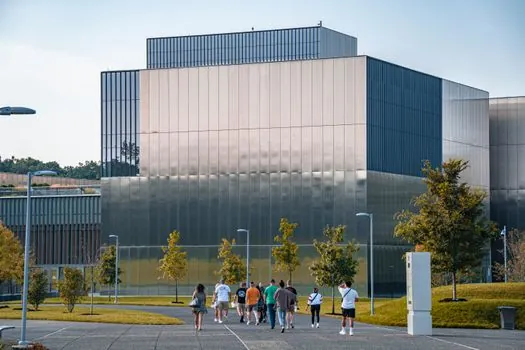
Aluminum veneer is for projects that need shaped, perforated, or high-rigidity single-skin cladding on a data center envelope, including equipment screens around mechanical yards, entrance canopies, soffit features, and feature walls where a metallic, anodized or PVDF finish is wanted [S1][S4]. It is also for projects with multi-product supply chains where ACP, veneer, honeycomb and coil need to come from one coordinated source to control colour drift and delivery across phases [S4].
Aluminum veneer is the wrong choice where the brief calls for the lowest possible cost per square meter of flat, plain cladding on a long data-hall wall, where ACP with an FR core will do the job at lower material cost, and where the local code does not require the additional rigidity of a solid sheet [S4]. It is also the wrong choice where the only fabrication need is small folded sheet-metal components, since those are better cut from aluminum coil by a local shop, avoiding the per-panel fabrication premium of solid veneer [S4].
Supply Chain, Lead Time and Common Pitfalls on Multi-Phase Builds
Multi-phase data center campuses are routinely built out over 2-5 years, and the procurement decision is shaped by expansion schedule as much as by unit price [S4]. A pitfall on this kind of build is mixing suppliers across phases, because colour drift between an initial PVDF batch and a later batch, even on the same spec, can produce visibly different elevations. Specifiers therefore fix the alloy, finish system, coil-coater, and gloss range in the original inquiry, and treat the supplier as a multi-product partner rather than a per-phase vendor [S4].
Other recurring pitfalls are: (1) under-specifying flatness tolerance, which shows up as oil-canning on large flat veneer panels, (2) using polyester or SMP finish in a high-UV location where PVDF is the correct family, (3) failing to confirm the recyclability and content claims, which on a sustainability-driven data center campus can derail LEED or BREEAM submittals, and (4) ordering the same panel geometry for equipment screens that need to be removable, so maintenance teams later cut the panels on site and break the finish [S4]. The Rucobond material-supply discussion and the Wieland data center alloy list both highlight that the supply partner should be involved at the inquiry stage, not after the panel schedule is locked, so that alloy, finish and lead time are aligned before the first PO [S4][S5].
Spec-First Buying Checklist for a Data Center Veneer Inquiry
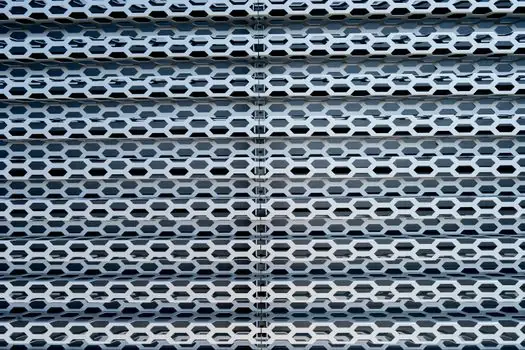
A workable inquiry should fix: alloy and temper (e.g. 3003-H24, 3105-H24 or 5052-H32), thickness (1.5-3.0 mm for formed veneer, 2.0-4.0 mm for perforated equipment screens), panel flatness, finish system and DFT, fire classification per ASTM E84, colour reference and acceptable delta-E between production batches, sub-framing type and clip material, and a packaging specification that protects the PVDF face during multi-container shipments to phased campus sites [S4][S5].
Trackable next signals for any team evaluating a data center veneer supplier in late 2026: confirmation that the coil-coater listed for the project actually produces the alloy and finish combination on the requested line, evidence of recent (2025-2026) data center project references with matching scope, and a written colour-control plan for phases 2 and beyond. Related procurement context that often runs in parallel sits in this metal powder selection guide for general fabrication, since the same factories that cut and finish aluminum often run powder-coat lines used on data center sub-framing, and in this stretch film spec map for the pallet loads that move finished veneer crates through port and site handling.