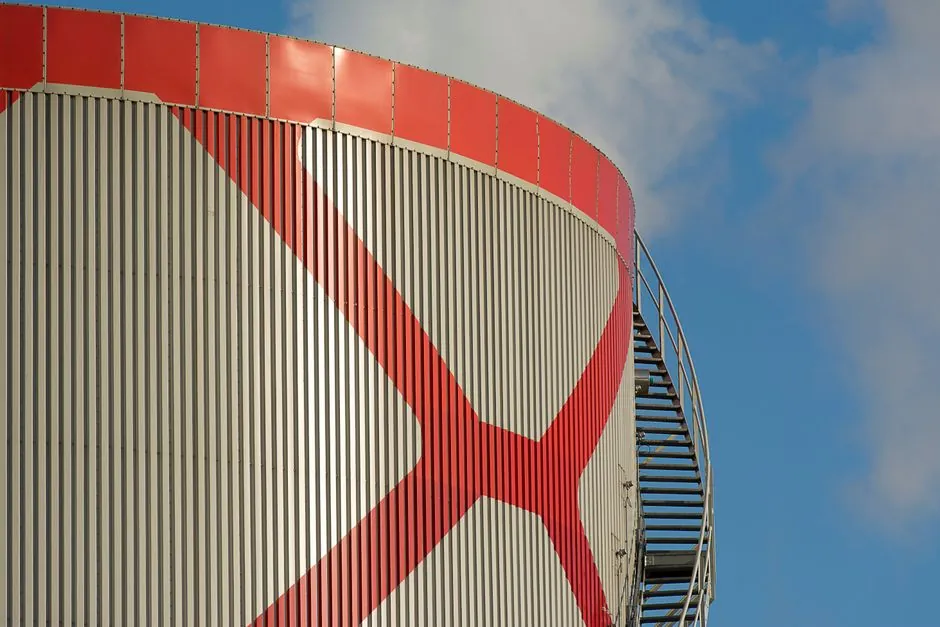
Industrial-facility cladding decisions resolve to two material families: solid aluminum veneer (single-sheet 1100/3003/5005/6061 alloy) and aluminum composite panel (ACP) with a polyethylene or fire-retardant mineral core, with honeycomb and perforated variants used for specialty zones [S1][S3][S5].
For plants, warehouses, and process buildings, solid veneer in 2.0-3.5mm thicknesses and widths up to 2500mm with lengths up to 8000mm covers most facade and interior-lining scopes, while 4mm ACP remains the industry default for flat, large-area curtain walls [S1][S7]. Selection hinges on geometry, fire code, structural load, and recycle stream, not aesthetics alone.
Material Codes, Thickness Ranges, and Mechanical Envelope
Solid aluminum veneer panels in industrial service are typically rolled from 1100, 3003, 5005, or 6061 series alloys, with 3003 and 5005 dominating cladding because of their formability and corrosion resistance [S1][S3]. Stock thicknesses run 2.0, 2.5, 3.0, and 3.5mm, with custom gauges available; ACP is supplied in 3mm, 4mm, and 6mm total thickness, with 4mm cited as the industry standard for general architectural cladding [S7].
ACP replaces a thick aluminum skin with a low-density polyethylene or fire-retardant mineral core, so an ACP sheet of equal rigidity weighs roughly half that of solid aluminum [S4]. For an industrial facility, this directly lowers dead load on the supporting steel and reduces fixing density. Common aluminum alloy selection: 3003 for general forming, 5005 for anodized architectural surfaces, 1100 for maximum formability, and 6061 when higher structural performance is needed at the panel or stiffener level [S1].
Fire Code and Building-Type Constraints
Solid aluminum veneer is non-combustible by nature, with an A1 fire rating because it contains no organic core; ACP must rely on a fire-retardant (typically mineral-filled) core to reach A2 or Class A ratings, with standard PE-core ACP restricted on tall buildings and public-assembly occupancies [S3][S4].
For auditoriums, stadiums, transit stations, and any industrial facility where local code references tall-building or public-assembly fire clauses, solid veneer is the conservative default; standard PE-core ACP is generally prohibited above the floor height defined by the local code. Class A / UL-recognized ACP products such as E-PANEL and DIBOND exist for sign and cladding use, but they are not a 1:1 substitute for A1-rated solid metal in the most restrictive assemblies [S3][S4].
Geometry, Fabrication, and Formability
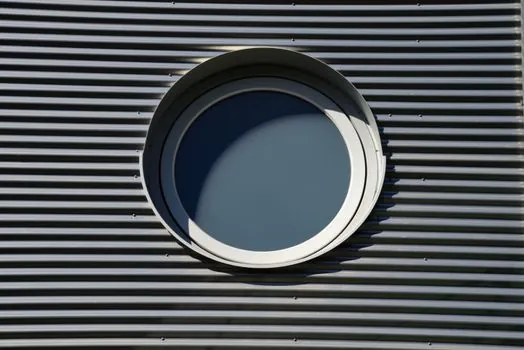
Solid aluminum veneer can be welded, folded to tight corners, and rolled into single- or double-curved geometry without delamination, which is why it is specified for spheres, hyperbolic column covers, and complex perforated facades [S3]. ACP is optimized for flatness: the sandwich structure keeps the panel flat across large surface areas but limits tight folding and double curvature, and its core can shear under aggressive forming [S3][S4].
For industrial facilities with curved equipment enclosures, hyperbolic control-room soffits, or perforated acoustic panels, solid veneer in 2.5-3.0mm with 3003-H14 or 5005-H14 temper is the working spec; ACP is the right call for flat machine-room walls, mezzanine enclosures, and standard curtain-wall runs where straight-line productivity matters. Aluminum veneer panel forming is typically done on CNC press brakes with minimum bend radii tied to thickness, while ACP is cut, routed, and punched with standard sheet-metal tooling at controlled feed rates [S1][S4].
Coating Systems and Service-Life Envelope
Three coating families dominate industrial-grade aluminum veneer panel supply: PVDF (polyvinylidene fluoride) fluorocarbon, powder coat, and anodizing; PVDF is the high-performance default for exterior cladding, with major-brand chemistries from AkzoNobel, PPG, and Valspar cited as the supplier baseline [S1][S5].
PVDF finishes give the best UV and chalk resistance for plant exteriors, with documented field service in the 20+ year range when applied over properly pretreated 3003/5005 substrate; powder coat is widely used for interior lines and color-critical zones, while anodizing adds a hard oxide layer that is favored for aggressive industrial atmospheres and for panels that need to remain metallic in appearance [S1][S5]. Standard color matching is to the RAL card, with custom colors available across all three coating families [S1].
ACP vs. Solid Veneer: Decision Criteria Side-by-Side
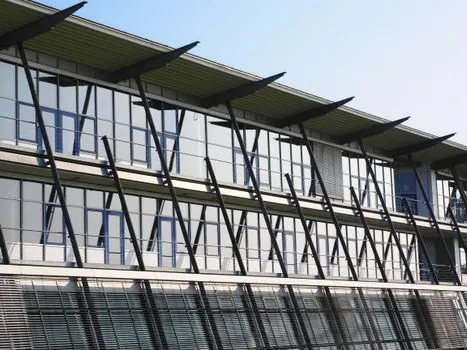
Specifying engineers typically score four criteria: fire rating, geometry, weight/cost, and recycle stream; the table below maps how each material family performs on these axes, so the call is reproducible across projects [S1][S3][S4].
On fire rating, solid veneer is A1 by composition while ACP ranges from unacceptable (PE core) to A2 / Class A (fire-retardant core or UL-recognized products). On geometry, solid veneer wins for welded, folded, and double-curved forms, while ACP wins for flat large-area runs. On weight and cost, ACP is roughly half the weight of solid aluminum of equal rigidity and is generally more cost-effective because less aluminum is used per square meter [S2][S3][S4]. On recycle stream, solid aluminum has higher residual scrap value and is easier to reintroduce into the aluminum alloy supply chain at end of life, while ACP requires core/skin separation [S3].
Who Should Pick Solid Veneer, and Who Should Stick With ACP
Solid aluminum veneer is the right call for industrial facilities with non-flat geometry, A1 fire requirements, or aggressive atmospheres: process towers with curved cladding, control rooms with hyperbolic soffits, public-facing facades of factories in tight urban sites, and any project with a long design life and a documented recycle plan [S3][S5].
ACP is the right call where the priority is flat, large-area cladding at minimum weight and minimum cost: warehouse and logistics-park facades, machine-room enclosures, mezzanine partitions, signage, and standard curtain-wall runs on buildings under local code height limits. For projects straddling both worlds, mixed systems are common: solid veneer on feature elevations and ACP on field areas, with fixing details matched to each material. Reference projects for adjacent cladding decisions appear in the high-rise building stone selection map and the explosion-proof electrical selection guide for hazardous-area facilities. Selection trackable signals: updated A1 / A2 ACP test reports against the latest local code cycle, and 3003 / 5005 coil price moves through the next quarter.
The underlying component specifications are covered under aluminum ladder.