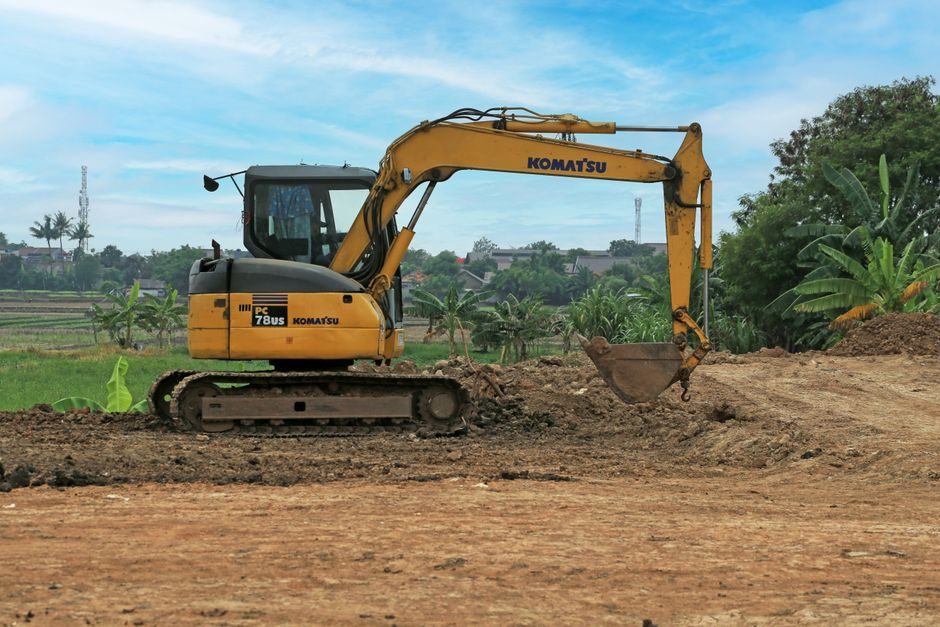
An amphibious excavator is a standard hydraulic upperstructure mated to a buoyant, sealed pontoon undercarriage instead of conventional steel tracks, allowing work in swamps, river deltas, settling ponds and intertidal zones where a regular excavator would bog or sink [S1][S3].
Sourcing data collected on 2026-07-11 across manufacturer listings (Relong, Jinyi, Qingdao Maxway) and the DirectIndustry supplier index shows the active commercial class spans 4 t mini units up to 50 t pontoon platforms, with most pontoon-undercarriage line items priced between $14,800 and $41,000 per unit [S1][S3].
Operating Weight and Class Boundaries
Manufacturer listings in the 2026 index define four practical size tiers: sub-8 t compact (Relong RL-AE04, 4 t), 8-15 t mid-size (Relong RL-AE08 at 8 t, RL-AE15 at 15 t), 20 t heavy (RL-AE20 at 20 t, RL-AE20D at 33,000 kg / 33 t), and 25 t+ deep-water class (RL-AE25 at 42,300 kg) [S1].
Bucket capacity scales non-linearly with operating weight: the 15 t RL-AE15 carries 0.6 m³, the 20 t RL-AE20 only 0.5 m³, and the 20 t RL-AE20D jumps to 1.0 m³, indicating that bucket choice is governed more by upper-structure hydraulic flow and reach than by mass class [S1].
Dig depth in the Relong tiered range stretches from 9,070 mm (RL-AE20) to 11,000 mm (RL-AE20D), giving contractors roughly a 2 m envelope to balance reach against pontoon draft and stability on the water [S1].
Pontoon Undercarriage Geometry and Stability
The pontoon is the differentiator: a sealed, compartmentalised buoyancy hull (often multi-chain for redundancy) that replaces the steel track frame, and its load moment rating drives the maximum upperstructure weight the platform can carry while floating [S3].
Jinyi lists pontoon platforms from 10 t ($14,800-15,000), 15 t leak-proof ($20,000-21,000), 30 t custom deep-water ($40,000-41,000), up to 50 t class (around $10,000-10,300 for the bare pontoon subassembly) — note that the 50 t listing price is for the pontoon unit only, not a complete machine [S3].
For a spec-first comparison on a wet jobsite, the decision pivots on three pontoon-side numbers: buoyancy reserve (tonnage class), freeboard at max upperstructure load, and chain/pin count. The dual-chain and three-chain floating pontoon configurations offered by Jinyi are the structural mechanism that prevents a single-compartment breach from sinking the machine [S3].
Upper Structure, Engine Tier and Hydraulic Match
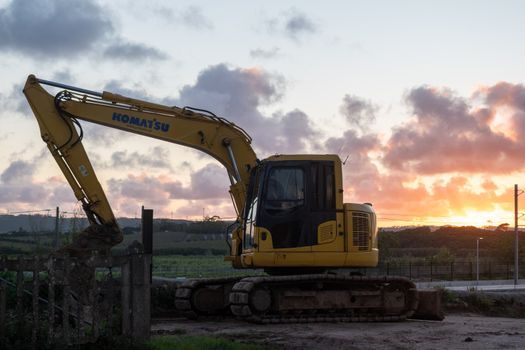
Most 2026 amphibious units re-use a proven diesel upper from a mainstream excavator OEM: Relong publishes SANY upper fitment on the RL-AE15, and Jinyi fits Doosan engines to its 10 t pontoon platform — this pattern keeps spare parts common with dry-land fleets and shortens mean time to repair on remote sites [S1][S3].
For context on engine sizing in adjacent classes, the standard dry-land 23.8-31 t ZE215E ACE upper runs at 128.5 kW, while a compact rubber-tired 7.2 t HWL80-6 uses 48 kW — amphibious units typically sit between these two power bands because pontoon drag at low speed penalises under-powered hydraulics [S1].
Attachments drive the business case: canal-cleaning buckets, long-reach booms, spud poles for station-keeping, and dredging pumps are the four most-requested options across the Relong and Jinyi product lines, and most factories will quote a customised upper rather than a fixed catalogue SKU [S1][S3].
Application Fit: Where Amphibious Beats Conventional
Amphibious is the right tool when the work zone is soft, flooded, or intertidal for more than 30% of the operating day — examples include river-mouth deepening, marsh management, pond desilting, and bund building for flood control [S1][S3].
It is the wrong tool for hard-rock riverbeds (bucket and pontoon both suffer impact damage), deep open water beyond pontoon freeboard (a spud barge is safer and cheaper per m³), or short-duration crossings where a conventional excavator on a temporary causeway is faster to mobilise [S1].
Used Cat 320-class amphibious conversions (Jinyi explicitly lists second-hand Cat 320C pontoon units) are common in this market because the Cat 320 upper is widely supported globally, and the pontoon can be re-used when the upper is repowered [S3].
Cost Structure, Lead Time and Sourcing Path
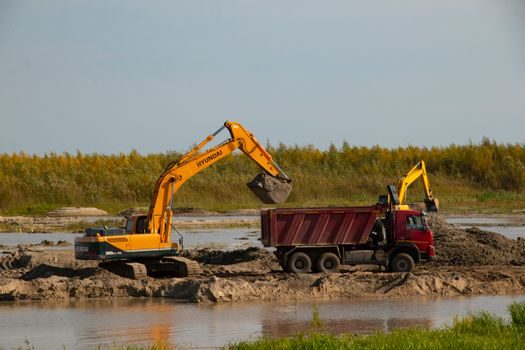
Three cost bands dominate the 2026 listings: bare pontoon undercarriage at $10,000-41,000 per unit, full amphibious excavator packages typically 3-5x the pontoon price once the upper, boom, bucket and spud poles are added, and used/refurbished conversions at the lower end of the pontoon range [S3].
Lead time drivers, based on the supplier profiles, are pontoon welding (most factories run 30,000 m² workshops with separate welding, painting, assembly and test bays), upperstructure sourcing (a stocked SANY, Doosan or Cat upper shortens delivery by 30-60 days versus a special order), and shipping (Alibaba Trade Assurance terms and 14-year track-record suppliers dominate this export channel) [S2][S3][S4].
For buyers cross-shopping adjacent classes, the spec-first logic in the Mini Excavator Selection Guide: Weight, Undercarriage, Engine Tier and Dig Specs applies in miniature here — the same weight/engine/reach trade-off, just with pontoon buoyancy substituted for ground-bearing pressure.
Inspection, Failure Modes and Standards Reality
The dominant failure modes on amphibious units are pontoon leak (seam weld fatigue after 3,000-5,000 operating hours in brackish water), chain pin wear on the track shoes that wrap the pontoon perimeter, and hydraulic contamination from repeated water immersion — none of these are governed by a single ISO or EN standard specific to amphibious excavators, so buyers must rely on factory pressure-test certificates and weld procedure specs rather than a third-party approvals mark [S3].
Engine and electrical packages on machines shipped to Europe typically carry the same CE / Stage V emissions declarations as the donor upper (Doosan, SANY, Cat), but the pontoon itself is generally outside the scope of ISO 3457 (earth-moving machinery — guards and deflectors) and is treated as a bespoke fabricated structure [S1][S3].
Trackable signals to watch through 2026 H2: new pontoon-only listings from established manufacturers (a sign of an aftermarket retrofit market maturing), and any supplier adding a 50 t+ class with verified freeboard specs rather than just headline tonnage [S3].
For component-level specifications, see linear guide, and crossed roller guide.