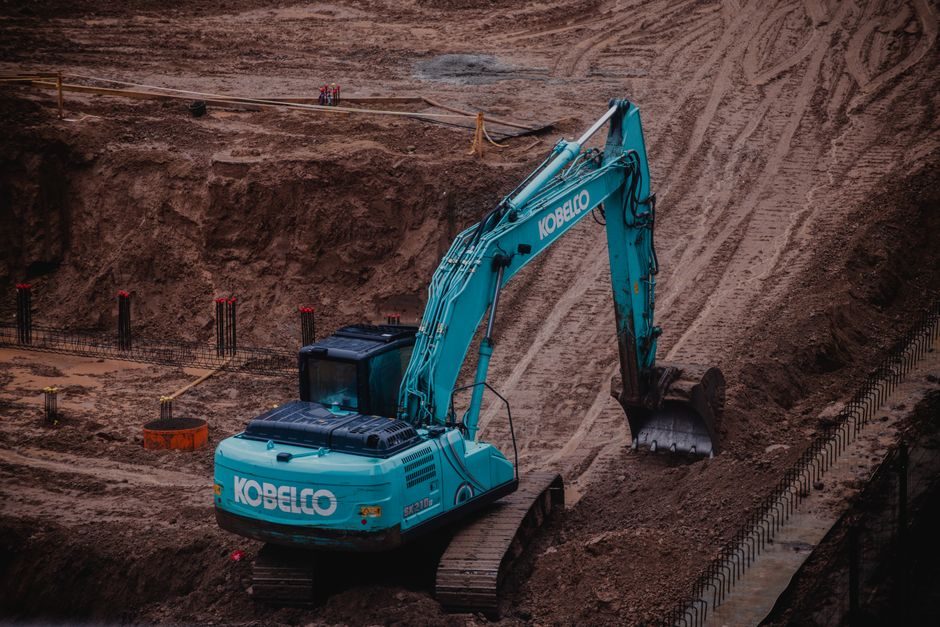
Operating weight is the single most decisive spec on an amphibious excavator: DirectIndustry's July 2026 amphibious-excavator index lists 14 products from 4 manufacturers spanning 4 t mini units to 50 t large dredging platforms, all on crawler undercarriages with diesel power [S4].
The category breaks into three working envelopes: 4-8 t mini/micro machines for canal cleaning, sediment removal, and narrow-wetland access; 20-37 t medium long-reach units for marsh management, river deepening, and pond construction; and 50 t large platforms for water-conservancy dredging with 1-2.6 m³ buckets [S1][S2][S3]. Selecting outside your true envelope costs you either transport headaches (too large) or insufficient reach/stability (too small), so the weight class question is settled before any brand comparison.
Mini and Micro Class (4-8 t): Canal, Sediment, and Container-Transport Jobs
Mini amphibious excavators in the 4-8 t bracket target narrow-channel and urban-wetland work where a full-size dredger cannot mobilise: the Relong RL-AE04 at 4 t operating weight is explicitly positioned for canal cleaning and sediment removal, while the RL-AE08 at 8 t adds landfill, construction, and quarrying applications [S1][S5]. Both share the same Relong pontoon architecture—3 watertight compartments per pontoon, 3 inspection holes per pontoon, Q355 steel track shoes and chain, and marine-grade anti-corrosion zinc blocks—which is the baseline you should require on any 4-8 t shortlist [S1][S5].
For buyers who need to ship in a container, the Heking HK100SD mini wetland dredger is built around a 4.4 m whole-machine transport envelope so it fits a standard container without disassembly, a real differentiator for Southeast Asia and Pacific island projects [S10]. Containerisable transport alone can cut mobilisation cost by 30-50% versus a lowboy trailer on remote sites, which usually outweighs a small productivity penalty. If your access route is road-only with weight-restricted bridges, the 4-8 t mini class is the correct choice; if you have barge or quay access, skip up to the medium class for better cycle times.
Medium Class (20-37 t): Marsh Management, Long-Reach Dredging, and Pond Construction
Medium amphibious excavators at 20-37 t operating weight carry the bulk of multi-purpose dredging work: the Relong RL-AE36 at 56,700 kg (≈36 t class) is spec'd at 0.8 m³ bucket capacity and an 18,800 mm digging depth, with long-reach boom geometry and an explicit duty list covering marsh management, canal/river-mouth deepening, fish-pond and salt-pond wall construction, and pipeline trench digging [S3]. The long-reach boom is the variant gate—if your dredging depth exceeds ~6 m of soft sediment, you need a long-reach upper structure, not just bigger pontoons.
Across the medium band, Relong's RL-AE20, RL-AE20D, RL-AE25, RL-AE30, and RL-AE36 give buyers a 5-step weight ladder inside the same pontoon family, which simplifies spare-parts pooling if a fleet runs mixed tonnages [S1]. This is the bracket to specify when ≥50% of working hours are afloat in shallow-to-mid water depths (0.5-4 m), and where reach, not bucket capacity, is the productivity limiter. For buyers cross-shopping conventional long-reach excavators, the long-reach excavator sourcing tier map lays out the upper-structure OEM gate; on an amphibious unit the upper structure is a customer choice, but the undercarriage is the fixed cost [S2].
Large Class (40-50 t): Deep-Water Dredging and Water Conservancy
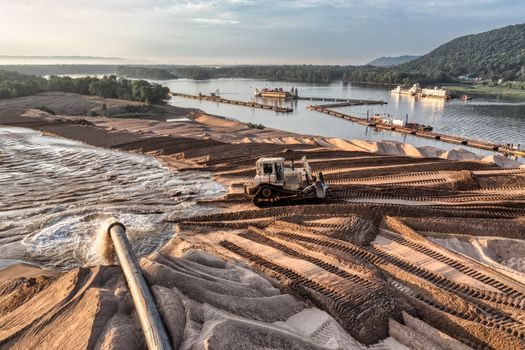
Large amphibious excavators at 40-50 t target deep-water water-conservancy and dredging contracts where bucket capacity and pontoon stability govern production: the Relong RL-AE50 is rated at 50 t operating weight with bucket capacity spanning 1.0-2.6 m³ (35.3-91.8 ft³), and the RL-AE40 sits one tier below in the same large-crawler family [S1][S2]. Both are positioned for water-conservancy, land reclamation, and bund/pile-driving work, and the same Relong pontoon spec (3 compartments, 3 inspection holes, Q355 tracks, zinc anti-corrosion blocks) carries over from the mini class [S2].
Two optional kits separate a usable large amphibious excavator from a stranded one: hydraulic extendable pontoons for narrow-area access and land transport, and additional pontoons plus spuds for deep-water stability [S1][S2]. For buyers evaluating an amphibious undercarriage retrofit onto a Cat or Komatsu upper structure, Jinyi's amphibious undercarriage product line and dual-purpose track pontoons are the modular path; the upper-structure brand stays customer-specifiable, which is why a 50 t Relong can ship with a non-Relong excavator upper [S2][S9]. Do not specify a large class machine for jobs under 2 m water depth or under 100 m reach—the pontoons add cost you will not amortise.
Pontoon Undercarriage: The Non-Negotiable Spec Gates
Across all three weight classes the pontoon undercarriage is the differentiating subsystem, and four spec gates separate a serious OEM from a fabricator: (1) compartmental flooding safety—3 watertight compartments per pontoon is the Relong baseline and the de facto industry default [S1][S2][S3][S5]; (2) inspection access—3 checking holes per pontoon allow divers or dry-dock crews to confirm integrity without cutting the hull [S1][S5]; (3) track and chain material—Q355 high-strength steel for track shoes and chain is the current Relong-standard offering [S1][S2][S3][S5]; (4) corrosion protection—marine-grade zinc sacrificial blocks on the hull extend service life in brackish and saltwater [S1][S2][S3].
Two optional pontoon features decide whether a machine is genuinely field-flexible: a hydraulic extendable pontoon (lets the operator narrow the undercarriage for transit through 3 m gates or low bridges, then widen for stability) and additional pontoons plus spuds (add buoyancy and 4-point anchoring for work in currents or deeper water) [S1][S2]. Buyers who skip these options typically pay for them as retrofit change orders 6-12 months into ownership. The amphibious undercarriage itself is now a buyable subassembly—Jinyi lists steel pontoon undercarriages, amphibious undercarriages for Cat excavators, and amphibious dual-purpose track undercarriages as standalone products, which means an OEM-agnostic retrofit path is real and not just marketing [S9]. For buyers who want a baseline read on conventional crawler platforms before committing to an amphibious undercarriage, the wheeled excavator suppliers 2026 sourcing map sets the tier-1 vs tier-2 OEM context that carries over.
Selection Criteria Matrix: Weight Class vs Duty Match
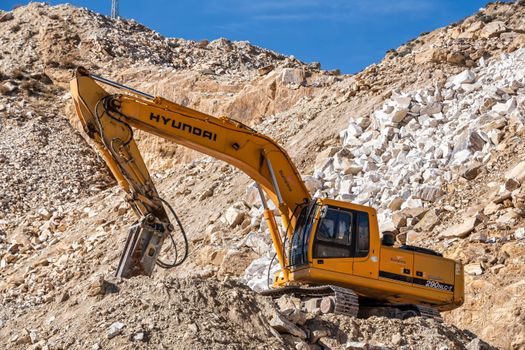
Match operating weight to water depth, bucket requirement, and transport envelope: 4 t mini units (RL-AE04) suit ≤1.5 m water depth, ≤0.2 m³ bucket work, and containerisable transport for canal/sediment jobs [S1]; 8 t mini units (RL-AE08) add landfill and quarry reach at the same pontoon spec [S5]; 20-36 t medium units (RL-AE20 through RL-AE36) are the long-reach dredging sweet spot, with the RL-AE36 delivering 0.8 m³ bucket and 18,800 mm dig depth at 56,700 kg [S3]; 40-50 t large units (RL-AE40, RL-AE50) handle 1.0-2.6 m³ bucket work in deeper water-conservancy and reclamation projects [S1][S2]. Bucket-capacity scaling is roughly 1 m³ per 10 t of operating weight across the Relong range, useful as a sanity check on quotes that promise disproportionate capacity at low tonnage.
Do not pick a 50 t class machine if your average job is under 2 m of water and under 200 m of canal—the pontoon cost and transport logistics are wasted. Do not pick a 4 t mini unit if you need to dredge below 3 m of soft sediment or place rockfill—reach and bucket force will fail. The medium class is the default for buyers running multi-site dredging contracts; the mini class is the right tool for single-site canal-cleaning and wetland jobs; the large class only pays back on water-conservancy or commercial-dredging work with daily production targets above ~1,500 m³. For buyers also evaluating adjacent equipment fleets, the industrial flooring types and spec selection and laser distance sensor selection pieces lay out the same weight-class-then-options logic for non-excavator assets.
Sourcing Reality and Market Context
Amphibious excavators are a niche sub-segment with a concentrated OEM base: DirectIndustry's July 2026 amphibious-excavator index lists only 4 manufacturers and 14 products globally, with Relong Tech holding 11 of the 14 listings and Sarrying, Hitachi Construction Machinery Europe, and a fourth vendor making up the balance [S4]. That concentration has two practical consequences—parts commonality across the Relong RL-AE family (RL-AE04, RL-AE08, RL-AE15, RL-AE20/AE20D, RL-AE25, RL-AE30, RL-AE36, RL-AE40, RL-AE50, RL-AE205) simplifies fleet maintenance, and second-source negotiation leverage is thin [S1]. The global amphibious excavator market was valued at USD 5.66 Billion in a Zion Market Research sizing exercise, indicating a small but durable installed base centred on water-conservancy, dredging, and land-reclamation projects [S7].
XCMG amphibious excavator listings also surface on the B2B marketplace Machmall alongside 37 t class crawler units, giving buyers a second Chinese OEM route for the upper structure if the pontoon supplier is decoupled [S8]. The Binzhou Jinyi amphibious undercarriage catalog reinforces that the pontoon is now a buyable, OEM-agnostic subassembly rather than a captive component, which lowers retrofit risk [S9]. Spec sheets on the Relong range are unusually consistent on pontoon design—3 compartments, 3 inspection holes, Q355 tracks, zinc anti-corrosion blocks—so a buyer comparing two Relong units is really comparing weight class, bucket, and reach, not undercarriage quality [S1][S2][S3][S5].
Limits, Failure Modes, and When Not to Specify
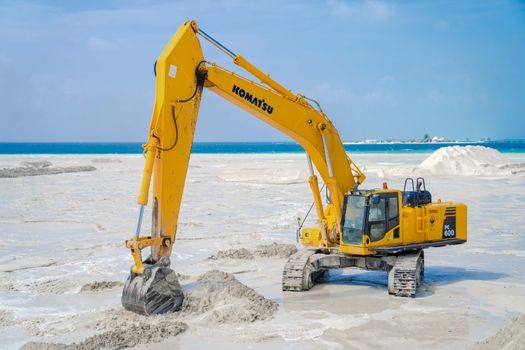
Amphibious excavators are not a substitute for cutter-suction dredgers on continuous-production river-mouth or harbour deepening jobs above ~5,000 m³/day, and they are not a substitute for marsh buggies on soft peat without a pontoon-bearing water layer. The two dominant field failure modes are (1) pontoon flooding after grounding damage or weld fatigue—mitigated only by the 3-compartment + 3-inspection-hole baseline spec, which keeps the machine afloat even with one compartment breached [S1][S2]; and (2) track and chain wear in abrasive sediment, which is why Q355 high-strength steel track shoes are spec'd rather than standard excavator undercarriage steel [S1][S3][S5]. Marine anti-corrosion zinc blocks extend service life but are sacrificial—budget for replacement every 2-4 years in saltwater duty, longer in freshwater [S1][S2].
Buyers should not specify an amphibious excavator if the work envelope is purely land-based (a standard crawler excavator costs 30-50% less), purely deep-water (a dredger is faster), or if there is no access route for a 4-50 t machine plus lowboy or barge. The transport envelope is the silent constraint: an 8 t mini unit on a standard lowboy is road-friendly, a 50 t large unit usually needs disassembly plus heavy-haul permits, and only the HK100SD-class containerisable mini dredgers skip the heavy-haul problem entirely [S10]. A defensible shortlist starts with transport feasibility, then weight class, then upper-structure brand, then options.
Trackable signals for the next sourcing cycle: DirectIndustry's amphibious-excavator index count (4 manufacturers, 14 products as of 24 May 2026 [S4]), Jinyi's amphibious-undercarriage catalog expansion on Alibaba (last indexed 23 July 2026 [S9]), and any new Relong RL-AE variant in the 15-25 t gap between the AE15 and AE20 lines would shift the medium-class pricing curve. Buyers with active 2026 tenders should lock pontoon delivery slots now—the OEM base is thin and lead times on welded steel pontoons run 8-14 weeks outside China.
Spec-level background on the components involved: excavator, pressure transmitter, and flow meter.