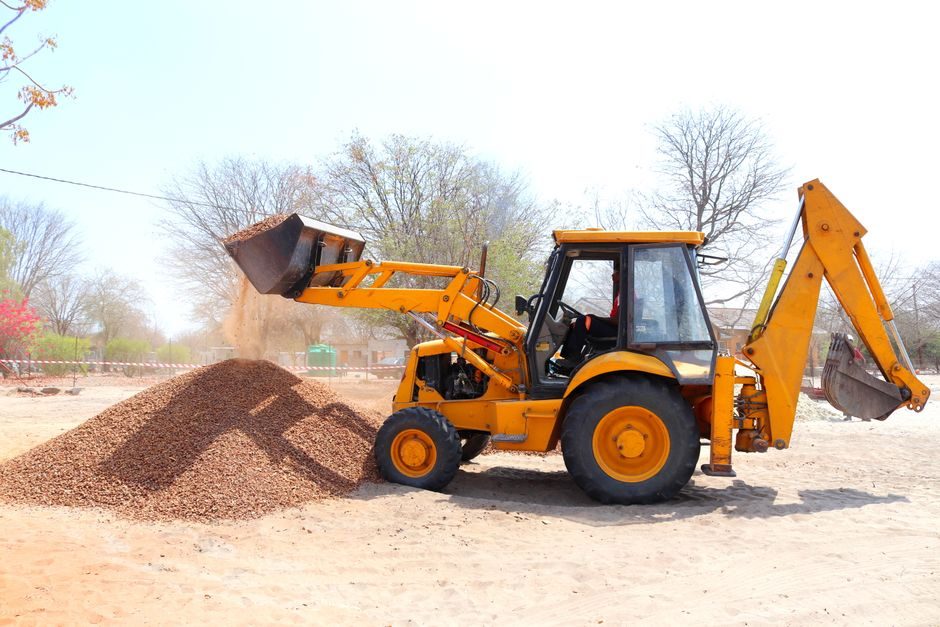
DirectIndustry's manufacturer index lists 13 amphibious excavator models from 3 vendors in 2026, with operating weights running from 4 t (Relong RL-AE04) to 42.3 t (Relong RL-AE25) and advertised bucket sizes between 0.5 m³ and 1.0 m³ [S1]. The class is defined less by engine output than by sealed pontoon undercarriage, waterline buoyancy, and dredging-reach geometry.
Three operating segments dominate 2026 builds: pontoon undercarriage units for shallow wetland work, long-reach dredging derivatives with booms past 10 m, and compact 4–8 t carriers for canal and forestry access. Wilco Marsh Buggies in the US Gulf and Great Excavations in Canada both position their fleets around wetland restoration, pipeline crossing, and dredge support rather than dry-earth bulk excavation [S2][S3].
Spec Bands by Class: Weight, Bucket, Reach
Relong's 2026 published line-up shows a clean ladder: RL-AE04 at 4 t for tight-access canal work, RL-AE08 at 8 t for general wetland projects, RL-AE15 at 15 t with 0.6 m³ bucket and 10 m dig depth, RL-AE20 at 20 t with 1 m³ bucket and 11 m dig depth, and the top-end RL-AE25 at 42,300 kg [S1]. The ZE215E ACE medium-boom excavator at 23,800–31,000 kg with 128.5 kW engine power is the dry-land comparator on the same product page, useful as a reference point when estimating what is given up to gain flotation [S1].
Dig depth correlates with class rather than mass: the 4 t RL-AE04 ships without a published dig depth, the 15 t RL-AE15 reaches 10 m, the 20 t RL-AE20 reaches 11 m, and the heavier RL-AE20D variant holds 9,070 mm at 33,000 kg [S1]. Buyers comparing amphibious units against conventional long-reach excavators should weight the loss-of-stability penalty heavily; a standard long-reach excavator delivers deeper dig on dry ground but cannot float.
Three Application Families and Their Working Envelope
Wetland and marshland construction is the dominant 2026 use case: Wilco Marsh Buggies advertises vegetation clearing, shoreline development, and habitat rebuilding as core rental scopes, with auxiliary support for dredge pipeline construction, turbidity control, and disposal-site containment [S2]. Great Excavations extends the same envelope into oil-field access, municipal works, and seismic-cut rehabilitation, with a smaller environmental footprint cited as the differentiator over conventional marsh mats and tracked carriers [S3].
Canal, river, and coastal dredging forms the second family. Relong's RL-AE20D is explicitly marketed for "Deepening of Canal, River and River Mouth to the Sea" and "Building Bund for Piling, Flood [control]" with a 1 m³ bucket and 11 m dig depth, paired with a "Powerful Engine and Long Reach Boom" [S1]. The third family — compact 4–8 t pontoon units — covers forestry, narrow canal cleaning, and shallow sediment removal where a full-size carrier cannot be mobilised; Hefei Get Engineering Equipment Manufacturing supplies the broader Chinese OEM channel for this class [S4].
Selection Criteria: Buoyancy, Draft, and Pontoon Geometry
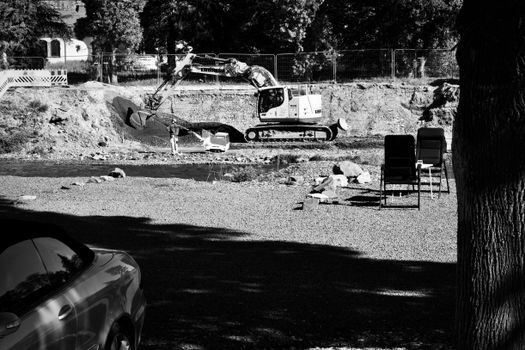
First-pass selection should fix water depth and soft-soil bearing capacity before engine power. Amphibious undercarriages use sealed pontoons with a wide footprint to reduce ground pressure below the threshold of soft wetland soils; operating weight is the proxy variable because published pontoon displacement data is rare across all three OEM sources [S1][S2][S3]. For deeper or faster water, a longer pontoon and a higher freeboard are required, which pushes buyers toward the 20–42 t class.
Second-pass criteria are reach and bucket match. The 10–11 m dig-depth band on the 15–20 t Relong models handles most river-mouth and bund work, while the 42 t RL-AE25 is positioned for higher-capacity dredging where the larger pontoon displacement is acceptable on the access route [S1]. Attachment flexibility is a third gate: Great Excavations lists dredges, pile drivers, and tree cutters across the same carrier, and Wilco Marsh Buggies runs a separate amphibious cargo carrier and bucket buggy line to extend the same platform into support roles [S2][S3].
Comparison: Amphibious vs Standard Long-Reach vs Wheeled Excavator
Across four decision criteria, amphibious and standard long-reach units trade off directly. Reach favours long-reach dry units; flotation and waterline workability favour amphibious. Mobilisation cost favours wheeled carriers, but wheeled units cannot operate in saturated soils [S1]. Buyers sourcing for 2026 wetland projects should consult the wheeled excavator supplier map only as a fallback for hard-ground adjacent sections.
A direct comparison: the 20 t RL-AE20D delivers 11 m dig depth and 1 m³ bucket on a floating undercarriage, against a comparable long-reach dry unit that may reach 15–18 m but requires mats or stable access tracks. The trade is reach for flotation; the engineering decision is whether the work site is wet often enough to justify the reach penalty and the higher pontoon-maintenance overhead [S1].
Limitations, Failure Modes, and Operating Constraints
Pontoon integrity is the dominant failure mode. Sealed hulls take impact damage from submerged debris, and puncture rates climb in rivers with woody debris; Wilco Marsh Buggies' heavy-duty wetland and swamp-conditions positioning is a direct response to that operating reality [S2]. Repair scope — welding, seal replacement, track-chain inspection on the lower rollers — is rarely itemised on OEM product pages, so total cost of ownership has to be estimated against rental-day rates rather than published service intervals.
Operating constraints are environmental, not mechanical: amphibious carriers underperform in fast current above roughly 1–1.5 m/s, and in water depths that exceed pontoon freeboard. Great Excavations notes the equipment is "there to do the job better" only with the right attachment and configuration, implying a misapplied amphibious unit is worse than a correctly sized conventional excavator on mats [S3]. Buyers operating near coastal or estuarine sites should also confirm corrosion-protection specifications directly, since salt-water duty shortens undercarriage life sharply compared to freshwater wetland work.
2026 Sourcing Reality: Vendor Map and Lead Times
Three vendor channels define 2026 sourcing: Chinese OEM-export (Relong Tech, Hefei Get Engineering Equipment) at the volume end with the widest published spec catalogue [S1][S4], North American specialty rental/leasing (Wilco Marsh Buggies) covering Texas, Louisiana, Mississippi, Florida, and the Carolinas [S2], and Canadian specialty contractors (Great Excavations) focused on engineering, environment, and energy sector projects [S3]. For larger fleet buyers, the long-reach excavator OEM tier map provides adjacent sourcing context for dry-land comparators.
Trackable 2026 signals: Relong's product line shows a clear ladder from 4 t to 42 t with published dig depths on every unit except the smallest [S1]; Wilco Marsh Buggies is expanding regional coverage across at least five US Gulf and Southeast states with both rental and contract services [S2]; and Great Excavations continues to position custom-engineered pontoon undercarriages and multi-attachment carriers as its differentiation versus volume OEM supply [S3]. Watch pontoon displacement specifications and corrosion-class certifications as the next published-data nodes from this vendor set.
Spec-level background on the components involved: excavator, pressure transmitter, and flow meter.