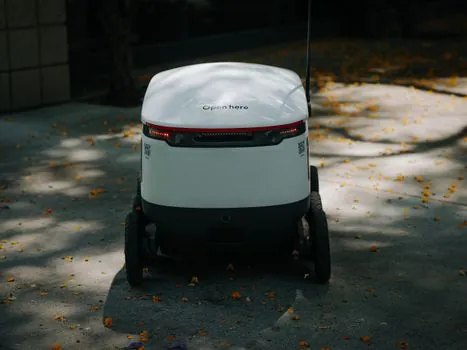
An autonomous mobile robot (AMR) for an air-cargo terminal is a self-navigating, differential-drive platform that uses on-board sensors and SLAM to move ULDs, cages, and loose cargo between landside and airside zones without fixed guide paths [S1]. Unlike AGVs, AMRs do not require buried wires, magnetic tape, or reflectors, and they re-plan trajectories in real time when a worker, dolly, or GSE vehicle crosses the lane.
The 2026 KUKA white paper on AMRs for intelligent manufacturing treats the platform as a manufacturing resource, not a vehicle, and pushes four selection gates: payload, navigation stack, fleet software, and safety classification [S1]. The same four gates carry over to air-cargo, with the addition of ULD contour compatibility and ramp/floor gradient limits inherited from airport civil engineering.
Payload class and ULD geometry
AMRs for air cargo split into three payload bands: light (50-300 kg) for parcel and baggage shuttles, mid (300-1000 kg) for cage and LD3 dollies, and heavy (1000-1500+ kg) for full AKE/LD3 container and M-1 main-deck pallet moves [S1]. The KUKA 2026 white paper explicitly segments its manufacturing AMR line by 100 kg steps to keep chassis, drive motor, and wheel-load ratings matched to the load [S1].
ULD compatibility is the harder gate: an LD3 container sits on a 1534 x 1630 mm footprint at 1587 kg max gross, an AKN at 2438 x 3185 mm at 6033 kg, and an M-1 main-deck pallet at 3175 x 2235 mm at 6804 kg [S4, airline-cargo context]. For air-cargo AMRs, the deck height (typically 300-508 mm off floor) and the contour of the roller deck must match the ULD base, otherwise the robot cannot dock under the container without a separate jack.
Navigation stack: LiDAR SLAM vs. depth camera vs. fused
Springer research on retail-warehouse AMRs documents a working differential-drive platform built on RP LIDAR plus a depth camera, with SLAM running in real time on the on-board compute and YOLO-family detection models (YOLOv4, Faster R-CNN) used to count cartons on shelves [S2]. The same sensor fusion (2-D LiDAR for SLAM and obstacle mapping, camera for object classification) is the de facto baseline for cargo AMRs in 2026.
For air-cargo, the dominant variable is ambient light. Open-sided warehouses, ramp areas exposed to direct sun, and night-shift operations under 50-200 lux metal-halide all break low-cost vision stacks; a 2-D safety LiDAR (typically 270-degree, 10-30 m range) plus a 3-D obstacle camera is the most common 2026 pairing [S1][S2]. 3-D LiDAR remains an option for high-value air-cargo yards but is rarely justified indoors where infrastructure is mapped once and updated infrequently.
Fleet software, WMS/CMS integration, and IATA messaging
An AMR is only useful inside a fleet manager that handles traffic, charging, and task dispatch; the KUKA 2026 white paper treats the fleet orchestrator as part of the deliverable, not an aftermarket add-on [S1]. For air cargo, the fleet must exchange task orders with the Cargo Management System (CMS) and theWarehouse Management System (WMS) using IATA messaging (XML/RPM, IATA Cargo-XML, or REST over the airline's ground-handling API).
Decision criteria for fleet software in 2026 include: API coverage of the airline's CMS, support for virtual lane editing without code change, charging policy (opportunity vs. cycle), and fail-safe behaviour when Wi-Fi drops. Air-cargo terminals routinely run 200-500 m Wi-Fi links across a 50,000-200,000 m² shed, so the orchestrator's tolerance for 30-60 s connectivity loss is a real spec gate, not a nice-to-have.
Safety, floor gradient, and battery
AMRs in air-cargo terminals must clear ISO 3691-4 (driverless industrial trucks) safety requirements, with a 360-degree LiDAR safety field, two independent E-stops, and a bumper that cuts drive on contact [S1]. The KUKA 2026 white paper benchmarks the safety field at 1.5-2.0 m radius in the slow (0.3-0.5 m/s) indoor mode and 3-5 m at the higher (1.5-2.0 m/s) transit speed [S1].
Floor gradient is a hidden gate: cargo shed ramps run 1:12 to 1:20 (5% to 8.3%), and an AMR specified for a flat factory floor will stall or tip on a typical air-cargo dock. Battery spec should call out LiFePO4 chemistry for thermal stability near GSE fueling areas, with 500-1500 cycle life at 80% depth of discharge and opportunity charging at 1C. For a full ULD shuttle, sizing the battery at 6-8 hours of mixed duty is more honest than chasing the largest kWh pack.
Who an air-cargo AMR is FOR, and who it is NOT for
An air-cargo AMR fits a greenfield terminal that handles 50,000+ tonnes/year, has a mapped indoor shed, and can support a 24/7 charging and maintenance contract. It also fits a brownfield shed where AGV rails are uneconomic to retrofit, the labour pool is tight, and shift patterns include 2-3 night windows with skeleton crews.
It is NOT for: terminals with mixed airside/landside traffic and uncontrolled pedestrian flow; sites without a working Wi-Fi or 5G private network; operations with heavy non-standard ULDs (military, oversized); and sheds with floor grades above 5% sustained. For outdoor ramp work, a tow tractor or follow-me AGV (see AGV robot selection criteria for the broader category) is still the 2026 default.
Comparison: AMR vs. AGV vs. manual dolly for air cargo
On the four decision criteria that matter to a cargo manager, AMRs score as follows: capex is higher than AGV (no infrastructure is the saving, but units run 2-3x the price of a tape-guided AGV), flexibility is the highest (route changes are software), throughput per shift in a 50,000 m² shed is 1.5-2x a manual dolly fleet, and integration with CMS/IATA Cargo-XML is direct. AGVs win on capex and on safety predictability in mixed traffic, but lose on layout change cost; manual dollies win on capex only and lose on labour exposure and 24/7 availability.
For automotive parts yards running a similar layout problem, the AMR selection for automotive parts logistics spec gates line up closely with air cargo on payload band and SLAM stack. A separate materials-handling view at mobile crane selection covers ULD heavy-lift for the air-freight side, while pneumatic lifting tools are the manual fallback for the same workcell.
Limitations and failure modes

The dominant 2026 failure modes for air-cargo AMRs are: SLAM drift in a 100,000 m² shed with low feature density (white walls, repeating columns), Wi-Fi hand-off loss at the airside boundary, and wheel wear from FOD on ramp aprons. None of these are surprises, and each is addressable with a quarterly re-mapping sweep, dual-radio APs at the airside gate, and pneumatic-tire options.
For a comparison set on heavy-load yard equipment, the crawler crane selection for port and terminal operations spec gates cover the ULD heavy-lift sibling of the AMR; the data center steel pipe selection spec gates piece is a useful cross-reference on facility-side spec discipline where terminal floor design and drainage are similar to a white-room data-hall build.
Track two signals over the next 6-12 months: airline RFPs that bundle AMR fleet with CMS upgrade (IATA Resolution 789 / Cargo-XML 4.0 migration), and ground-handler procurement notices that list ISO 3691-4 and IATA ULD contour data in the same tender. Either will move the air-cargo AMR market from pilot to baseline procurement.