
Apparel DCs running piece-pick, hanging-garment, and returns-sort flows are converging on three AMR archetypes: QR-code guided low-lift units (typical 30-100 kg payload), roller-deck top-transfer units for line-side replenishment, and lifting platforms that dock under shelf/cart underframes. The MSI AMR-AI-Lift reads multiple QR-code shelf markers and uses a vertical lift to carry entire shelving racks to pick stations, a topology that maps directly onto hanging-rail and fold-cube storage used in garment fulfilment [S5].
Navigation splits cleanly: Visual SLAM removes the floor-tape and QR-grid maintenance burden, while 2D-laser + reflector and QR-floor grids remain the workhorse for high-density tote traffic. ABB's AMR T702 explicitly couples Visual SLAM with the AMR Studio fleet software, positioning the unit for sites where retrofits into existing racking rule out floor-sticker grids [S1]. Cyberclean, an AMR advisor with 2,400 documented installations across facility types, lists underutilisation as the single most common failure mode post-deployment, which is why utilisation-driven selection gates now outweigh headline speed specs [S3].
Selection Criteria That Actually Matter for Garment DCs
Payload 30-100 kg covers the majority of piece-pick totes, while hanging-garment carts often push effective loads to 150-300 kg once the rail frame is included. Dimensional envelope matters more than peak speed: a 580-650 mm wide chassis typically clears 900 mm pick aisles, and a 1,800-2,200 mm lift platform is the minimum for two-level fold-cube racks. A 2D safety laser scanner per ISO 3691-4 is the de facto floor-safety perimeter, and most Tier-1 units add front and rear bumper strips plus emergency-stop circuits at all four corners [S1].
Fleet software is the real differentiator. AMR Studio (ABB) and Intel's Edge Insights for AMR, the latter built on ROS 2 and OpenVINO for on-device perception, both target the same pain points: traffic management at narrow pick aisles, WMS/ERP hand-off via REST or OPC UA, and a simulator that lets engineers replay peaks before live cutover [S1][S4]. For multi-vendor fleets, ROS 2-based stacks shorten integration work for apparel WMS modules that already expose REST hooks, a pattern Cyberclean calls out as the highest-ROI integration step in modern DC rollouts [S3].
Apparel-Specific Use Cases and Matching AMR Type
Piece-pick totes (folded shirts, trousers, accessories) match the MSI AMR-AI-Lift and AMR-AI-Roller class: the lift variant reads QR-code shelves and physically relocates the rack to the picker, while the roller variant docks against a fixed conveyor for line-side replenishment [S5]. For e-commerce returns that arrive in mixed cartons, a roller-top AMR with vision-based barcode reading slots into the existing sorter without a parallel conveyor build-out.
Hanging-garment flows are the harder problem. The rack is taller, narrower, and prone to sway; this is where chassis width below 600 mm, a low centre of gravity, and dual 2D-laser safety fields on the long axis become hard requirements. Visual SLAM retrofits are attractive here because hanging-rail aisles rarely tolerate floor QR stickers that can snag garment hangers. Picking-rollout work in adjacent sectors, including food and beverage AMR selection, follows the same payload-and-aisle logic and reinforces the case for using SKU mix and aisle width, not brand, as the primary gate. For high-throughput carton sortation, a power distribution box spec sized for the AMR charging bank is a downstream but easy-to-miss item, since 10-20 units on opportunity charging can pull 30-60 A per charging zone.
Limits, Failure Modes, and What to Reject
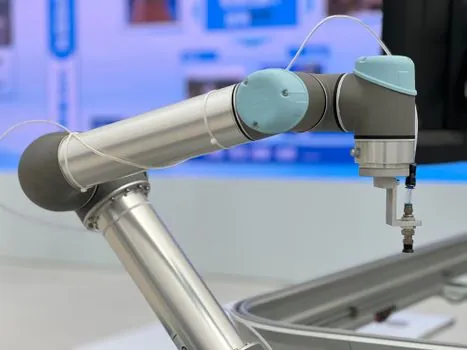
Reject any vendor that cannot document safety conformance to ISO 3691-4, cannot replay traffic in a simulator, and cannot expose WMS/ERP integration via a documented API. Underutilisation, the single most common post-deployment failure per Cyberclean's 2,400-installation track record, almost always traces back to skippi ng a utilisation model before purchase, not to the robot itself [S3]. Cyberclean's evaluation, deployment, and optimisation workflow exists specifically because raw vendor benchmarks rarely translate to a real SKU mix.
Battery and opportunity-charging architecture is a frequent surprise cost. Lithium-ion packs at 24-48 V DC with 60-100 Ah capacity are typical; 10 units sharing one opportunity-charge station need a dedicated power distribution feeder and, in many jurisdictions, an explosion-proof distribution cabinet if the DC handles aerosolised fabric-dust zones. Floor flatness tolerance is a subtler gate: most QR-code AMRs want less than 3 mm/m deviation, and Visual SLAM units degrade sharply under direct sunlight from rooftop skylights, both common in older apparel sheds.
Comparison of the Three Main Apparel-DC Archetypes
On four decision criteria, payload, aisle clearance, retrofit pain, and integration surface, the three archetypes line up as follows. QR-code lift (MSI AMR-AI-Lift class): 30-300 kg payload, 900 mm aisles, low retrofit pain thanks to a stickable floor grid, WMS integration through fleet software plus REST [S5]. Roller-top transfer (MSI AMR-AI-Roller class): 30-100 kg payload, 1,000+ mm aisles, medium retrofit pain since it docks to fixed conveyors, integration through PLC handshakes plus WMS REST [S5]. Visual SLAM platform (ABB AMR T702 class): 100-1,500 kg payload, 900-1,200 mm aisles, the lowest retrofit pain because no floor marking is needed, and the broadest integration surface through AMR Studio, ROS 2, and OPC UA [S1].
For a greenfield apparel DC, the QR-code lift gives the lowest CapEx per pick station. For a brownfield retrofit with mixed rack types and uneven floors, the Visual SLAM platform is the safer bet, but budget an extra 10-15% for commissioning because path tuning under skylight glare takes longer than vendor benchmarks suggest.
Standards, Sourcing, and What to Demand from Vendors
Floor-vehicle safety conformance should be documented to ISO 3691-4, with CE/UL marks for the complete vehicle, not just the safety laser. On the software side, demand a documented API surface, traffic simulation replay, and a stated ROS 2 or vendor-neutral middleware story, which is exactly the layer Intel's Edge Insights for AMR targets with its modular SDK [S4]. Cyberclean notes that AMR-as-a-Service (RaaS) pricing, first pioneered for healthcare in 2018, is now common in apparel DCs that want to convert CapEx to OpEx during peak-season scaling [S3].
Insist on a site-survey deliverable that includes aisle width measurements at three points per aisle, ceiling clearance at the lowest obstruction, and a one-week shadow run with tote simulation before signing. The combination of AGV robot class hardware, a ROS 2-friendly fleet manager, and an integration partner with a documented utilisation model is the pattern that survives contact with a real SKU mix; brand-name bidding without those gates is the pattern that does not.
Two trackable signals to watch through Q4 2026: Visual SLAM units shipping with multi-floor mapping out of the box, which would let a single fleet serve mezzanine and ground floors, and tighter ROS 2 LTS releases that fold the Intel Edge Insights middleware into a vendor-supported LTS branch [S4]. Either signal would shift the cost calculus again for apparel DCs planning 2027 expansions.