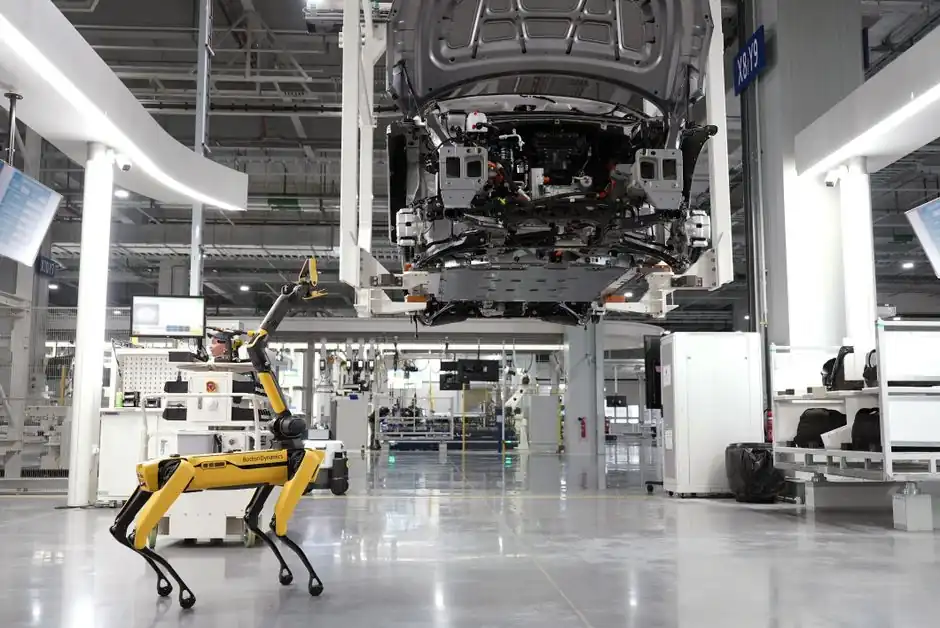
AMR fleets now split cleanly between low-payload goods-to-person bots (typically 50–100 kg) and pallet-scale autonomous forklifts (1,000–1,500 kg), with the 2026 buying decision driven less by chassis brand than by four gates: payload, navigation stack, fleet software, and floor tolerance [S6][S7].
Warehouse automation budgets in mid-2026 are flowing toward AMRs that can interface directly with WMS and ERP layers, and the Numina Group's Batchbot module advertises a 50% reduction in picker walk time and 5× higher pick rates when AMRs are coupled with voice picking [S6]. The competitive pressure on legacy automated guided vehicle (AGV) lines is structural: AMRs self-locate via onboard sensors, while AGVs depend on fixed guides such as magnetic tape or QR landmarks [S3][S9].
Where AMRs Sit Against AGVs and ACRs
An AMR is a self-guided vehicle equipped with sensors, controllers, and software that plans its own path in a mapped environment, distinguishing it from an AGV that follows fixed guides and from an Automated Container Retrieval (ACR) system that relies on rail or rack-mounted shuttles [S9][S3]. Atmos Systems' product catalogue lists an ACR System alongside its AMR-based conveyor and palletizing lines, a typical 2026 mix where the ACR handles dense vertical storage and the AMR covers flexible picking and transfer between zones [S1]. The ACR system is sold as a sibling, not a substitute, to the AMR fleet, with the division of labour defined by aisle width and storage density rather than by payload alone.
For duty profiles dominated by fixed-route, high-throughput transfers, an AGV or ACR still wins on cost-per-move. Where the route changes daily, or where pickers must collaborate with the robot, the AMR's onboard SLAM stack (commonly ROS with gmapping or Cartographer) delivers the adaptability that justifies a higher unit price [S5][S8]. ScienceDirect's review frames the migration as an evolution: AMRs inherit AGV tasks but absorb the cost of a richer sensing and planning layer [S3].
Payload, Footprint, and the Aisle-Width Gate
The first hard gate is payload, and the 2026 warehouse market clusters into three tiers: 50–100 kg tote/cart bots (the A201/A202 series in the Kitairu catalogue, where the seller has been an OEM since 1995 and entered AMRs in 2015), 300–600 kg mid-pallet bots, and 1,000–1,500 kg autonomous forklifts [S4]. Choosing outside your true peak load (not the average) is the most common 2025–2026 spec error; the chassis and drive train are sized for peak, and derating later requires a fleet swap.
The second gate is footprint. A 100 kg tote bot typically measures 600–900 mm wide, which fits a 1,000 mm aisle; a 1,500 kg autonomous forklift needs 2,200–2,600 mm of clearance for in-aisle rotation. Floor condition sits next to footprint: polyurethane omni-wheels tolerate painted concrete with minor debris, while rubber wheels on a 1,500 kg chassis need a flatness tolerance tighter than 5 mm over 2 m to prevent load sway at 1.5 m/s. Atmos Systems lists drive-in racking and overhead conveyor systems as part of its warehouse stack, which signals the same lesson: the rack, the floor, and the AMR must be specified together, not in sequence [S1].
Navigation Stack and Fleet Software

Two navigation stacks dominate 2026 warehouse AMRs: ROS-based SLAM (gmapping, Cartographer, or hector_mapping) for unstructured or frequently reconfigured layouts, and 2D-LiDAR plus AprilTag/QR fiducials for greenfield sites where the map can be pre-surveyed [S5][S8]. The Springer AMR study for CNC factory logistics couples Google's Cartographer with a linear-quadratic-Gaussian (LQG) controller, a pattern now common in metals and recycling duty [S8]. Vendors that still ship only magnetic-tape followers are competing for the residual AGV retrofit market, not for new AMR orders.
Fleet software is the second decision pillar. A WMS-to-AMR handshake, exposed as REST or MQTT, is the baseline; vendors that ship a closed proprietary dispatcher add integration cost that often equals 15–25% of the hardware budget. The Kitairu seller explicitly advertises an elevator, PABX, auto-door, and 3rd-party-software interface module, a checklist worth applying to any shortlist [S4]. Automated Warehouse Online's August 2026 coverage flags a related data-ownership question in robots-as-a-service contracts, a procurement item that belongs in the spec sheet, not in legal review after signature [S7].
Who Should Buy AMRs in 2026, and Who Should Wait
AMRs pay back fastest where pickers walk more than 8 km per shift, where SKU counts exceed 5,000, or where order profiles change weekly. The Numina Group's RDS + Batchbot pairing is a worked example: same-day picking with mixed-case pick-to-pallet, with the vendor claiming the industry's highest hourly AMR pick rates [S6]. Sites with steady, high-volume case flows and minimal re-slotting are usually better served by conveyors plus a fixed ACR stack than by a free-roaming AMR fleet [S1].
The market signal worth tracking in the back half of 2026 is the North American pilot-to-scale gap. Automated Warehouse Online's August 7, 2026 piece notes that deployments stall between pilot and scale, and Toyota Material Handling North America's autonomous-forklift activity is one barometer of whether that gap is closing [S7]. Buyers should also weigh parallels in adjacent duty profiles; the apparel-distribution AMR spec gates and the pharmaceutical AMR spec gates show how the same four-gate logic (payload, navigation, WMS, floor) tilts when tote volume, cleanroom class, or validation burden changes.
Comparison: AMR, AGV, and ACR on Four 2026 Criteria

On payload range, AMRs span roughly 50–1,500 kg, AGVs typically 100–3,000 kg, and ACRs are constrained by rack geometry to standard tote and bin sizes. On layout flexibility, the AMR scores highest because no guide infrastructure is required after the initial SLAM map, while AGVs need magnetic tape, QR floor tags, or inductive wire, and ACRs are tied to a fixed rail [S3][S9]. On integration cost, the AMR's REST/MQTT WMS interface is now table stakes, against the AGV's often-proprietary dispatcher, while the ACR usually ships with a tightly coupled warehouse execution module [S4][S6]. On capex per move, AGV and ACR lines win at high steady volumes, but the AMR pulls ahead once the route set changes more than quarterly, a threshold the ScienceDirect intralogistics review treats as a defining AMR advantage [S3].
For buyers cross-referencing heavy-industry robots, the crawler crane spec gates for quarrying are a useful analogue: the spec gate logic (load class, ground pressure, duty cycle) translates even though the duty itself does not. The same logic applies when AMR selection for electronics handling tightens the payload and ESD requirements, narrowing the vendor list further.
Limitations, Failure Modes, and Procurement Watch-Items
AMRs do not eliminate the need for floor survey: SLAM drifts in long, featureless aisles, and reflective rack uprights can confuse 2D-LiDAR. Pioneer 3-AT field data and the Cartographer-LQG CNC study both report measurable position error growth beyond 50 m of open travel without fiducials, a number worth pinning in the acceptance test [S5][S8]. Battery chemistry is a second failure mode; lithium-iron-phosphate (LFP) packs now dominate 2026 fleets because they tolerate opportunity charging at higher C-rates than NMC, but cold-store duty below 0 °C still demands heated battery bays.
Procurement watch-items: data ownership in RaaS contracts, charger standardisation (opportunity vs. swap), spare-parts lead time for LiDAR and wheel modules, and the validation package (FAT, SAT, site acceptance) for the WMS handshake. The Automated Warehouse Online August 2026 data-ownership podcast and the North American pilot-to-scale story are the two narratives to follow over the next two quarters, because they will decide whether 2026 buyers receive per-hour SLAs or per-move pricing [S7]. Until that resolves, insist on a clearly written uptime clause (commonly 95–98% during operating hours) and a defined escalation path for SLAM map refreshes after any racking change.
Track three signals into Q4 2026: the Toyota Material Handling North America autonomous-forklift order book, the Numina Group Batchbot pick-rate benchmarks against fixed ACR lines, and any new ROS-2 fleet-manager reference architectures from the ScienceDirect AMR research agenda [S3][S6][S7].
Component reference pages worth checking: agv robot, mobile crane, and amr robot.