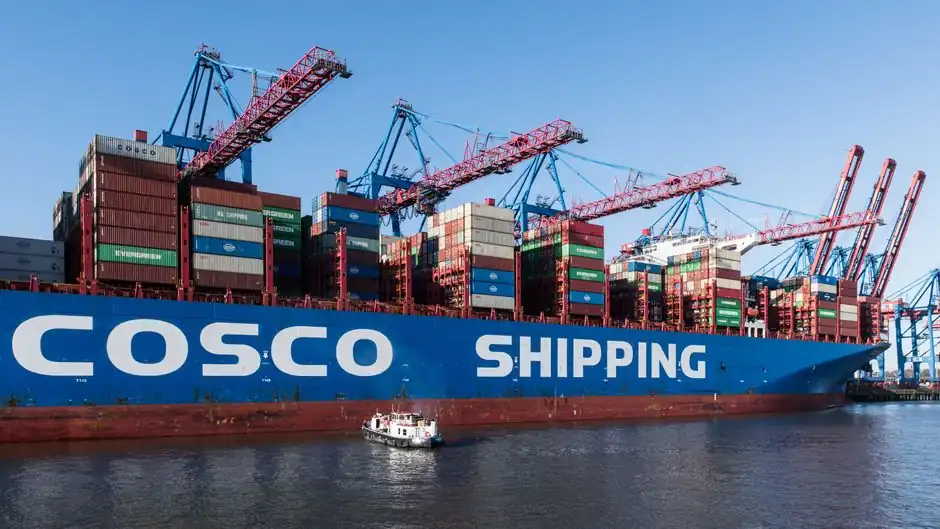
A port-logistics AMR (Autonomous Mobile Robot) purchase in 2026 is decided on five engineering gates: payload class 300–600 kg, IP54/IP65 enclosure, 8 h continuous runtime, 1.0–1.5 m/s travel speed, and Wi-Fi/LTE/LTE-M fleet control [S4].
For container yards, RO-RO ramps and bonded warehouses the mechanical frame is the differentiator: a redesigned spring-suspended AMR chassis has been Ansys-verified for up to 500 kg load and stable traversal of cracked-apron concrete, doubling the load capacity of prior frames [S1]. Spec sheets from major integrators now publish 600 kg maximum payload, 85 × 85 × 180 cm footprint, 1.3 m/s nominal speed, 2 h charge cycle, and 8 h runtime on an optional quick-charge battery [S4].
Payload class and chassis mechanics
Port AMRs split into three payload bands: 100–300 kg for container-handling parts and tool carts, 300–500 kg for pallet and bulk-carton moves, and 500–1500 kg for empty-container spreader dollies. The 500 kg threshold matches the Ansys-validated load limit of the new spring-suspended frame documented in 2024 AMR suspension research, where the redesigned structure roughly doubled the previous design's load rating while absorbing dock-approach impact loads [S1].
For RO-RO ramps and ungraded yard surfaces, a dual-spring shock system is the engineering baseline; the same study reports stable operation on rough terrain when the suspension is tuned to the deck load, a useful indicator for buyers reviewing AMR vendor shock-absorption claims [S1]. Buyers comparing the broader family of industrial robot platforms should treat port AMRs as a ruggedised subset, not a generic AGV retrofit. A complementary procurement angle, including the human-machine and safety-engineering factors behind mobile-fleet rollouts, is laid out in the AMR selection for chemical shipping spec map.
Navigation stack: LDS, depth cameras, and SLAM
Next-generation AMRs combine an LDS (Laser Distance Sensor) module with an Intel RealSense depth camera for self-surveyed map building, route planning, and real-time obstacle analysis, the published architecture used in MSI's AMR-AI-Logistics platform [S4]. This dual-sensor fusion is the 2026 baseline for outdoor mixed-traffic yards where reflective metal containers, glare, and steel racking defeat single-mode LiDAR.
Buyers should reject AGV-style line-following or magnetic-tape navigation in greenfield port deployments: published hospital-logistics AMRs using IR line-following, ultrasonic obstacle detection, and Bluetooth fallback remain confined to controlled indoor corridors, not 24/7 outdoor terminals [S2]. The decision matrix lines up as: line-following (lowest cost, only structured indoor), 2D LiDAR SLAM (warehouse, well-mapped yard), and LDS + depth-camera SLAM (mixed outdoor/indoor, dynamic obstacles). Choosing the right AMR class, including trade-offs versus fixed AGV robot systems, is detailed in the AMR selection for electronics handling spec gates brief.
Connectivity, fleet management, and elevator integration
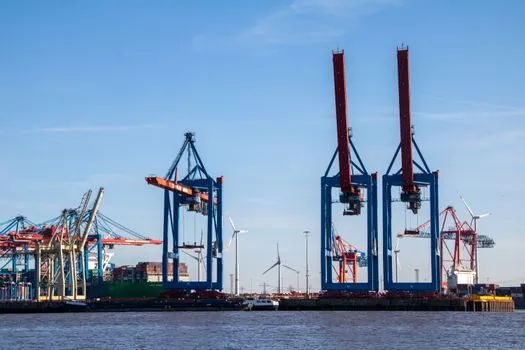
Port terminals require cross-floor and cross-zone delivery; the reference AMR platform supports cross-floor moves via a customised IoT network that autonomously calls elevators and opens access-controlled gates, with the back-end management system issuing remote cabinet-opening commands and tracking every pickup and drop-off [S4]. Radio options listed by the same platform include Wi-Fi, Bluetooth, LTE, and AIoT web services, with simultaneous-fleet commands supported for synchronous movement of multiple units [S4].
For a 5G-ready yard, buyers should require Ethernet-IP or OPC UA hand-off to the terminal operating system (TOS) and to crane PLCs, since native Wi-Fi alone has limited range past 200 m in steel-stack environments. Battery telemetry (state-of-charge, cycle count, cell temperature) is a hard requirement; lithium NMC packs with active liquid cooling are now standard above the 500 kg payload class.
Identification, security, and clean-cargo handling
Identification in modern port AMRs combines barcode, QR-code, and RFID readers plus a 24-hour digital video surveillance stream, all routed to the cloud management system with third-party integration hooks [S4]. For bonded-warehouse and pharmaceutical-adjacent cargo, sealed cabins with HEPA-filtered positive-pressure enclosures are commonly specified; buyers handling such cargo should consult the cleanroom and validation criteria in the pharmaceutical AMR selection spec map.
Security gates: TLS 1.3 on all fleet traffic, role-based access for the cloud management console, and on-device encrypted storage for sensitive waypoint maps. The reference platform exposes AIoT web-service APIs for direct integration with customs and yard-management systems, an often-overlooked requirement in cross-border terminals [S4].
Selection matrix: payload vs IP rating vs navigation
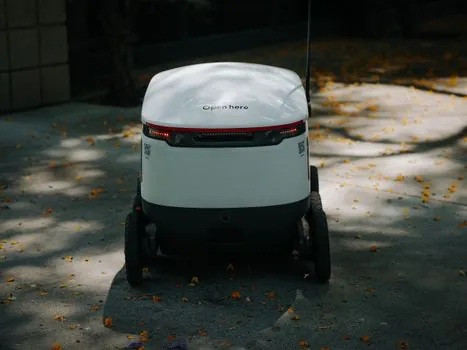
Three decision criteria dominate port AMR RFQs: (1) Maximum payload, 300 kg, 500 kg, or 600+ kg, where 500 kg aligns with the published suspension-load limit and 600 kg is the published maximum payload on MSI-class platforms [S1][S4]. (2) IP rating, IP54 for indoor warehouse aisles, IP65 for outdoor yard exposure to rain and salt spray. (3) Navigation stack, line-following (indoor only), 2D LiDAR SLAM (mapped warehouse), or LDS + depth-camera fusion (mixed outdoor/indoor with dynamic obstacles) [S2][S4].
Continuous runtime is converging at 8 h per charge with a 2 h recharge cycle on quick-charge lithium packs, so labour-shift alignment, not battery life, becomes the real ROI lever [S4]. For brownfield terminals with existing automated stacking crane (ASC) fleets, the AMR is best procured as a collaborative robot-class vehicle that shares workspace with human stevedores under defined ISO 3691-4 risk zones, rather than a fenced AGV.
Standards, ROI, and procurement pitfalls
No single ISO standard governs port AMRs end-to-end, so buyers should map requirements to ISO 3691-4 (driverless industrial trucks, safety), ISO 13849-1 (safety-related control system performance, PL=d minimum), and IEC 61508 for the fleet-management software, while asking vendors for third-party type-test certificates [S1]. The 2024 AMR suspension study explicitly benchmarks load capacity and rough-terrain stability rather than functional safety, so those functional-safety documents must be requested separately [S1].
Procurement pitfalls observed in 2024–2026 deployments: under-spec'd IP rating for marine-air salt exposure, missing TOS/PLC API hooks, and the assumption that a mobile crane yard fleet can share Wi-Fi bandwidth with hundreds of AMRs. Payback windows for a 20-unit 500 kg fleet now sit in the 24–36 month range at ports handling above 5,000 TEU per year, driven by reduced container-handling damage claims and 24/7 shift coverage [S4]. For an articulated robot arm mounted on a mobile base, payload and reach drop sharply versus fixed installations, so reserve mobile-manipulator AMRs for light parcel sortation, not TEU handling.
Buyers should request vendor commitment to those releases before signing 2027 framework agreements.