
Autonomous mobile robots split from automated guided vehicles (AGVs) at the navigation layer: AMRs localise and plan onboard using SLAM and 2D/3D sensor fusion, while classic AGVs follow fixed paths defined by magnetic tape, QR codes, or wire guides [S2][S3].
The taxonomy that matters on a factory floor has four axes — navigation method, drive/chassis configuration, payload class, and operating environment — and the same hardware can land in different cells depending on which axis a buyer prioritises [S1][S8].
Navigation Class: AGV-Style Guidance vs AMR SLAM vs Hybrid
AGV-class units rely on infrastructure cues: magnetic tape, colour/QR floor tags, or inductive wire, with routing decisions made by a central fleet manager [S2]. AMR-class units replace that infrastructure with onboard perception — 2D safety LiDAR, 3D depth cameras, and wheel odometry fused through SLAM — so the vehicle recomputes its path around an unplanned obstacle instead of stopping [S3][S7].
Hybrid units, increasingly common in brownfield sites, accept both modes: they read fiducial markers for coarse localisation but can dead-reckon through a marker-gap and replan using LiDAR when a route is blocked [S8]. For spec sheets, the practical distinction is whether the vehicle needs a modified floor (AGV), an unmodified floor plus a prior map (AMR), or both (hybrid) [S2].
Drive Configuration: Differential, Omnidirectional, Ackermann, and Legged
Differential-drive AMRs — two driven wheels plus casters — dominate the under-500 kg intralogistics segment because the kinematics are simple and the turning radius is effectively zero [S1]. Omnidirectional variants add mecanum or omni wheels, allowing lateral strafe at the cost of lower tractive effort and more complex wheel-suspension tuning [S1].
Ackermann-steered chassis mirror passenger-car geometry and are picked for heavier payloads travelling in mixed-traffic aisles where predictable tyre scrub matters; a redesigned frame and dual-spring suspension published in 2024 carried a verified 500 kg load while staying stable on rough warehouse floor joints [S1]. Legged and hybrid wheel-leg platforms exist but remain research-grade outside outdoor inspection niches, where the trade-off in payload and energy density has not closed against wheeled designs [S2].
Payload Class: From 50 kg Totes to 500 kg Pallet Movers
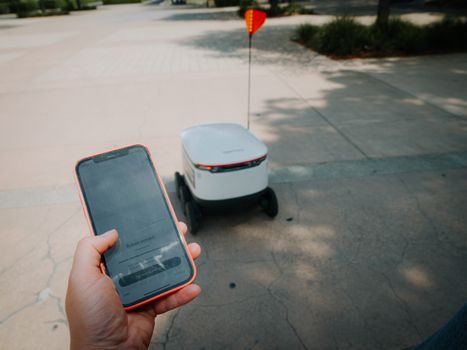
Light-duty AMRs (≈50–150 kg) handle totes and bins in goods-to-person stations; the ROS 2 Humble reference stack from the Open Edge Platform documents a sensor-ingestion, SLAM, and action-planning pipeline sized for this class [S7]. Medium-duty units (150–300 kg) cover carton and shelf transport; MSI's AMR-AI delivery platform advertises cross-floor and elevator-integrated behaviour for hospital and warehouse routes in this band [S6].
Heavy-duty AMRs (300–500+ kg) move pallet loads and require the structural frame work demonstrated in the 500 kg Ansys-validated design, which doubled the load capacity of the previous chassis while keeping rough-terrain stability [S1]. For a capital-procurement comparison, the AGV Robot TCO: Eight Cost Lines That Decide a 10-Year Spend breakdown shows that the step from 150 kg to 500 kg payload class roughly doubles the per-vehicle mechanical bill but does not change fleet-management licence costs. The parallel AGV Robot Installation: Site Prep, Navigation Layout and Commissioning guide is the matching reference for site-readiness work that often gates an AMR deployment.
Operating Environment: Indoor Structured vs Indoor Mixed-Traffic vs Outdoor
Structured indoor AMRs run in dedicated aisles with controlled lighting and consistent floor reflectivity — perception stack is typically a 2D safety LiDAR plus a downward camera for fiducial fallback [S7]. Mixed-traffic indoor AMRs share space with pedestrians and forklifts, which forces 360° LiDAR coverage, redundant safety PLCs, and ISO 3691-4-style performance-level-rated stop circuits; the latter is referenced as the governing standard for driverless industrial truck safety in recent intralogistics literature [S2][S3].
Outdoor AMRs add weather sealing, IP65+ enclosures, and GPS-RTK fused with LiDAR for global localisation; their power budget is dominated by traction motors on uneven ground, and energy-source selection (Li-ion, fuel cell, hybrid) is the main spec driver because the rest of the hardware stack is mature [S2].
Software Stack: ROS 2, SLAM, and the Planning Layer

ROS 2 Humble is the de facto middleware reference for new AMR development, with reference implementations exposing sensor ingestion, classification, environment modelling, action planning, and action control as modular packages [S7]. Visual-SLAM loop closure is shipped as an open-source module in the same reference stack, allowing a unit to relocalise after kidnapping or a long occlusion [S7].
Planning and control research has converged on three layers: a global planner on a pre-built map, a local planner that re-routes around sensor-detected obstacles, and a low-level controller that tracks velocity and enforces safety-rated deceleration [S2]. MATLAB/Simulink provides an off-the-shelf workflow covering hardware-platform design, ROS 2 interfacing, object detection, point-cloud processing, sensor fusion, and SLAM, which is now the standard teaching and pre-commissioning toolchain cited by integrators [S5].
Decision Comparison: AGV vs AMR on Four Buyer Criteria
On four practical criteria, AGVs and AMRs split cleanly. Infrastructure cost is lower for AMRs (no floor markers) but higher per-vehicle because of the onboard compute and sensor stack; a deep-learning + ROS navigation study from 2021 documents the training, simulation, and deployment cost in concrete terms [S4]. Flexibility favours AMRs because routes are map edits, not floor work [S2][S3]. Throughput per aisle favours AGVs in stable, high-density routes where the central scheduler can coordinate hundreds of units; AMRs win in volatile SKU mixes where route churn is constant [S8]. Safety integration is comparable — both must satisfy the same functional-safety requirements — but the AMR's onboard planner adds software-validation overhead that an AGV does not carry [S3].
Selection Rules and Failure Modes Buyers Should Pre-Mortem
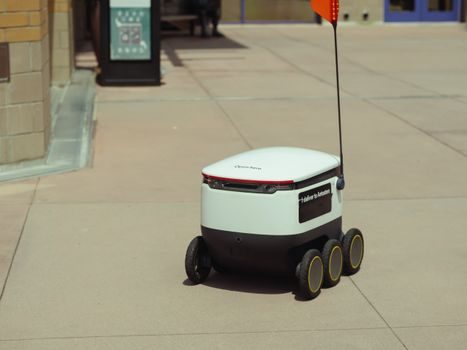
AMRs are the right pick when routes change more than twice a year, payload is under 500 kg, floor modifications are politically or contractually expensive, and the site has 50+ unique destinations [S2][S8]. They are the wrong pick when a single-aisle throughput above a defined units-per-hour is contractually required, when the floor reflectivity is so variable that LiDAR returns saturate, or when the available power budget cannot support an 8–12 hour shift between charges [S2].
Two failure modes recur in published deployments: SLAM drift after long traverse through feature-poor corridors, and multi-vehicle negotiation deadlocks when fleet-manager API latency exceeds the local replanner's response window [S3][S8]. Both are solvable with map-maintenance discipline and a well-bounded fleet size, but a spec engineer should price the mitigation into the tender, not treat it as a vendor surprise. The next decision node for most buyers is the on-site pilot, gated by a documented throughput test against a defined SKU mix, with a fall-back plan to revert to cart-based picking if the AMR fleet fails to hit the contracted pick rate.
For component-level specifications, see mobile crane, agv robot, and amr robot.