Selective, drive-in, push-back, pallet flow, cantilever and mobile rack are the six structural families most warehouses spec against today; the differentiator is always the same — how the beam meets the upright, and how the forklift reaches the load [S1][S3].
Across US distribution centres, teardrop-style selective rack remains the default because its riveted or bolted teardrop keyhole lets beams be re-shelved in 50.8 mm vertical increments without specialised tools, and the same frames are shared across Apex, Dexion-compatible, Stow and Interlake-style product lines [S3][S4]. The same catalogues, however, list drive-in, structural and cantilever systems for heavier, longer or higher-density SKUs [S6].
Selective Teardrop Rack: The 50.8 mm Increment Baseline
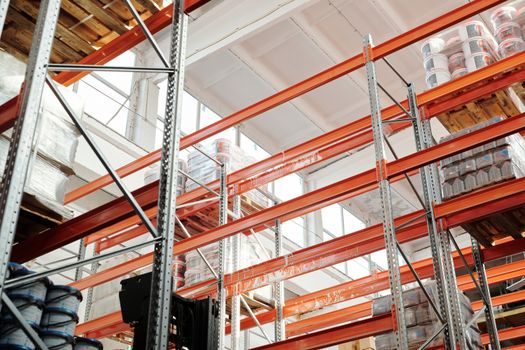
Selective teardrop rack pairs roll-formed uprights with stepped teardrop keyholes and clip-in beams, the geometry that has made it "one of the most common types of pallet racks used by warehouse storage and distribution centres across America" [S3]. Beam heights of 63.5 mm, 76.2 mm, 88.9 mm, 101.6 mm and 127 mm are standard across most teardrop lines, with typical capacities per pair rated from 1000 kg to 4500 kg depending on beam profile and length.
The down-aisle lateral stiffness of these roll-formed frames comes from the beam-to-column connector itself, not from bracing in the loading plane — "for steel storage pallet racks, lateral stiffness in down-aisle direction is usually provided by beam-to-column joints and base-plate connections, owing to the impracticability of using bracing systems in selected areas of pallet racks" [S5]. Used Link 51, Dexion, Apex, Stow and Redirack selective stock is regularly resold in the West Midlands and Staffordshire regions, evidence of a mature secondary market around this geometry [S4].
Structural Pallet Rack: Heavier Loads, Welded Beam Pockets
Structural rack uses hot-rolled C-channel columns and C-channel or structural-tube beams with bolted or welded end plates, giving a heavier frame for fork-truck impact zones, seismic zones and freezer applications [S6]. A typical structural column is 76.2 mm × 76.2 mm or 101.6 mm × 101.6 mm, with 12.7 mm to 19.1 mm thick end plates; beam capacities commonly reach 6000 kg per pair, and the bolted end-plate connection avoids the teardrop clip's tendency to loosen under repeated impact.
Baker Industrial lists structural pallet rack alongside structural cantilever, drive-in and push-back as the four heavy-duty product families it integrates nationwide, separating them from the lighter teardrop roll-formed line [S6]. Where teardrop frames are roll-formed from 1.5 mm to 2.0 mm steel, structural uprights start around 2.5 mm and run past 4.5 mm, which is why pallet rack inspectors treat structural frames as a separate inspection class with stricter column-protector protocols.
Drive-In and Drive-Through Rack: LIFO vs FIFO at High Density
Drive-in rack uses continuous rails on the floor and upper levels so a forklift drives horizontally into the bay, stacking pallets 2 to 10 deep; drive-through is the same geometry with openings on both ends, trading LIFO for FIFO [S6]. Pallet stacking depth of 4 to 6 is the common operating range — beyond 6, fork-truck reach and impact risk degrade the system.
The EBILTECH standard catalogue lists drive-in pallet rack alongside push-back, gravity-flow and radio-shuttle under the high-intensity storage family, deliberately separate from the teardrop standard line [S3]. The Böckelt Tower cassette rack takes the same drive-in logic into a tubular modular format rated for long items, sheet metal and pipes, with double-sided and compact configurations listed on its product datasheet [S2].
Push-Back Rack: LIFO With Carton Flow Dynamics
Push-back rack stores pallets 2 to 6 deep on nested carts running on inclined rails; a new load pushes the previous ones back by one position, so the next pick is always at the front face.
The same component family is sold as "Push Back Rack" in EBILTECH's high-intensity catalogue, sitting beside drive-in and radio-shuttle solutions that share the same depth-versus-selectivity trade-off [S3]. The cart-and-rail assembly is the part that fails first under impact, which is why some sites pair push-back with pallet stacker retrieval rather than counter-balanced fork trucks.
Cantilever Rack: Long, Flat, or Awkward Loads
Cantilever rack replaces the front beam with a series of arms bolted to a vertical column, designed for pipe, lumber, sheet metal, furniture and reels where a standard pallet beam would block the load face [S2][S6]. Column heights commonly run 3 m to 6 m, with single- or double-sided arm faces, and arm lengths of 600 mm to 1500 mm at 1000 kg to 4000 kg per arm pair.
Böckelt lists cantilever as part of the same modular family as its cassette and tubular racks, with a galvanised-steel arm and self-supporting base configuration [S2]. Baker Industrial places structural cantilever in the same integrator menu as structural pallet rack, drive-in and push-back, signalling that the heavy end of the rack market is bought as a turnkey project rather than a single product line [S6].
Mobile Rack and AS/RS: When the Aisle Moves
Mobile rack mounts conventional pallet frames on motorised carriages running on floor rails, eliminating fixed aisles and roughly doubling storage density over selective rack on the same footprint [S3]. Carriage speeds are typically 3 m/min to 6 m/min under no-load, with the moving aisle controlled by a single access interlock; the system pays back when land cost per square metre dominates the project, not when rack cost does.
EBILTECH's electric mobile rack sits next to radio shuttle, four-way shuttle, automated vertical carousel and honeycomb storage under its high-intensity racking menu — a category that itself sits below the AS/RS stacker-crane and shuttle-carrier product lines [S3]. When aisles move, the right pallet stacker on the infeed side becomes a different spec gate than a counter-balanced truck. For structural cantilever or drive-in layouts, the storage rack family is also typically paired with manual pallet jack flows at floor level rather than full forklift reach.
Selection Criteria: Six Families Against Four Decision Gates
The four decision gates that actually pick the rack family are SKU count, pallet weight, pick frequency and floor cost. Selective teardrop wins on SKU count and pick frequency, with no penalty on pallet weight up to about 1500 kg [S3][S4]. Drive-in and drive-through take over once the same SKU faces 5+ pallets and pick frequency drops below one cycle per shift, with depth capped around 6 to keep fork-truck reach honest [S3][S6].
Push-back fits the 2-to-5-deep LIFO band where selectivity per lane matters more than full FIFO; pallet flow is the FIFO mirror image for 3 to 10-deep face picking [S6]. Cantilever is the only family that takes long, flat, or reel loads without a pallet beam blocking the face [S2]. Mobile rack and AS/RS only beat selective once the floor cost per stored pallet is high enough to justify the carriage and controls premium [S3]. Most national integrators in 2026 — including Baker Industrial — list tear-drop roll-formed, structural pallet, structural cantilever, drive-in, push-back, reel rack and guide-rail accessories as their core product menu, so the family boundary lines are now fairly stable across the US, UK and India [S6]. For comparison, a cast iron types reference uses the same family-versus-criteria logic, but the criteria are mechanical rather than warehouse-flow. Likewise, the spec gates around a stacker crane install overlap directly with mobile rack when the carriage is replaced by an aisle-bound crane.
Inspection, Damage and Sourcing Signals
Annual rack inspection is now standard in the US and UK, with the inspection scope covering anchor pull-out, column straightness, beam-end clip engagement and fork-impact damage; upright protectors — plastic, fifth- and sixth-generation — are sold alongside guardrail, bollards and goal-post protection as a separate product family [S3]. Cranston Pallet Rack Inspectors explicitly sells the service as risk identification, report and compliance against safety standards, not as a one-off audit.
On the used-rack side, Pallet Racking Systems Ltd in the UK sells "thousands of bays" of second-hand Link 51, Dexion, Apex, Stow and Redirack stock with installation and removal services, while Delhi-based Aldon Steel Fabricator lists slotted-angle racks and palletised racking systems as its core logistic-equipment line — two regional sourcing patterns that show the secondary market tracks the same brand families as the new-rack market [S4]. Chinese OEM Smaco, founded in 2000, exports the same teardrop, drive-in and cantilever families from Dongguan, confirming that the six-family classification travels across both Asia and Western markets.
For a new spec, the verifiable next nodes are: (1) confirm whether the site falls under RMI/ANSI MH16.1 or EN 15635 for rack design and inspection, (2) lock the beam height and beam-end connection family before choosing an upright, and (3) run a cycle-time model on the chosen family before committing to a depth — for anything beyond 6-deep drive-in, the fork-truck reach itself becomes the constraint, not the rack [S3][S5].