
For a new facility, AMR deployment typically completes in 2-6 weeks because no floor infrastructure is required, while AGV installation takes 8-16 weeks once path installation and commissioning are included [S9].
The gap is not about robot speed but about what the building has to give up first: AMRs map and adapt, AGVs require the floor to be modified before the first unit ever runs a load [S2][S3].
What Actually Drives the Deployment Clock
AGVs need fixed guidance: magnetic tape, embedded wires, laser reflectors, or floor markers must be installed, tested, and commissioned before any vehicle can run production routes, and that work is the dominant part of the AGV timeline [S2][S10]. The construction phase can force operations to pause while contractors cut into concrete or apply tape runs, and any route change after go-live repeats the cycle [S3].
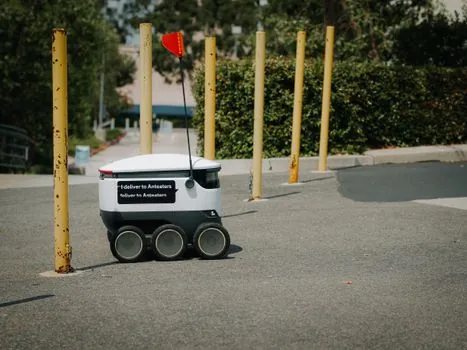
AMRs use onboard LiDAR, cameras, and SLAM-based mapping to learn the facility layout, so the building is treated as-is rather than retrofitted [S2][S5]. A typical first deployment covers site survey, map creation, fleet manager setup, WMS or MES hookup, and user acceptance testing, all without breaking the floor [S6].
Decision Criteria: Navigation, Infrastructure, Payload, Safety Standard
AGVs follow fixed paths defined by physical guides, stop when blocked, and need segregated zones or hard-guarded safety per ISO 3691-4; AMRs dynamically reroute around obstacles using onboard sensors, share space with human workers, and are built to the same ISO 3691-4 driverless industrial truck standard but with a different safety-case profile [S4][S5]. Payload caps the split as well: AMR unit volume is climbing fastest in lighter, high-variability applications, while AGVs continue to hold heavy-payload, high-precision, takt-critical work where cost certainty and repeatability matter [S4].
Upfront cost tracks the same axis: AGVs carry a larger initial bill for wiring, magnetic strips, or floor markers, and any layout change means re-installation fees; AMRs shift cost into software, so route changes are reprogrammed rather than reconstructed [S5]. Safety standards are converging, with ISO 3691-4 internationally and ANSI/RIA R15.08 plus B56.5 in North America treating both as one family of driverless industrial trucks [S4].
Use-Case Match: When Each Timeline Is the Right Answer

For e-commerce, third-party logistics, and any high-mix picking or transport flow, the AMR 2-6 week window is the decisive number, and ROI often lands under six months on standard picking and transport deployments [S5][S9]. For a greenfield heavy-assembly plant where a 70,000 lb unit-load AGV replaces skillet systems or overhead power-and-free carriers, the AGV timeline pays back through precision, takt-time stability, and the ability to double as a moving assembly platform, which an AMR chassis cannot match [S4].
If the new facility still has a fluid layout, frequent SKU changes, or a phased ramp, an AMR-first scope lets operations start generating value while the heavy-flow backbone is engineered, and a mixed fleet can be orchestrated under the VDA 5050 v3.0 interface released March 2026 [S4]. For details on sizing AMR chassis to tote weights between 20 and 80 kg, see Tote-Transport AMR Payload: Sizing the Chassis Class for 20-80 kg Loads.
Real-World Failure Modes: Why the Faster Number Can Bite Back
The 2-6 week AMR window assumes the surrounding process is clean. Automation amplifies broken processes rather than fixing them, and pilot environments hide exceptions that surface at production scale [S1]. Pilots run in controlled cells with well-defined workflows, but full-facility rollout exposes undocumented workarounds, traffic conflicts between multiple automation systems, and shared-pathway collisions that a single-robot demo never showed [S1].
Hardware alone rarely determines the outcome, so the real constraint is WMS, MES, and ERP integration plus fleet orchestration: without that data context, even a fast AMR deployment stalls on the first exception it cannot resolve [S1]. A defensible plan books time for process redesign, exception handling, and traffic management, not just for the robot to map the floor and start moving pallets.
Sourcing and Standards Reference
Safety case for both platforms sits on ISO 3691-4 (driverless industrial trucks, international) with ANSI/RIA R15.08 and B56.5 in North America, and MHI's Mobile Automation Group now treats AGV and AMR as one family rather than two categories [S4]. Interoperability across mixed-brand AGV and AMR fleets is governed by VDA 5050, version 3.0 published March 2026, which lets one fleet manager orchestrate heterogeneous vehicles [S4]. Market sizing for context: Interact Analysis projects mobile robot revenue rising from just under $5 billion in 2024 to roughly $14 billion in 2030, roughly 19% a year, against about 2.4% for fixed automation [S4].
Limits and Trade-Offs Worth Naming
AGV deployment time stretches well past 16 weeks once a facility has dense infrastructure, multi-floor routes, or integration with line-side conveyors, and any AMR rollout past 50-100 vehicles introduces its own orchestration overhead that erodes the speed advantage [S4][S1]. The label is becoming less important than the system around it, so the real question for a new facility is which point on the navigation, payload, and autonomy spectrum fits the work, and how reversible the choice needs to be if demand shifts in year two [S4].
Trackable signals worth watching: VDA 5050 v3.0-compliant fleet manager releases from incumbent WMS vendors, and the first mixed AGV/AMR retrofits of existing heavy-assembly lines under that interface. For a deeper look at how LiDAR field-of-view and range trade off on the AMR safety scanner that underpins the 2-6 week deployment claim, see AMR safety LiDAR: FOV, range, and blind-spot tradeoffs.