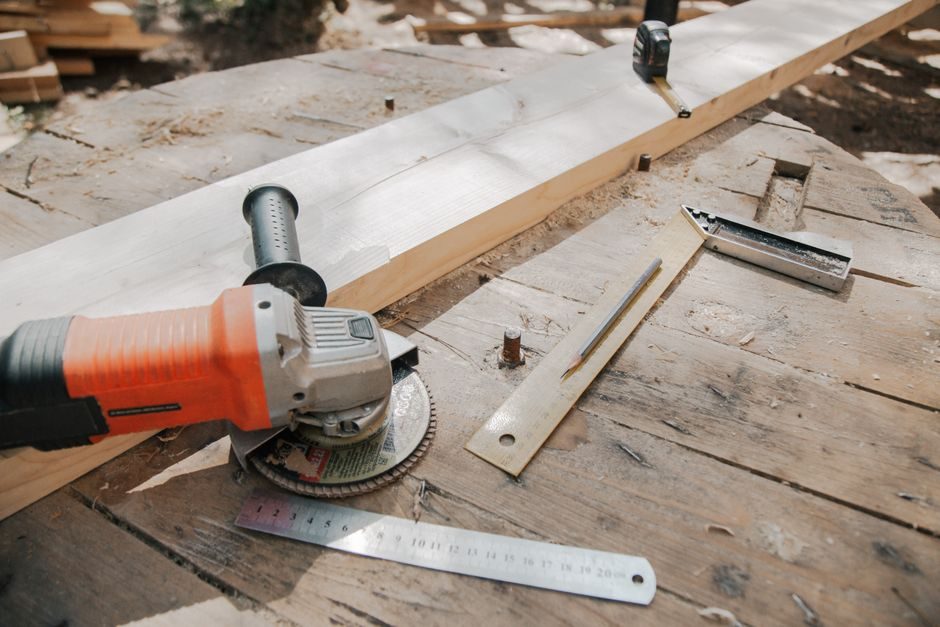
Industrial buyers evaluating an angle grinder in 2026 face a price spread of roughly 10× between a 100 mm entry-level corded unit around US$30 and a 125 mm brushless cordless kit with two 5 Ah batteries above US$300; the gap is set by wheel diameter, motor wattage, brushless vs brushed drive, and battery platform, not by brand markup [S1][S5].
The CUMI CAG 100 E, a 100 mm 600 W corded industrial grinder running at 11,000 rpm on 230 V / 50 Hz, is representative of the lower-cost electric class: M10 spindle, 16 mm bore, 1.5 kg bare tool [S1]. At the opposite end, 18 V brushless cordless kits in the Einhell TE-AG 18 Li Solo family were listed at GBP 58.37 (≈US$73) bare-tool in 2021 eBay listings, with a typical charger + case bundle pushing the total to the US$120–180 band once two batteries are added [S5].
Price Tiers by Wheel Diameter and Power
The market splits cleanly on disc diameter. 100 mm (4 in) corded grinders cluster between US$25 and US$60 for brushed models in the 500–750 W class; the 100 mm format suits light metal finishing and tight-body work and is the format CUMI's 600 W CAG 100 E targets at 11,000 rpm with a 1.5 kg head [S1]. 115 mm (4.5 in) corded units — the most common DIY format — span US$40–90 for brushed 700–900 W tools and US$90–150 for entry-level brushless builds. 125 mm (5 in) corded industrial grinders run US$60–180, with 1,400–1,500 W brushless pro units from the major power-tool brands at US$180–260 [S4][S6].
Above 125 mm, the 180 mm (7 in) and 230 mm (9 in) classes are concrete-cutting and stock-removal tools in the 2,000–2,600 W band, with published retail between US$200 and US$450. For an at-a-glance read of how the disc class maps to typical use, the encyclopedia angle grinder entry is the starting reference; the fettling grinder page covers the heavier foundry-duty variant above 180 mm, and the floor grinder page covers the walk-behind concrete class that uses the same 180–230 mm discs but at much higher power and with dust extraction.
Corded vs Cordless: Where the 2026 Money Goes
Corded tools still win on US$/watt and continuous duty. A 1,250 W corded 125 mm grinder from a Tier-1 brand retails for roughly US$130–180 bare-tool, with no battery premium. The same 125 mm brushless cordless bare-tool typically retails US$110–160, but adding two 5 Ah batteries and a fast charger moves the kit to US$220–320 — the platform lock-in is the real cost, not the tool [S5].
For shop-floor buyers weighing 18 V vs 230 V, the decision rule is straightforward: if the tool runs more than 30 minutes per shift on a stationary post, corded wins on US$/watt-hour; if the user is mobile and already owns a battery platform, the cordless premium breaks even at roughly 18 months of heavy use. The Einhell TE-AG 18 Li Solo 18 V cordless listed at GBP 58.37 in 2021 (≈US$73) is the historical price anchor; current 2026 listings for the same Solo platform with one battery and charger sit in the US$90–130 range, with bare-tool promotions dipping under US$70 [S5].
What Drives the Quote Beyond the Sticker
Three line items move the total cost of ownership more than the tool price itself: abrasive wheels, spare batteries, and duty-cycle rated motors. Abrasive discs are the recurring cost — a 125 mm Type 27 cutting disc is US$0.40–1.20 each, a 125 mm Type 27 grinding disc US$0.80–2.50, a 125 mm diamond cup wheel US$8–25, and a 125 mm diamond cutting disc US$4–12, depending on bond and segment height [S2]. A shop burning 20 cutting discs a day at US$0.80 spends roughly US$4,000 a year per grinder on consumables — several times the bare-tool price.
Battery replacement is the cordless-specific line item. A 5 Ah 18 V lithium pack costs US$60–110 to replace at 2026 retail; a 9 Ah pack US$110–180. IP-rated dust-sealed motors (IP5X or higher) command a US$20–50 premium but pay back in bearing life on masonry and concrete work.
How the Main Options Compare on Decision Criteria
Four criteria separate the main options for a 2026 buyer: cost (US$ bare-tool), continuous-duty capability, mobility, and consumable cost. Corded 100 mm brushed (CUMI-class) is the cheapest at US$25–60, runs indefinitely on mains, is light and mobile, and uses the cheapest 100 mm discs (US$0.30–0.80). Corded 125 mm brushed is the workhorse at US$50–150, runs indefinitely, moderate mobility, mid-cost discs. Corded 125 mm brushless pro adds variable-speed electronics, soft-start, and electronic brake for US$150–260 — the format most abrasive on a fabrication floor [S4].
Cordless 125 mm brushless 18 V kits run US$220–320 once batteries and charger are counted, are battery-limited to roughly 30–60 minutes of cutting per 5 Ah pack, and are fully mobile. The cost-per-cut analysis depends on shift length: at less than 30 minutes of cutting per day, cordless wins on operator productivity; at more than 2 hours per day, corded wins on electricity plus consumable consistency. For context on the type of work the two formats actually do differently, the angle grinder vs demolition hammer piece walks through the overlap between 1,100–1,500 W rotary grinding and percussive chipping.
Use-Case Cost Snapshots for 2026 Buyers
Auto-repair and light fabrication shop, single 125 mm corded 1,400 W tool: bare-tool US$110, US$8 disc kit per month, electricity negligible — total first-year outlay roughly US$200 with US$100/year recurring. Construction site with mobile 18 V cordless kit, 125 mm brushless, two 5 Ah batteries, fast charger: kit US$250–320, plus US$60–110 battery replacement every 2–3 years, plus US$6–10/day in diamond and cutting discs. Foundry or heavy fabrication on 180–230 mm corded: bare-tool US$250–450, 2,000+ W motor, IP5X dust sealing, US$15–30/day in fettling grinder-class consumables [S2][S4].
DIY and home workshop: 115 mm corded brushed 800 W tools are the sweet spot at US$40–70, with the full abrasive and accessory ecosystem under US$100 to start. DIY-focused kits on Alibaba list entry-level 100–125 mm brushed corded kits in the US$15–35 wholesale band for bulk buyers [S3]. Pakistani retail in 2022 saw Black & Decker 570 W 100 mm small grinders in the Rs. 3,500–5,500 band (≈US$12–20 at the time), a useful reference for what 100 mm brushed entry-level tools have cost at retail in emerging markets.
Standards, Safety and Warranty Line Items
Industrial buyers should weight the standards footprint, not just the price. CE-marked 230 V tools must meet EN 60745-1 and EN 60745-2-3 (hand-held electric tools safety, particular requirements for grinders); UL-listed 120 V tools follow UL 60745-1 / UL 60745-2-3 in North America. A brushless motor with electronic brake and soft-start is not a marketing line — it is a restart-after-power-cut safety feature, and a grinder sold into the European market must demonstrate the no-restart behaviour under EN 60745-2-3. [S1]
For a 2026 quote, the watch-points are: spindle thread (M10 for 100/115/125 mm, M14 for 150/180/230 mm — a wrong disc arbor is a US$15–40 re-ordering mistake), guard type (Type 27 cutting vs Type 27 grinding guards are not interchangeable, and many import shipments ship only with one), and whether the warranty covers the armature/motor (most pro brands offer 2–3 years, DIY brands 1 year). The angle grinder entry on SourceBySpec is the cross-reference for spindle, guard and disc-class spec ranges.
What to Track Over the Next Quarter
Two verifiable signals worth watching into Q3 2026: battery-pack pricing on 18 V 5 Ah Li-ion (a 10% drop moves cordless kit break-even by roughly 3 months), and the spread between M10 and M14 spindle-disc inventories in 115 mm and 125 mm formats — the 115 mm format has been gaining shelf space at DIY retailers in 2025–2026, and 125 mm disc pricing has firmed as a result [S3][S4].