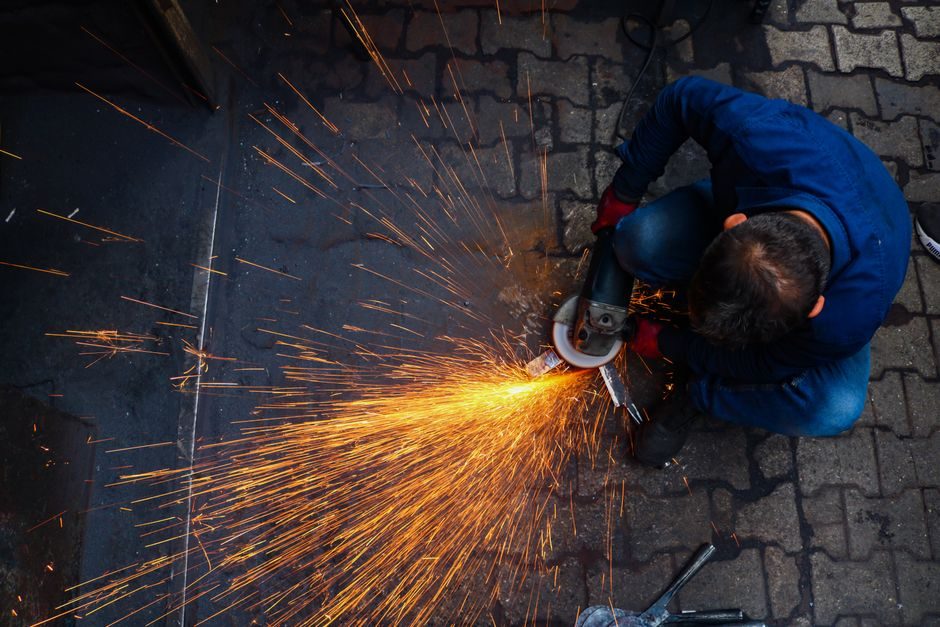
Specifying the right angle grinder in 2026 hinges on four spec gates: disc diameter from 100 mm to 230 mm, input wattage bands from 500 W portable class up to 2600 W heavy-cut, rated no-load speed between 6600 rpm and 12000 rpm, and spindle thread fitment (M10 × 1.5, 5/8"-11 UNC, or M14 × 2) — get any one wrong and the disc, guard or backing flange will not physically fit the machine.
For light fabrication shops, auto body work and site cleanup, 4-1/2" / 115 mm and 5" / 125 mm corded units in the 700–1100 W band are still the workhorse choice; 9" / 230 mm machines in the 2000–2600 W class are specified for masonry cutting, heavy stock removal and pipeline beveling [S2][S4][S9].
Disc Diameter and Power Class: The First Gate
Disc diameter is the single specification that locks in both the cutting depth and the required motor torque, and it is the first gate a buyer should set. The 100 mm (4") mini class typically pairs with 500–720 W motors for tight-body sheet-metal work; the 115 mm (4-1/2") and 125 mm (5") classes — the global volume sellers — pair with 700–1100 W motors; 150 mm (6") units sit in the 1200–1500 W range; 180 mm (7") units run 1500–2200 W; and 230 mm (9") machines need 2000–2600 W to keep peripheral speed inside the safe window for bonded abrasive or diamond blades [S2][S4][S9].
On a 9" / 230 mm platform, current export-catalog SKUs cluster around 2000–2400 W no-load rated input with a 6500–8500 rpm no-load speed — a band chosen so that a 230 mm abrasive disc running at the rated speed sits inside the disc maker's maximum peripheral-speed window, typically 80 m/s for reinforced Type 41/42 cutting wheels [S4][S9]. Undersizing the motor on a 230 mm disc is the classic cause of bog-down, glazing and disc shatter.
Speed, Voltage and Corded vs Brushless vs Cordless
Rated no-load speed is not a marketing number — it is a safety envelope. Standard 115–125 mm grinders ship at 11000–12000 rpm, 180 mm at 8000–9000 rpm, and 230 mm at 6500 rpm, all calibrated to keep peripheral speed of bonded abrasive wheels inside the 72–80 m/s band printed on the wheel label [S9].
48 V cordless grinders now match corded RPM in 115/125 mm sizes — 1000 W-class brushless platforms in this voltage band list 4-1/2" / 100 mm disc capacity and 7-speed electronics for matching speed to disc type and material [S6]. Compared with 18 V / 20 V max platforms, 48 V systems hold rated speed under load far better on 125 mm wheels. For fixed-shop work where extension cords and battery cost are not constraints, 220–240 V corded still wins on duty cycle; for site erection work where tripping over cables is a real hazard — see our demolition hammer 2026 buying guide on joules, chuck and vibration for adjacent site-tool spec logic — 48 V brushless is now the default.
Spindle Thread, Guard and Disc Fitment
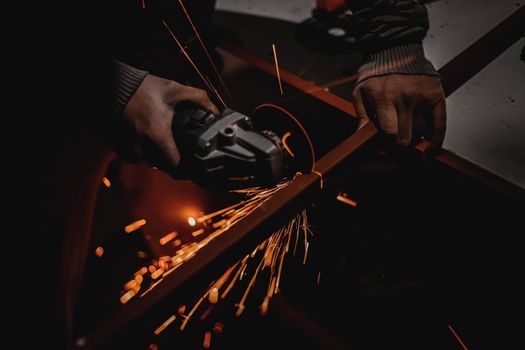
Three thread standards cover essentially every disc a buyer will fit: M10 × 1.5 on most 100/115/125 mm European and Asian models, M14 × 2 on 125/150/180/230 mm heavy class, and 5/8"-11 UNC on North American 7" and 9" machines [S9]. Adapters between M14 and 5/8"-11 are common, but stacking adapters to mount a wheel that physically clamps inside the guard throat is the most common fitment failure in the field.
Spindle lock geometry is the second fitment detail: pin-style spindle locks need a through-bore backing flange, while button-style locks accept flat backing flanges — and the two systems are not interchangeable within the same grinder [S9]. Buyers should also verify guard throat depth and inner diameter against the largest disc they intend to run; a 125 mm guard on a 125 mm disc leaves no allowance for raised-hub flap discs, while a 230 mm guard on a 230 mm wheel is a hard legal requirement under EN 60745-1 for hand-held grinders sold in the EU/UK.
Switch Type, Side Handle and Vibration
Three switch architectures dominate: slide switch (toggle on the side body, common on US 7"/9" metalworking grinders), paddle / dead-man switch (large lever that cuts power when released — the safe default in EU/UK under EN 60745-1), and trigger switch (small body-grip, ergonomic but requires a two-handed grip and is restricted in many industrial sites) [S9]. For pipeline, structural-steel and shipyard work the paddle / dead-man is the spec to write into the purchase order.
Use-Case Comparison: Four Job Profiles
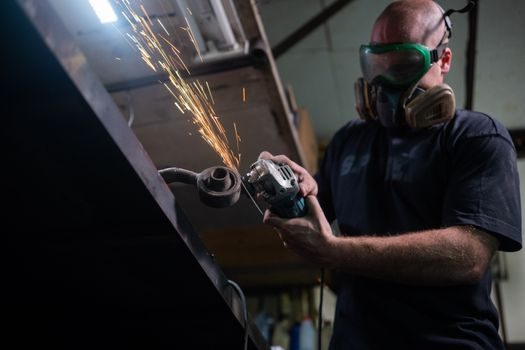
Four common job profiles and the spec bundle each one requires: (1) Auto body / sheet metal — 115 mm, 700–900 W, slide switch, 11000 rpm, M10 spindle, flap and cut-off wheels in 1.0–1.6 mm thickness; (2) Site structural steel — 125 mm, 1000–1100 W, paddle switch, 11000 rpm, M14 spindle, Type 42 depressed-centre cutting wheels up to 6 mm; (3) Masonry / tile / concrete — 180 mm, 1500–2000 W, paddle switch, 8000 rpm, diamond blades rated 80 m/s peripheral; (4) Heavy pipeline beveling — 230 mm, 2200–2600 W, paddle switch, 6500 rpm, M14 spindle, Type 27 grinding wheels and large-diameter flap discs [S2][S3][S4][S9].
For cross-shop procurement logic and how these spec gates tie back into FOB pricing bands and MOQ tiers, our adjacent cut-off machine 2026 price & cost guide breaks down the same lever set on the larger abrasive-cutting platform.
Accessories, Discs and the Disc-Matching Rule
Three accessory families do most of the work: reinforced Type 41/42 cutting wheels in 1.0–6.0 mm thickness for metal, Type 27 depressed-centre grinding wheels in 4–8 mm for stock removal, and diamond continuous-rim or segmented blades in 105–230 mm for stone and concrete [S3]. Each disc carries a printed maximum operating speed in rpm and a maximum peripheral speed in m/s — both must meet or exceed the grinder's no-load speed and the calculated peripheral speed of the wheel at that speed.
Backing flanges must match the disc centre bore (typically 22.23 mm for 100–230 mm reinforced wheels, 16 mm for some 100/115 mm), and the printed wheel date code plus EN 12413 / ISO 525 conformity mark are the two minimum print lines a buyer should verify on every box [S3][S9]. Heat and humidity in the UAE's coastal and desert environments shorten resin-bond shelf life, so stock rotation by date code — not by visual inspection — is the safe practice [S3].
Safety Standards and Sourcing Discipline
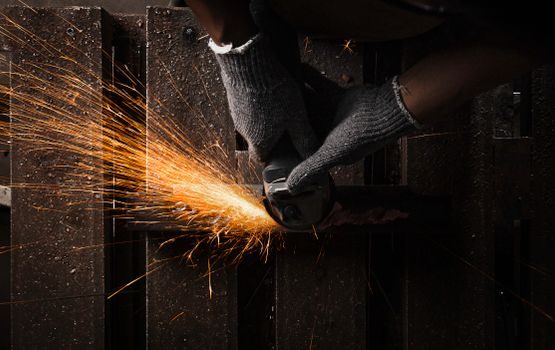
Three standards govern almost every angle grinder on a 2026 buy sheet: EN 60745-1 / IEC 60745-1 for hand-held motor-driven tools (mechanical guards, paddle-switch logic, noise and vibration test methods), EN ISO 5349-1 / 5349-2 for hand-arm vibration exposure (the 2.5 m/s² and 5 m/s² action and limit values), and EN 12413 for bonded abrasive product safety (wheel speed, date code, bursting-test requirement) [S9].
For cross-spec sourcing context — buyer MOQ tiers, OEM/ODM concentration and FOB band logic on an adjacent hand-held platform — the pneumatic nail gun 2026 price & cost guide and the rotary hammer 2026 supplier map read in parallel. The two signals worth tracking over the next 6 months are: (1) whether 48 V brushless platforms drop below 4 kg with a 125 mm wheel rated for 11000 rpm — currently the 4.5–5.0 kg ceiling — and (2) whether paddle-switch becomes mandatory in non-EU jurisdictions, which would force a slide-switch retooling across US-bound 7"/9" SKUs [S6][S9].
For component-level specifications, see angle grinder, fettling grinder, and floor grinder.