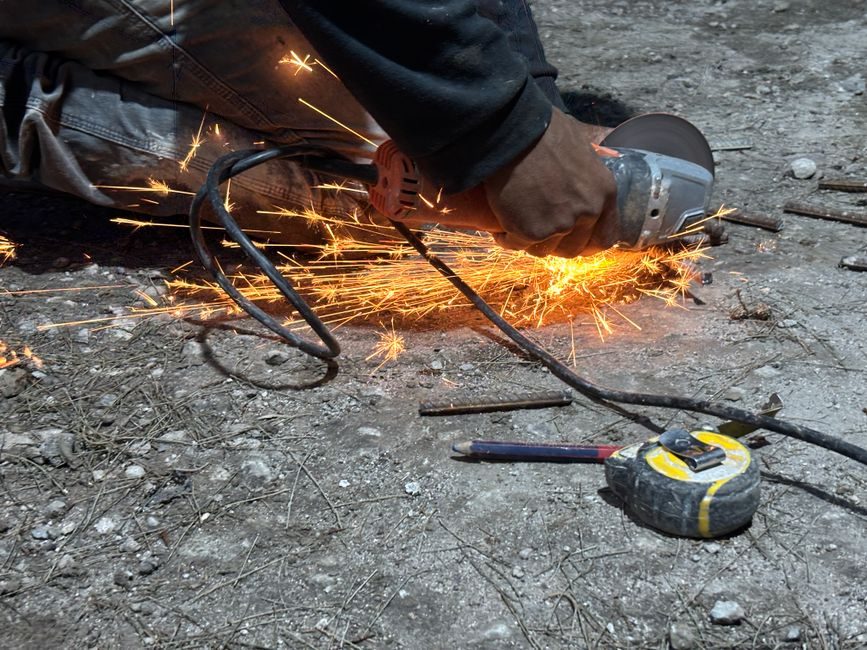
For bridge construction duty, 125mm cordless brushless and 125-150mm corded 900-2200W angle grinders are the two configurations most commonly stocked in 2026 wholesale catalogues aimed at structural and rebar work [S1][S2].
Bridge-site grinder requirements differ from generic metal-shop duty: cuts traverse rebar (typically 12-32mm dia.), structural plate (up to 25mm), concrete, stone and corroded weathering steel, often at height, near edge work or inside girder boxes. The selection map below ties the three decision variables — disc size, motor power and power source — to the four most common bridge tasks, and flags the operator-protection stack that procurement should specify alongside the tool itself.
Disc diameter and arbor: 100mm, 125mm, 150mm, 180mm
2026 wholesale SKU data shows 125mm as the most-listed disc diameter for construction-grade angle grinders, with 100mm cordless and 150mm corded as the two flanking sizes [S1][S2]. The 125mm class covers the majority of rebar trimming, plate edge dressing and field-cut bolt work; a 100mm brushless cordless at 19500 RPM is commonly stocked for overhead girder work where tool mass matters [S1]. 150-180mm corded models are reserved for deep cuts in plate and formed sections. Disc-arbor mismatch is the single most common field error: 125mm and 150mm discs do not interchange, and the spindle thread on a 125mm grinder will not accept a 150mm hub.
Power source: corded AC vs brushless cordless DC
Corded 900-2200W AC units dominate the 125-150mm heavy-duty class in 2026 manufacturer listings, while 18-20V brushless cordless platforms lead the 100-125mm class [S1][S2]. On a bridge deck with limited generator access, 18V brushless cordless at 19500 RPM removes trip-hazard cords and avoids the GFCI nuisance trips common on construction site distribution boards [S1]. On long-duration plate and rebar work, corded 2000-2200W AC units maintain rated speed under load; cordless platforms throttle as the battery state-of-charge drops, which manifests as slow cut rate and visible disc glaze. For procurement: spec cordless for overhead, scaffold and confined-space work; spec corded for ground-level plate prep and rebar cage dressing.
Motor power, RPM and no-load speed bands

2026 wholesale listings cluster 125mm corded grinders at 900W, 1100W, 1400W and 2200W, with the 1400-2200W band the most common for construction-power SKUs [S2]. No-load speed for 125mm stone-cutting discs is typically rated 11000-12000 RPM, and thin cutting wheels are run at the upper end to maintain chip clearance. The 19500 RPM figure that appears on 100mm brushless cordless listings refers to no-load speed on small-diameter discs and is not directly comparable to the 11000 RPM on a 125mm corded model — line speed at the disc edge scales with diameter, so a 100mm wheel at 19500 RPM and a 125mm wheel at 11000 RPM run at roughly the same peripheral speed [S1][S3].
Bridge-site duty tasks: rebar, plate, concrete, weathering steel
Bridge work maps to four abrasive stacks: 1.0-1.6mm Type 41 cutting wheels for rebar 12-32mm, 4-6mm Type 27 depressed-centre grinding wheels for plate edge and weld dressing, diamond tuck-point or cup wheels for concrete spall repair, and clean-and-finish flap discs (Type 27, zirconia alumina) for weathering steel burnishing where a corrosion-protective oxide layer is desired [S3]. On the broader angle grinder selection map for tunnel construction sites, the same abrasive stack is used but with a much higher proportion of diamond tooling and a wet-cutting requirement that bridge deck work does not impose. The bridge-versus-tunnel divergence is mostly environmental: tunnel work is wet and dust-bound, bridge work is wind-exposed and often at height.
Operator protection, dust and the bridge-site safety stack
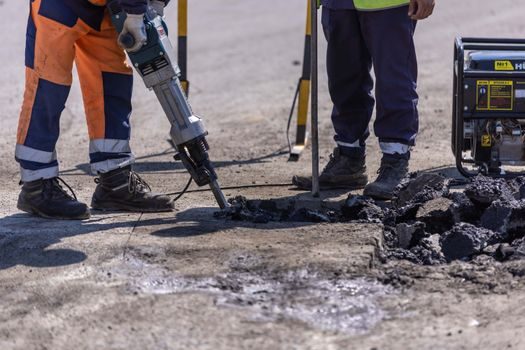
Angle grinders are the leading causal agent for hand and eye injuries in construction industry statistics, and bridge sites add the fall-hazard dimension because cut-off wheels bind and kick back [S3]. A procurement-spec for a bridge-deck grinder should include: an adjustable tool-less disc guard (mandatory, not optional), a dead-man paddle switch (preferred over a slide switch for site work because the tool stops on release), a side handle fitted at the 3 o'clock or 9 o'clock position relative to the disc rotation, and a tether or lanyard attachment for any tool used above 1.8m. For cut-on-rebar at deck level, a Type 41 cut-off wheel rated at least 80 m/s peripheral speed on a 125mm guard is the minimum, and discs must be stored dry — moisture-contaminated resin-bonded wheels are a documented shatter risk.
Selection comparison: 100mm brushless cordless vs 125mm corded 1400W vs 150mm corded 2200W
Decision criteria for the three dominant configurations: 1. Typical bridge task — 100mm brushless cordless wins for overhead rebar trim and confined-space work, 125mm corded 1400W wins for ground-level plate and rebar, 150mm corded 2200W wins for deep cuts in 20-25mm plate and formed sections. 2. Mass and operator fatigue — 100mm cordless is the lightest class and is preferred for shift-long overhead use; 150mm corded is heaviest and is typically used in two-handed short-duration cuts. 3. Power-source logistics — cordless removes the GFCI and trip-hazard problem on deck but introduces battery-swap downtime; corded needs a 16A 230V supply and a residual-current device on the source. 4. Cost per tool and consumables — 100mm cordless platforms carry higher upfront cost per tool but the discs are cheaper; 150mm corded has lower tool cost per watt but the 150mm abrasive disc is the most expensive consumable. A useful proxy: budget the tool itself and three months of abrasives together, not separately — the consumable line is typically 3-5x the tool cost over a project. [S2]
Sourcing, standards and what to verify on a 2026 OEM datasheet

For a procurement engineer, the minimum datasheet check on a 2026 OEM or wholesale listing is: rated voltage and frequency, rated input power (watts, not peak), no-load RPM, disc diameter and arbor, spindle thread, weight without cable, sound pressure LpA and vibration ahv at the side handle, double-insulation class and the relevant regional compliance mark (CE/UKCA for Europe, CCC for China, UL/cUL for North America) [S1][S2][S3]. EN 60745-2-3 is the harmonised standard that covers hand-held motor-operated electric tools — safety — particular requirements for grinders, and the datasheet should reference it or its regional equivalent; without that reference the tool is not procurable on most European and UK bridge projects. EN ISO 28927-1 covers vibration measurement at the handle and is the standard procurement engineers should ask for when comparing fatigue figures between bidders. The angle grinder encyclopedia entry is a useful cross-check on the generic duty classes; the fettling grinder and floor grinder entries cover the heavier stationary cousins that bridge precast yards often use instead of handheld tools for production-rate work.
Trackable signals for the next procurement cycle: published updates to EN 60745-2-3 brushless-motor testing annexes (review the harmonised catalogue quarterly), regional dust-extraction guard retrofits being offered by the major 125mm corded OEMs, and any move by the major bridge owners to mandate tether attachment points on all handheld tools used above deck level. Sourcing from 2026 wholesale platforms, 125mm brushless cordless platforms under $25 bare-tool are now widely listed and represent a price floor that the procurement engineer should not beat further at the expense of the CE/UKCA mark and EN 60745-2-3 datasheet compliance [S1][S2].