
In tunnel construction, the angle grinder is a secondary finishing tool rather than a primary excavation implement, and its selection pivots on three numbers: disc diameter 110-180 mm, continuous power 0.9-2.5 kW, and no-load speed 8,500-12,000 rpm [S1][S4].
The duty profile inside a tunnel differs sharply from a fabrication shop: cutting temporary rebar, dressing shotcrete flash, grinding segment gasket seats, and deburring ring-build welds all happen in a confined, often wet, sometimes explosive-gas environment that excludes a standard 230 V domestic corded tool [S1][S3].
Duty profile: what the tunnel actually asks an angle grinder to do
A typical shield-tunnel segment ring uses temporary steel cross-joists, T-bolts and starter bars that must be trimmed flush before the next ring is erected; an angle grinder fitted with a 125 mm thin cutting wheel is the conventional tool for that trim, and 125 mm is the de-facto standard disc size for ring-build work in segmental tunnels [S3][S4].
Soft-soil shield tunnels such as the Shaoxing Rail Transit Line 1 interval settle measurably during construction, and adjacent utility openings, rail-clip pockets and invert drainage grooves are finished by hand-held grinding after the TBM passes [S2]. The operator is rarely in a clean, dry booth, so dust and water ingestion are the dominant failure modes, not burn-out from over-cycles.
Power source: pneumatic, corded AC, or cordless — matched to atmosphere
Pneumatic angle grinders in the 2.5 kW (3.4 hp) class run at 8,500 rpm or 12,000 rpm with 110-180 mm wheels and are the default choice where a flammable atmosphere (methane from adjacent strata, residual LPG from service vehicles) is foreseeable [S1]. Compressed-air plants also tolerate water and slurry ingress far better than an open-frame induction motor.
Corded AC units dominate the 900-2200 W range with 125 mm wheels and are used in dry tunnel reaches with reliable grid power; the typical 125 mm electric angle grinder is offered from 900 W to 2200 W on Chinese OEM listings to cover both 110 V and 220 V regional grids [S4]. Cordless 18-54 V brushless platforms are now competitive on light rebar-trim duty but are still rare on heavy segment-grinding work because battery thermal limits shorten continuous-run duty cycle.
Selection criteria, ranked
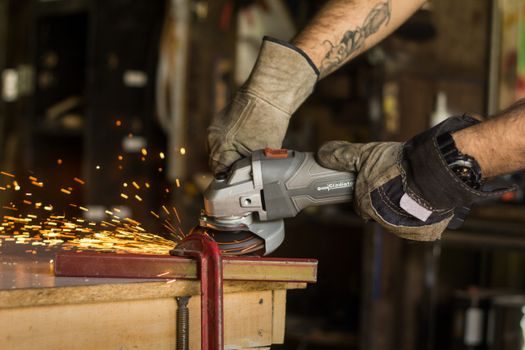
Disc diameter, power, no-load speed, weight, and ingress protection are the five numbers that determine whether a given tool can be specified into a tunnel method statement. The 4½ in (115 mm) / 5 in (125 mm) disc is the workhorse for ring-build; 7 in (180 mm) and 9 in (230 mm) wheels appear only on bench-style or floor angle grinders used in the portal workshop, not on the face [S3].
Weight under 3 kg for a 125 mm cordless tool is a hard limit for overhead trimming; corded 125 mm tools run 2.0-2.8 kg, and 180 mm pneumatic units run 4-6 kg with the hose [S3][S1]. For a side-by-side criteria view, the table below lines the three power-source families against four decision axes used in tunnel method statements.
Criteria comparison: pneumatic vs corded AC vs cordless
On power density, pneumatic 2.5 kW at 2.5-3.0 kg is the highest, followed by 2200 W corded AC at 2.5-2.8 kg, then 18 V-54 V brushless cordless at 0.8-1.5 kW but 2.0-3.0 kg including the battery [S1][S3][S4]. On flammable-atmosphere suitability, pneumatic and air-driven units are inherently safe; corded AC requires a residual-current device plus an Ex-rated supply; cordless removes the electric-shock risk but the brushless motor and battery cell chemistry still need an ignition-risk assessment for methane.
On water and dust tolerance, pneumatic leads because there is no electronics enclosure, corded AC needs at least IP54, and cordless units must be checked to IP55 or better for the wet invert. On continuous-run duty cycle, pneumatic can run as long as the compressor supplies, corded AC is limited mainly by brush life (≈100-200 hours on brushed, far longer on brushless), and cordless is limited to 15-45 minutes per battery at full throttle [S1][S3][S4].
Who an angle grinder is for, and who should not be specifying one
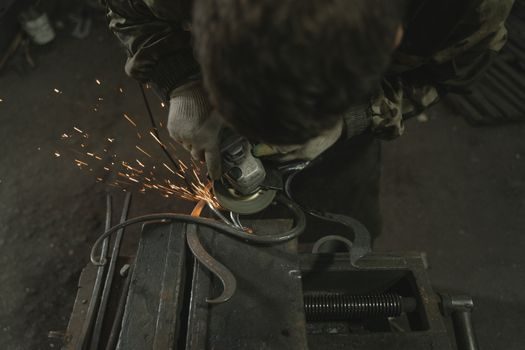
The tunnel-side user is the ring-build crew, the shotcrete finisher, and the welder's grinder operator cleaning rebar and lugs after burn-out. For masonry and concrete-cutting-only operations, a masonry angle grinder on a dust-extraction shroud is the better match because the disc spec, dust port and the OSHA/EN-compliant extraction differ from a rebar-trim tool [S1][S3].
It is not the right tool for primary concrete demolition inside the tunnel, which is done with hydraulic breakers or roadheader picks, and it is not the right tool for floor grinding or large-area surface preparation, which belongs to a floor grinder with a planetary head and HEPA dust pickup [S1]. Specifying a 125 mm hand-held tool where a 400 mm walk-behind machine belongs wastes labour and creates a respirable-crystalline-silica hazard.
Standards, ingress, and operator-side safety
Disc-speed marking to ISO 7010 and a wheel speed no greater than the marked maximum on the abrasive wheel are non-negotiable on any angle grinder entering a tunnel ring-build, and the disc guard must be adjusted to the workpiece before each cut [S3]. In the EU, a powered hand tool used in a potentially explosive methane atmosphere in a tunnel falls under ATEX 2014/34/EU for the equipment and 1999/92/EC for the worker-side risk assessment, but the exact zone classification (Zone 1 vs Zone 2) is set by the project's HSE plan, not by the tool vendor [S1].
Personal-protective equipment on the operator side is a face shield rated to the disc speed, hearing protection above 85 dB(A), and an FFP3 or half-mask respirator for silica dust when no extraction is fitted [S3]. A dead-man paddle (kill switch on release) and a brake that stops the wheel within a few seconds are the two controls that differentiate a tunnel-rated tool from a generic DIY product.
Limitations, failure modes, and cost-of-ownership signals
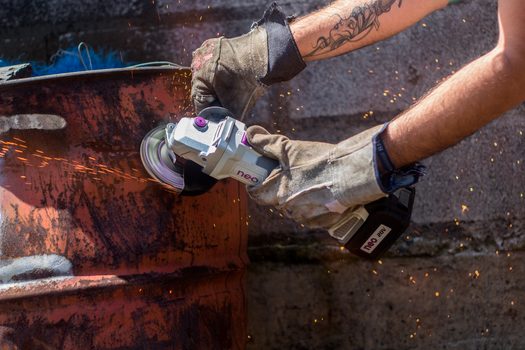
The dominant failure mode on a tunnel angle grinder is not motor burn-out but water ingestion into the bearing housing, which causes spindle runout and disc shatter; pneumatic tools survive this, sealed brushless cordless tools survive it, and open-frame brushed AC tools do not [S1][S3]. The second failure mode is abrasive-wheel disc consumption: a 125 mm cutting disc on rebar typically lasts 30-80 cuts before reaching minimum diameter, and the per-disc cost dominates consumable spend over the tool's service life.
Cost-of-ownership signals to track on a 2026 procurement round: 125 mm wheel price per piece from Chinese OEMs on wholesale listings is the budget benchmark, mid-tier branded 125 mm electric tools are 3-5× the OEM tool price, and pneumatic 180 mm industrial units from European vendors such as AMTRU sit 10-20× above the 125 mm entry-level electric, with a spindle, parallelogram compliance and robot-mounting option that justifies the premium in automated cells rather than hand-held tunnel work [S1][S4][S5]. On the same line, look for parallelogram-compliance kinematics when the angle grinder is mounted to a robot arm for rail-grinding trolleys, because the parallelogram mechanism keeps the wheel angle constant as the compliance spring deflects [S1].
Trackable signals for the next procurement cycle: (1) the share of tunnel ring-build tenders that list a specific disc size and power class in the method statement, (2) OEM entries with 125 mm brushless cordless platforms rated IP55 or above, and (3) the convergence of pneumatic and cordless platforms on a 12,000 rpm no-load speed at the 125 mm class — the spindle speed band that has been stable for industrial angle grinders since 2010 [S1][S3].
Spec-level background on the components involved: fettling grinder.
For related coverage, see Draw-Wire Sensor vs Inclinometer: 2026 Spec Map and Selection Guide.