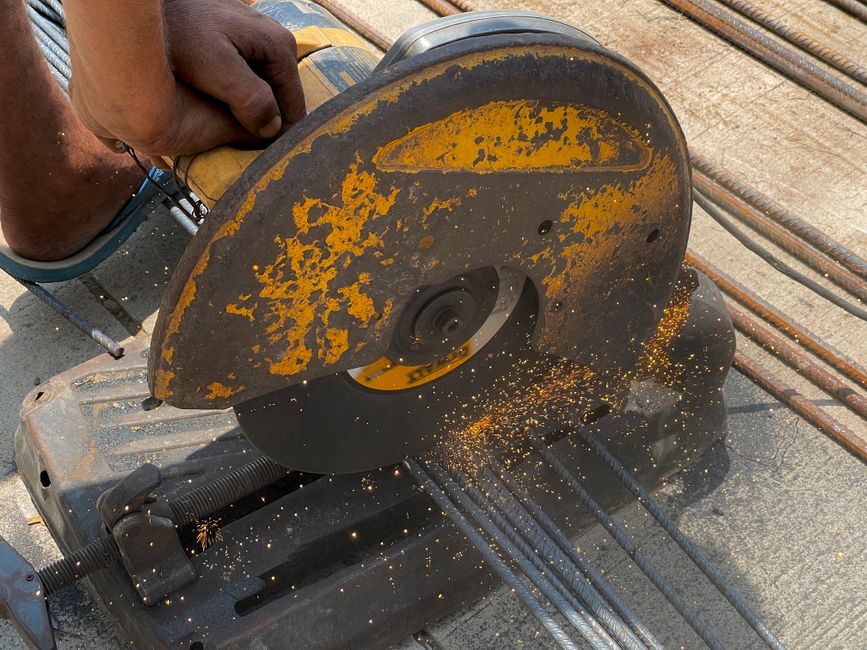
A 4-1/2 in (115 mm) corded angle grinder in the 1100–1300 W class, paired with a 4-1/2 x 0.045 in Type 27 cutoff wheel, handles roughly 90 % of residential HVAC sheet-metal cutting and grinding on the jobsite; the remaining 10 % is thicker commercial gauge that justifies a 7 in (180 mm) tool [S4][S6].
HVAC installation crews cut galvanized mild steel from 26 gauge (0.45 mm) up to 10 gauge (3.4 mm), dress weld seams on rectangular duct, and deboss mounting holes for line-set and flue penetrations; each task stresses a different combination of rpm, wheel thickness, and motor cooling [S5].
Wheel Diameter and Disc Selection: 4-1/2 in vs 5 in vs 7 in
A 4-1/2 in (115 mm) disc runs near 11000 rpm no-load on most corded motors and is the smallest size a trim installer can reasonably control one-handed in a plenum, with a 0.045 in (1.0–1.2 mm) Type 27 cutoff wheel delivering clean galvanized cuts at 26–22 gauge without distortion [S4]. A 7 in (180 mm) grinder rotates near 8000 rpm no-load and is the practical ceiling for HVAC; it is specified only when the cut stack reaches 12 gauge (2.7 mm) or thicker, and many site safety plans in commercial work restrict 7 in cutoff use to a two-handed, glove-and-guard setup [S4]. Wheel standard reference is ANSI B7.1 for the safety/selection rules governing the abrasive itself, and OSHA 29 CFR 1926.303 governs abrasive-wheel machinery on construction sites.
Power Source: Corded AC vs Brushless Cordless vs Pneumatic
Corded 120 V / 60 Hz angle grinders in the 1100–1300 W class remain the default on HVAC work because they sustain full load speed through long cuts in 16-gauge (1.5 mm) galvanized duct, where a 18 V/20 V brushless cordless tool will derate 15–25 % as cell voltage sags below 18 V under load [S4]. Brushless cordless 18 V platforms have closed the gap on cut count — a 5.0 Ah pack typically delivers 35–50 cuts through 2 in EMT or 1-1/4 in unistrut before the tool speed-limits itself on a hot pack — and they are now the standard for service vans where running a 14 AWG extension cord into a finished attic is not practical [S4]. Pneumatic 4 in and 5 in angle grinders from the TFT Pneumatic / Fuji-line category are specified only where ignition risk rules out electric motors (Class I Div 1 retrofit rooms, hydrogen-side chiller plants) or where an intrinsically safe environment rules out brushless ESC electronics [S6]. A straight corded-vs-cordless comparison for an HVAC fitter normally reduces to: corded for new-construction, cordless for service and retrofit, pneumatic only for hazardous-area work.
Duty Cycle, Weight, and Vibration on Ductwork Runs

Bare-tool weight lands at 1.6–2.0 kg (3.5–4.4 lb) for a 4-1/2 in corded head with side handle, and crossing 2.3 kg in the same size class measurably increases forearm fatigue over a 4 h install — a documented driver of cut-quality drift on long rectangular-duct seams. Tri-axis vibration per ISO 28927-1 (hand-transmitted vibration measurement) sits near 5–7 m/s² a(hv) for most 4-1/2 in heads in this class; daily exposure A(8) above 2.5 m/s² puts the operator on the action-value track, so anti-vibration gloves and 15-min job-rotation are now standard on union HVAC installs.
Wheel Type Match: Cutoff vs Grinding vs Flap vs Diamond
Type 27 (depressed-center) 4-1/2 x 0.045 in cutoff wheels are the correct primary choice for sheet-metal cuts because the depressed geometry keeps the arbor nut inside the cut kerf and allows a 15°–30° working angle without binding the flange [S4]. Type 27 grinding wheels in 4-1/2 x 1/4 in (6 mm) thickness are reserved for weld-seam dressing on black-iron flue and boiler vent piping, not for sheet metal — using a 1/4 in grinding wheel on 26-gauge (0.45 mm) galvanized stock will warp the panel in 2–3 seconds. Flap discs (Type 27, 4-1/2 in, 40–120 grit) handle paint and zinc-burr cleanup after the cutoff pass and are the only disc that should touch the visible side of a supply-register boot. Diamond tuck-point or segment blades are a different tool family and are not used on galvanized HVAC sheet; over-specifying them on 26-gauge stock shatters the disc in under 10 s of contact.
Safety Guard, Arbor, and Site-Specific PPE
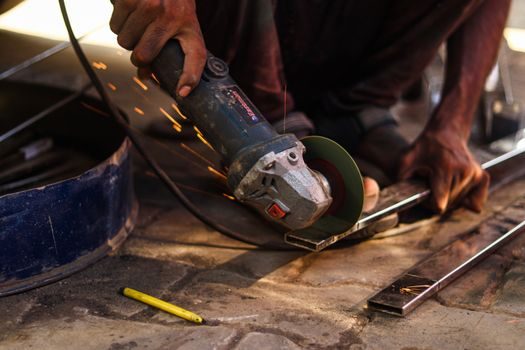
Type 27 cutoffs must run with the wheel guard rotated to the operator side and a closed-face shield plus Z87.1-rated safety glasses; ANSI Z87.1-2020 sets the eye protection standard, and OSHA 29 CFR 1926.95 governs the general PPE duty on construction. The standard 7/8 in (22.23 mm) arbor is universal across 4-1/2, 5, and 7 in discs in this class, so crews do not need two arbor adapters — a common source of out-of-balance vibration when a 5/8-11 adapter is misused on a 7/8 in spindle. Galvanized steel cuts at the speeds above produce zinc-oxide fume well above the OSHA PEL action level of 5 mg/m³ for total zinc oxide; the practical fix is a half-mask N95 or, on hot galvanized, a P100 with organic-vapor relief, plus local exhaust ventilation whenever a return-duct cut is made indoors. For more on duty-cycle selection across tool platforms, see this Angle Grinder Spec Map for Demolition: Wheel, Power, and Duty guide. [S2]
Real HVAC Tasks vs the Right Tool Setting
Trimming a 26-gauge supply boot to fit a floor register: 4-1/2 in corded, 0.045 in Type 27 cutoff, no grinding pass, 30° lead angle, one-handed control; cut time per side 5–8 s. Cutting a 16-gauge (1.5 mm) combustion-air inlet on a furnace cabinet: 5 in or 7 in corded, 0.045 in Type 27 cutoff, two-handed grip, light clamp on the workpiece; expect 25–40 s per side. Dressing a weld seam on a black-iron flue: 4-1/2 in corded, 1/4 in Type 27 grinding wheel, 15°–20° blade angle, sparks directed away from combustibles; never substitute a cutoff wheel here. Drilling a 4 in (100 mm) round pipe penetration: stop — this is a hole saw or bimetal step drill job, not an angle-grinder task; a 4 in cutoff leaves a 0.045 in kerf that destroys the press-fit tolerance on standard register boots and flex duct cuffs. [S2]
Acceptance Test and When Not to Repair the Tool
Acceptance check on a new or freshly serviced angle grinder: no-load speed within ±10 % of nameplate (11000 ± 1100 rpm for 4-1/2 in class), brush length ≥ 6 mm on brushed motors, guard rotation detent holds at every 30° stop, spindle runs without side play beyond 0.05 mm, and the side handle threads fully home with no cross-thread [S4]. Reject and tag out if: the armature has visible commutator burn across more than 25 % of the bar width, the guard latch no longer indexes, the on/off paddle fails to return to OFF under spring pressure, or vibration a(hv) exceeds 10 m/s² on a test bar — all four are documented trigger conditions for retirement, not repair. For adjacent selection context on related metalworking and process tools, the Masonry Angle Grinder Selection: Disc, Power, and Dust Match piece covers dust-extraction pairing for the same platform.
The underlying component specifications are covered under angle grinder, fettling grinder, and floor grinder.