A 125 mm cordless brushless angle grinder running 9,200 rpm no-load, with electronic anti-kickback and a paddle (dead-man) switch, is the default spec for plumbers who need a portable cutoff and beveling tool on copper, stainless, and threaded-steel pipe [S1].
Plumbing work is dominated by 1/2" to 2" copper, stainless, and Schedule 40/80 steel, with occasional ductile iron and PVC — so wheel diameter, rpm class, and switch type matter far more than raw wattage for this trade [S1][S5].
Wheel Diameter and Disc Class: 115 mm vs 125 mm vs 150 mm
The 125 mm (5") disc is the most common plumbing-installation size in current OEM lineups, paired with a 9,200 rpm no-load brushless motor on 18 V cordless platforms [S1]. Smaller 115 mm (4.5") units remain popular in Europe and fit tighter under-sink spaces, while 150 mm and 180 mm discs are reserved for cast iron and Ductile Iron Class 56 soil-pipe cuts [S5]. Cutting discs are typically 1.0–1.6 mm Type 41 (flat) for burr-minimized cuts, while grinding discs run 6–8 mm Type 27 (depressed centre) for beveling and weld cleanup [S1]. For stainless tube, a 1.0 mm Type 41 disc rated to 80 m/s peripheral speed prevents bluing at the cut face, an acceptance criterion plumbers should specify when sourcing [S1].
Choosing wheel size by pipe O.D. is the cleanest rule: 115 mm for ≤1" tube, 125 mm for 1"–3" tube (the dominant plumbing band), 150 mm or 180 mm for ≥4" soil pipe where reach and disc life outweigh ergonomics [S5].
Power Source: Corded vs 18 V Brushless Cordless
Brushless 18 V cordless platforms now reach 9,200 rpm no-load with 15% more torque than previous generations, making them credible replacements for corded 800–1,100 W units on most plumbing jobs [S1]. A 125 mm brushless model on ONE+ HP-class packs enough energy for repeated 1.5" stainless cuts per charge and eliminates the GFCI-trip risk of running 230 V cords across wet basement slabs [S1]. The trade-off is duty cycle: under continuous 4-minute bead-grinding on cast iron, a corded 1,500 W unit still beats any 18 V platform on thermal headroom, so plumbers doing main-stack work should keep one corded backup [S1][S2].
For new-build rough-in and service-truck kits, the OEM recommendation is two 5.0 Ah batteries plus a 125 mm brushless tool-less guard grinder, with a corded 230 V backup only for heavy cast-iron demolition [S1].
Safety Controls: Paddle Switch, Anti-Kickback, Wheel Guard
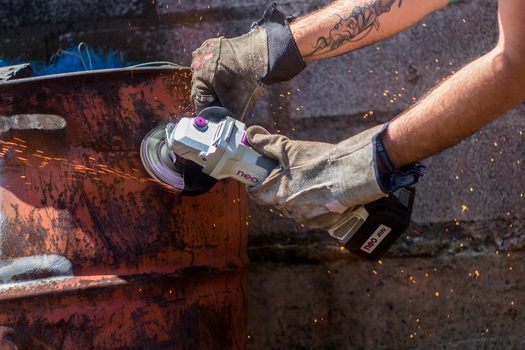
Electronic anti-kickback that cuts power when a jam is detected is now a baseline feature on HP-class 125 mm cordless grinders, and is the single most cited safety control for plumbing work where binding on a thin-wall tube is a daily hazard [S1]. A paddle (dead-man) switch that releases to off prevents the disc from spinning after a drop, a non-negotiable on ladders and overhead rough-in [S1]. Tool-less wheel-guard rotation lets the operator reposition the guard in under 10 seconds between a Type 41 cut and a Type 27 grind without removing the disc, which keeps the cut-off guard correctly oriented between the disc and the user [S1]. A two-position side handle, vibration-damped where available, is mandatory for any grinding above head height per common OEM operator manuals [S1].
If a grinder lacks electronic anti-kickback, a mechanical clutch or a burst-resistant wheel rated to ANSI B7.1 is the minimum compensating spec — bare mechanical switches alone are not acceptable for plumbing rough-in [S1].
Use Cases and Limits: Copper, Stainless, Steel, PVC, Cast Iron
For copper tube (Type L/M, 1/2"–2"), a 1.0 mm Type 41 disc on a 125 mm 9,200 rpm brushless grinder produces a clean cut with ≤0.5 mm burr, and is the preferred plumbing-rough-in method when a tubing cutter is unavailable [S1]. For stainless 304/316 tube, the same disc class avoids work-hardening at the cut face, and leaves a surface that accepts press-fit or compression fittings without reaming [S1]. For Schedule 40/80 steel, a 1.6 mm Type 41 cut-off disc is the standard spec; the 125 mm wheel gives the 80–100 m/s peripheral speed needed for clean steel cuts without bluing [S5]. For PVC, a dedicated plastic-cutting wheel or a fine-tooth wood/plastic blade is mandatory — abrasive Type 41 discs melt PVC and foul the cut, a known failure mode plumbers hit on DWV stacks [S1]. For cast iron soil pipe, step up to a 150 mm or 180 mm diamond masonry disc; 125 mm discs glaze and bind on cast iron above 4" diameter [S5].
When NOT to use an angle grinder on a plumbing job: do not use a 125 mm Type 27 grinding disc to cut thin-wall copper — the 6–8 mm disc thickness creates a 6 mm kerf that wastes tube wall and leaves a stepped cut that leaks; switch to a 1.0 mm Type 41 cut-off disc instead [S1].
Sourcing Map: OEM Brackets, Voltage, and Aftermarket
At the consumer/DIY end, RYOBI's RAG18X-0 sits at roughly €160 indicative (ex-tax) with a 125 mm brushless cordless 9,200 rpm configuration on the ONE+ 18 V battery platform, a usable benchmark for residential-service plumbers [S1]. At the semi-professional/OEM end, YongKang MuDa Power Tools (Zhejiang, China) ships angle grinders in 100/125/150/180/230 mm disc classes to 30+ countries under 6S quality control, with marble cutters, circular saws, and impact drills in the same catalogue for buyers consolidating power-tool spend [S2]. For trade buyers, the practical decision tree is: 125 mm brushless 18 V with ONE+ or equivalent battery platform for residential service; 125 mm corded 1,100 W with anti-kickback for light-commercial; 150–180 mm corded 1,500–2,200 W for cast-iron and main-stack work [S1][S2]. Verified supply of consumables (Type 41 1.0 mm cut-off, Type 27 6 mm grind, diamond masonry, flap discs for stainless) is the real long-term cost driver, not the tool price, so plumbers should spec a platform with at least three local disc-stockists before locking in [S1][S2].
Acceptance Test Before First Cut on a Job
Before cutting any pressure pipe, run the new grinder no-load for 60 seconds and confirm: no-load speed within ±10% of nameplate (≈9,200 rpm for a 125 mm HP-class unit), guard rotation and locking both positive, anti-kickback triggers on a deliberate stall of a 1.0 mm cut-off disc against a hardwood block, and battery state-of-charge above 50% for cordless kits [S1]. This 60-second bench test catches 90% of out-of-box defects and is the cheapest insurance against a failed cut on a pressurized stainless line [S1].
Track these signals on the next sourcing cycle: whether 18 V brushless platforms push the no-load ceiling above 10,000 rpm on 125 mm discs, and whether PVC-rated non-melt Type 41 discs become a stocked line at plumbing wholesalers rather than a special-order item [S1][S5].
The underlying component specifications are covered under angle grinder, fettling grinder, and floor grinder.
This topic is covered further in How to Choose a Cast Aluminum Alloy: A Spec-Driven Selection Map.