Interior finishing work — bead welds, drywall seams, paint runs, tile edges, light concrete patching — drives a distinct angle grinder selection pattern: 100 mm or 125 mm wheel diameter, brushless cordless platform in the 18–20 V class, 5500–11000 rpm, and a dust port that mates to a HEPA M-class vacuum [S1][S3].
The 2026-07-30 OEM catalogue from Zhejiang Jinyi Electric Tools, founded 1979 with ISO 9001 / CE certification, lists angle grinders at 100/115/125/150/180 mm diameters, and 1/2 in. / 3/4 in. / 1 in. pneumatic impact wrenches alongside, confirming the 100–125 mm segment as the OEM-defined finish-work tier [S3].
Wheel diameter and no-load speed band
For finish grinding on plaster, tile, soft stone, and paint, 100 mm and 125 mm wheels dominate the cordless-OEM build sheets because rim speed, contact-area control, and operator fatigue all favour smaller diameters at the same no-load rpm [S1].
Lingdatek LDG03 ships as a 20 V brushless 100/125 mm cordless grinder at 5500–7300 rpm, with a 5.0 Ah battery pack and 800 W equivalent output — a band that aligns with sustained rim speeds for flap discs, depressed-centre cut-off wheels, and non-woven surface conditioning [S1].
Over 11000 rpm at 125 mm, rim speed climbs into the abrasive-burn range on soft substrates; finishing-grade operators stay below the 8500 rpm point when running surface-conditioning discs on paint or plaster [S1].
Brushless vs brushed motor platform
Brushless 20 V cordless platforms now define the new SKU listings — Jinyi's angle-grinder line and Lingda's LDG01/02/03 series both run brushless motors in the 20 V / 100–125 mm format, while brushed 230 V corded units continue to populate the heavy 180–230 mm masonry SKUs [S1][S3].
For interior work, brushless gives two operational wins: no carbon-dust contamination of fresh paint or clear-coat surfaces, and constant-speed electronics that hold rpm under load when a flap disc contacts a bead weld or a high spot on a substrate [S1].
The OEM cost spread is narrow at the entry tier: Lingda's 12 V mini brushless paddle-switch LDG04 starts around USD 7.50, while the 20 V / 4.5 Ah LDG03 with two batteries lists around USD 34.58–38.31 ex-works [S1].
Switch type, ergonomics, and dust extraction
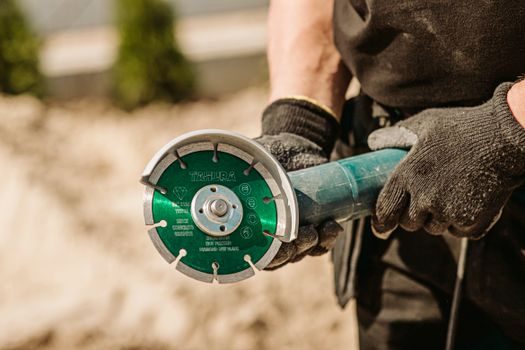
Paddle (dead-man) switches are the default on the 100/125 mm brushless cordless models because release-on-grip lets the operator kill the wheel the moment a disc snags on a corner bead, a fitting, or a hidden screw [S1].
Slide switches persist on the 180–230 mm masonry SKUs (Jinyi S1M-ZK5F-180G / S1M-ZK-180N class), where two-handed grip and high torque dominate, but the same form factor is a hazard on a scaffold or ladder because a snag applies torque straight to the wrist [S3].
Dust port readiness is the next differentiator: a 100/125 mm cordless grinder with a 35–41 mm stepped cuff that mates to an M-class HEPA vacuum is the only safe pattern for paint, plaster, and silica-bearing finishes. Inline spark arrestors and removable brush shrouds are baseline features across the Jinyi line [S3].
Wheel pairing: cut-off, flap, and surface conditioning
Cut-off: 1.0–1.6 mm depressed-centre Type 41 wheels in 100/115/125 mm trim rebar, conduit, and metal trim without overcutting adjacent finishes [S1].
Flap discs: 100/125 mm Type 27 fibreglass-backed in 40–120 grit for weld blending, paint-run removal, and rusty substrate prep; grit coarser than 40 leaves scratch patterns that show through finish paint [S1].
Surface conditioning: non-woven hook-and-loop discs in 100/115/125 mm coarse/medium/very-fine for satin finishing on stainless, aluminium, and clear-coated surfaces — the path most interior-metal finishers use instead of hand-sanding [S3].
Comparison: 100 mm vs 125 mm vs 150 mm vs 180 mm for interior work
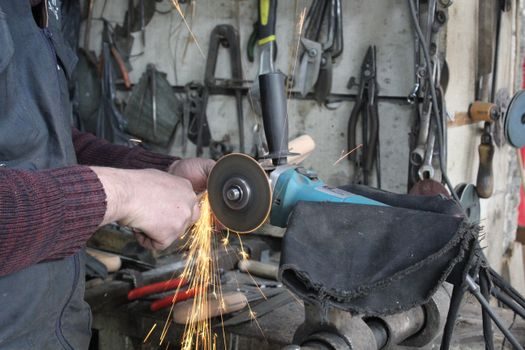
100 mm: best for tight corners, recessed lighting cutouts, switch-box openings, small-diameter cut-off, light paint prep; ~5500–8000 rpm; 18–20 V brushless; weight 1.2–1.6 kg bare [S1].
125 mm: workhorse for weld blending, tile edge, conduit cut, general flap-disc work; 5500–8500 rpm; weight 1.6–2.1 kg; the OEM workhorse tier [S1][S3].
150 mm: oversize for finish work — only useful where a 125 mm wheel cannot reach the cut depth, and harder to control in a single-handed grip [S3].
180–230 mm: masonry and stock-removal class, slide-switch two-handed, 8500–11000 rpm corded — wrong tool for interior finishing, because the wheel mass and slide-switch control make snags destructive [S3].
Sourcing and certifications to verify on the spec sheet
Confirm ISO 9001, CE, and (for North American sites) CSA / UL listings on the supplier's declaration of conformity before signing off a build sheet — Jinyi and Lingda both list ISO 9001 + CE on the corporate page, which is the entry gate but does not cover every SKU [S3].
For metal-fire risk in occupied interiors, the 100/125 mm brushless cordless grinder is also safer than a 230 V brushed unit because it has no carbon-brush sparks, no commutator dust, and lower stalled-rotor current on snag — a meaningful safety margin on finishing work near solvent vapours or spray booths [S1][S3].
For deeper field context on heavy-class 180 mm selection logic, see the related road-maintenance angle-grinder spec map; for impact-wrench pairing in the same tool crib, the Jinyi pneumatic line runs 1/2 in. / 3/4 in. / 1 in. patterns and is the natural complement [S3].
Spec-level background on the components involved: fettling grinder, and floor grinder.