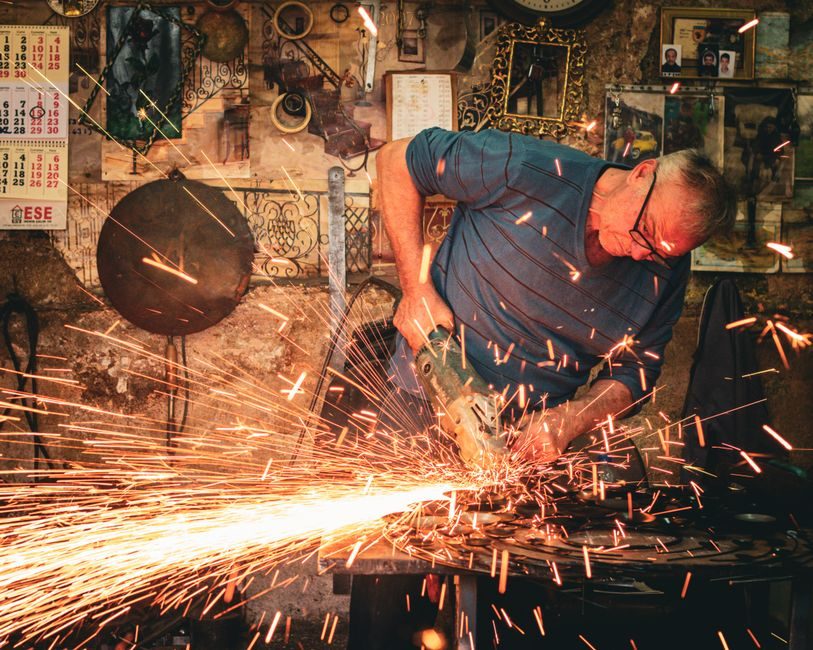
Demolition-grade angle grinders are typically specified at 180-230 mm disc diameter with 2000-2600 W input power, kickback control, and Type 27 (depressed-center) abrasive wheels rated to the tool's no-load RPM, per current vendor listings [S1][S3].
For masonry, concrete, and rebar cutting on structural strip-out, the angle grinder category splits into three working bands: 115-125 mm finishing, 150-180 mm mid-duty, and 180-230 mm demolition-class, with the larger two carrying the bulk of breaking work [S2][S3].
Wheel Diameter and Motor Power Bands
Wheel diameter sets the cut depth and governs the required motor torque; vendor catalogues in 2026-07 list 115 mm, 125 mm, 150 mm, 180 mm, and 230 mm as the standard five sizes for handheld angle grinder platforms, with no-load speeds in the 6500-11000 rpm range [S3].
For demolition work specifically, 180 mm and 230 mm platforms dominate: 180 mm units typically pair with 1900-2200 W motors and reach roughly 8500 rpm no-load, while 230 mm units step up to 2200-2600 W and drop to about 6500 rpm to keep peripheral speed within abrasive-wheel safety envelopes [S1][S3]. A 115 mm finishing grinder running at 11000 rpm cannot sustain a 25 mm rebar cut without stalling and is therefore excluded from structural demolition [S2].
Disc Selection by Substrate
Type 27 depressed-center abrasive wheels in 180-230 mm diameters are the primary consumable for steel and rebar, with typical 6-7 mm thickness for cutting and 4-6 mm for grinding [S2]. Diamond cup wheels and segmented diamond blades are required for cured concrete, brick, and stone, since abrasive silicon-carbide discs glaze and lose cut rate on mineral substrates [S2][S3].
Wheel maximum operating speed must equal or exceed the grinder's no-load RPM; common 180 mm Type 27 discs carry an 80 m/s maximum peripheral speed rating, while 230 mm discs are typically rated to the same peripheral band and therefore run at lower rotational speeds [S3]. Operators should verify the printed RPM value stamped on every wheel before mounting, and never exceed the marked maximum.
Safety Controls: Kickback, Soft-Start, and Brake
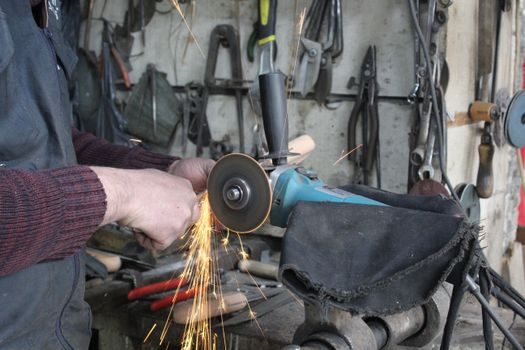
Demolition work produces the highest disc-bind and kickback rate of any angle-grinder application, because the disc encounters uneven rebar mesh, embedded aggregate, and mixed material interfaces [S2]. Three controls are now considered baseline on demolition-class tools: electronic soft-start to limit inrush current, kickback shut-off that stops the spindle within roughly 1 second of sudden bind, and a mechanical or electric brake that halts wheel rotation after trigger release [S1][S3].
Dead-man switches (paddle vs. slide vs. trigger) follow operator preference but must conform to local regulations on two-handed control; a no-volt release prevents automatic restart after power loss, which is critical when cutting off-site on temporary generators [S3]. For abrasive-wheel safety on stationary bench mounting, refer to the general bench-grinder guard and wheel criteria covered in the fettling grinder reference.
Power Source: Corded AC vs. Brushless DC vs. Pneumatic
Corded AC 220-240 V models still dominate the 180-230 mm demolition class because the 2000-2600 W input demand exceeds what handheld battery packs can deliver continuously without thermal cutoff [S1][S3]. 54 V brushless DC cordless platforms reach roughly 1500-1900 W equivalent and are limited to 125-150 mm discs in real demolition use, where sustained cuts on rebar trigger thermal protection within minutes [S3].
Pneumatic angle grinders in 180-230 mm sizes exist for ATEX-zone and shipyard work, typically rated 0.6-1.0 MPa air pressure at 1100-1700 L/min free air delivery, and are the only option where electric sparks or brush dust are prohibited [S3]. For heavy horizontal slab removal and surface preparation after the initial breakout, the floor grinder category takes over with walk-behind planetary heads; the handheld demolition grinder's job is to remove the bulk and clear rebar.
Duty Cycle, Vibration, and Operator Exposure
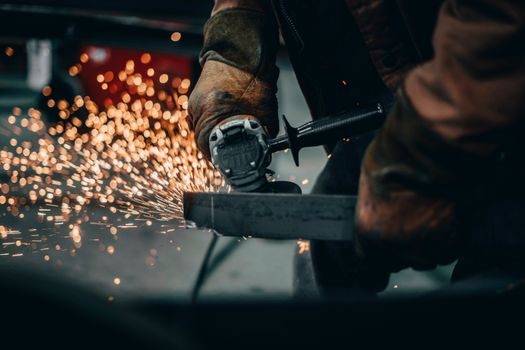
Demolition work pushes angle grinders into sustained-load operation, where armature heat and bearing wear are the dominant failure modes; spec sheets typically rate continuous-duty operation at 15-30 minutes before thermal cutout on 230 mm corded platforms, with a 50% duty cycle at maximum load being the realistic field assumption [S1][S3]. Vibration total value (ahv, triaxial) is generally published in the 5-8 m/s² range for demolition-class tools, which triggers ISO/TR 19664 guidance on exposure time and the need for anti-vibration gloves and job-rotation planning [S3].
Noise emission values of 95-105 dB(A) sound pressure and 106-115 dB(A) sound power are typical, mandating Class A earmuffs or equivalent in addition to the FFP2/FFP3 respiratory protection required for concrete dust [S1][S2]. Side handles must be fitted to the left or right as the work dictates; three-position handles are standard on demolition-class tools and reduce the wrist torque that drives hand-arm vibration exposure during vertical cuts [S3].
Consumables, Guard Fitment, and Spindle Thread
Spindle thread is a de facto standard: M14 x 2.0 for 180-230 mm European-market tools, with 5/8-11 UNC common on North American units; reducing sleeves from 5/8-11 to M14 are vendor-supplied and must be torqued to the spindle-lock pin, never gripped with pliers on the rotating disc [S3]. Guards must cover at least 180° of the disc and be adjusted to the cut direction so debris deflects away from the operator; a guard set to the wrong side is the single most common cited cause of abrasive-wheel eye injury in demolition [S2][S3].
For on-site selection flow, the duty match approach used in road-maintenance cutting maps closely to demolition: wheel diameter, motor power, then control set, in that order, as detailed in this related angle grinder selection guide for road maintenance. Abrasive shelf life is typically 2-3 years from manufacture when stored below 80% relative humidity and away from direct sunlight; expired wheels must be discarded even if visually intact, because the resin bond degrades [S3].
When breaking up large slab sections or scoring concrete before the heavy breakout, specifiers often pair the handheld demolition grinder with a demolition hammer for chipping and a floor grinder for surface prep, since the three machines cover three distinct load profiles and should not be substituted for one another on a single work face.